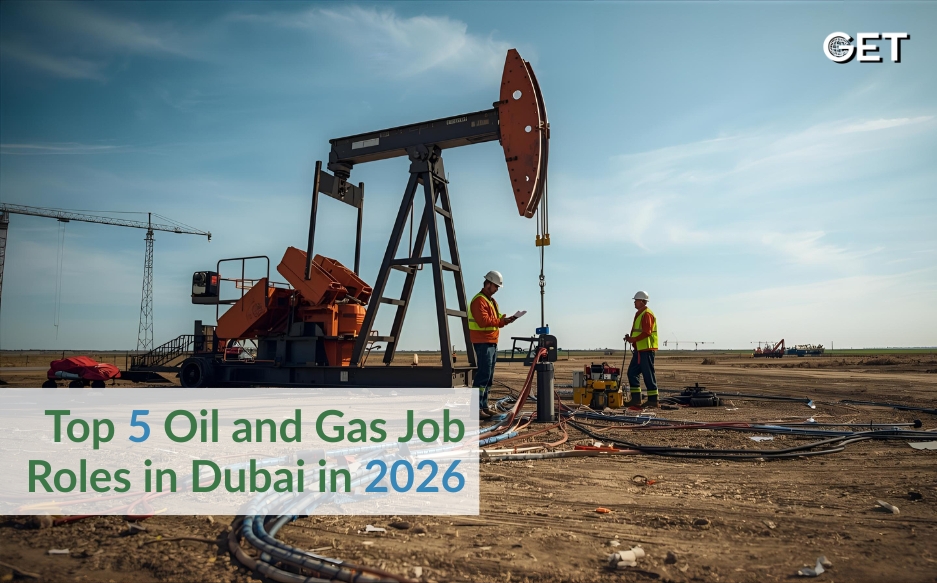
If there’s one thing that has kept Dubai booming for decades, apart from tourism and trade – it’s the upstream oil and gas sector. Even as the world slowly leans toward renewable energy, oil and gas still play a massive part in the UAE’s economy. And that means jobs.
Now, 2026 looks like an interesting year. The energy sector is changing- becoming cleaner, smarter, and more digital. But it still needs engineers, safety experts, and managers who understand how the whole system works. So, let’s look at the top 5 oil and gas job roles that’ll stay strong in Dubai next year.
This is one of the most classic roles in the upstream oil and gas business. A petroleum engineer figures out how to get the most oil or gas out of a reservoir without wasting time or money. In Dubai, the role is getting more tech-heavy now with lots of data and modeling.
Why it matters:
Oil fields aren’t endless. Companies are working on smart recovery methods, using AI and digital twins to make better decisions. So, someone who understands both geology and data is gold.
You’ll be doing things like:
Needed skills:
A Petroleum Engineering degree (obviously), but also some know-how of software like Petrel or Eclipse. And if you understand coding or data analytics even a bit – that’s a bonus.
Pay range: Around AED 18,000–30,000/month, depending on how many years you’ve got under your belt.
Also Read- Why Reservoir Engineering is Essential for Upstream Oil and Gas Success
If you’re the kind of person who likes big machines, dirt, and pressure (literally), drilling could be your thing. A drilling engineer plans and supervises how wells are drilled ensuring safety and efficiency.
Why it matters:
The UAE’s drilling projects are still going strong, especially offshore. The rigs now have automation and real-time data systems, so engineers need both field knowledge and tech awareness.
On the job, you’ll do:
Needed skills:
Degree in Petroleum or Mechanical Engineering. IWCF certification is a must for most roles. And yes, experience on-site makes a big difference.
Pay range: Somewhere between AED 25,000–40,000/month for mid to senior levels.
In oil and gas, safety isn’t optional. It’s the backbone of everything. HSE professionals make sure everyone follows safety standards, from field workers to engineers in offices.
Why it matters:
Dubai companies are putting more focus on sustainability and ESG goals. That means the safety guy is now also partly the “environment guy.” The role isn’t just about helmets and fire drills anymore, it’s about eco-friendly operations, waste control, and compliance.
What you’ll do:
Qualifications:
Certifications like NEBOSH or IOSH are common. Engineering background helps. Strong communication is key as you’ll be talking to everyone from rig workers to CEOs.
Pay range: Around AED 20,000–35,000/month, sometimes higher if you manage multiple sites.
Read Also- Top Oil & Gas Training Courses to Build Your Career in 2025
Project Managers are like the glue that holds an operation together. They make sure the entire project right from design to delivery stays on track, on budget, and on time.
Why it matters:
Dubai is home to massive EPC and downstream projects. As companies modernize plants and refineries, they need project heads who can handle both engineering and digital transformation.
What you’ll actually do:
Skills that help:
PMP or PRINCE2 certification is great. A solid technical background (mechanical, chemical, or petroleum) helps too. But soft skills like communication and negotiation matter more than most people think.
Pay range: Anywhere from AED 30,000–50,000/month, depending on project size.
Now here’s a role that didn’t even exist in most oil companies a few years ago. The oil and gas industry is going digital first, and this role is all about using automation, AI, and data to make production smarter and cheaper.
Why it matters:
Companies want to predict problems before they happen. They’re using sensors, IoT, and cloud systems to do it. And they need engineers who can bridge the gap between IT and field operations.
Day-to-day work:
What you’ll need:
Some experience in programming (Python, SQL, Power BI). Understanding how oil operations work is also key. This job is perfect for young professionals who like both coding and engineering.
Pay range: Around AED 18,000–28,000/month, with a lot of room to grow as companies go more digital.
Dubai’s oil and gas industry isn’t going anywhere. It’s just changing shape. The field still needs experts but now, they need to be a little more flexible, tech-aware, and environmentally conscious.
If you’re planning to enter this industry in 2026, keep learning new tools, stay updated on sustainability trends, and don’t be afraid to mix traditional oil skills with tech. The city’s energy market rewards people who adapt fast.
In short: oil and gas jobs in Dubai aren’t dying, they’re evolving. And if you move with the change, there’s a solid future waiting for you.
By Get global | October 12, 2026
By Get global | October 12, 2026
Saudi Arabia is traditionally considered a key country where people work in the oil and gas sector. As there is quite a lot of drilling, well intervention and production processes in this country, many engineers, technicians and specialists from the field try to find suitable positions there. However, not all […]
By Get global | October 9, 2026
Ask any person working night shifts in rigs and compressor stations what holds the industry back, and you will seldom hear anything about geology. Disconnected information, delayed decision-making, and machinery breaking down at the wrong moment – all these factors are more common causes of productivity losses in the industry. […]
By Get global | October 5, 2026
Specialized expertise turns a hard project in the oil and gas industry into a workable one. Every oilfield has its own geology, risks, and surprises. The teams that handle them the operations on field have usually met something similar before. In the modern world, upstream oil and gas companies are […]
By Get global | September 30, 2026