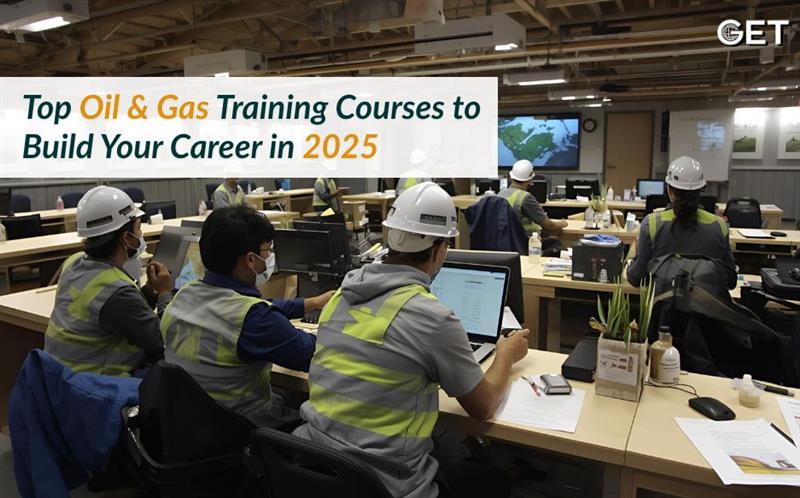
Breaking into the oil and gas industry can feel overwhelming. The work is technical. The rules are strict. The stakes are high: safety, money, environment. But if you want a real shot at a good role, you cannot just show up with a degree and hope to learn everything on site.
Training changes the game. It gets you noticed, keeps you safe, and makes you useful from day one. If your goal this year is to land a better oil and gas job or move up inside upstream oil and gas companies, here’s what matters.
People sometimes think oil and gas is about brute work. It is not. It is about control and safety. A single mistake offshore or at a wellsite can cost lives or millions. That is why most employers filter candidates by what they know before they even interview.
Think of training as a passport. Without it, career movement gets harder.
Here’s where most oil and gas training should be focus for skill-building:
| Area | Why It Matters |
| Exploration & Reservoir | Understand rock formations, analyze seismic data, model reservoirs |
| Drilling & Well Engineering | Design and drill safe wells, control fluids, manage completions |
| Production & Processing | Get oil and gas from the well to the pipeline safely and efficiently |
| Health & Safety (HSE) | Stay alive offshore, manage hazards, follow strict compliance |
| Operations & Maintenance | Keep pumps, compressors, and rotating equipment running |
| Digital & Data Skills | Use analytics, predictive maintenance, digital oilfield tech |
| Commercial / Project Skills | Negotiate contracts, plan projects, control costs |
A smart move? Pair safety courses with technical skills. For example, BOSIET plus drilling basics gets you closer to offshore jobs.
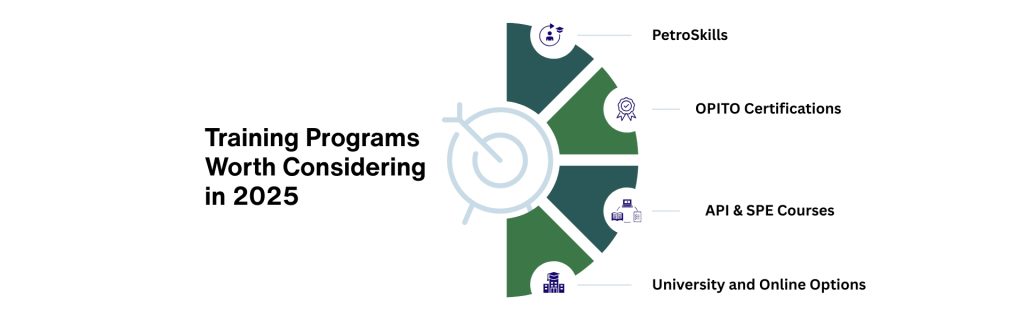
PetroSkills is a big name for upstream training. Practical, recognized, and widely accepted across operators (PetroSkills). Great picks: drilling operations, well completions, production facilities.
If you plan to work offshore, you will almost certainly need BOSIET (Basic Offshore Safety Induction & Emergency Training) and HUET (Helicopter Underwater Escape Training). They prepare you for emergencies and are recognized worldwide (OPITO).
API and the Society of Petroleum Engineers offer advanced, deep technical learning and leadership programs. Good if you want to climb into specialized or senior roles.
Do not overload. Pick one or two key areas per year and go deep.
For more info visit here- https://getglobalgroup.com/explore-openings/
With the right mix, you can step into:
Upstream companies often shortlist by certifications before even calling.
There are plenty of training shops out there. But it helps to learn from people who actually work in the field.
GET Global Group is not just a training provider. They are active in upstream oil and gas services. They help companies with operations and workforce development, so their training reflects real work conditions and global safety standards. That means if you take their programs, you are learning what rigs and plants truly expect.
If you want to feel job-ready and credible from the start, looking into what they offer is worth your time.
Oil and gas is still full of opportunity, but only for people willing to skill up. Start with safety, build strong technical depth, and stay alert to new tech. Take one course that makes you safer, one that makes you smarter, and one that keeps you future-proof. If you want training tied to how the industry really runs, GET Global Group is a solid place to check out.
Read Also- 5 Essential Skills You Need to Become a Renewable Energy Technician in 2025
By Get global | October 16, 2026
By Get global | October 12, 2026
Saudi Arabia is traditionally considered a key country where people work in the oil and gas sector. As there is quite a lot of drilling, well intervention and production processes in this country, many engineers, technicians and specialists from the field try to find suitable positions there. However, not all […]

By Get global | October 9, 2026
Ask any person working night shifts in rigs and compressor stations what holds the industry back, and you will seldom hear anything about geology. Disconnected information, delayed decision-making, and machinery breaking down at the wrong moment – all these factors are more common causes of productivity losses in the industry. […]
By Get global | October 5, 2026
Specialized expertise turns a hard project in the oil and gas industry into a workable one. Every oilfield has its own geology, risks, and surprises. The teams that handle them the operations on field have usually met something similar before. In the modern world, upstream oil and gas companies are […]
By Get global | September 30, 2026