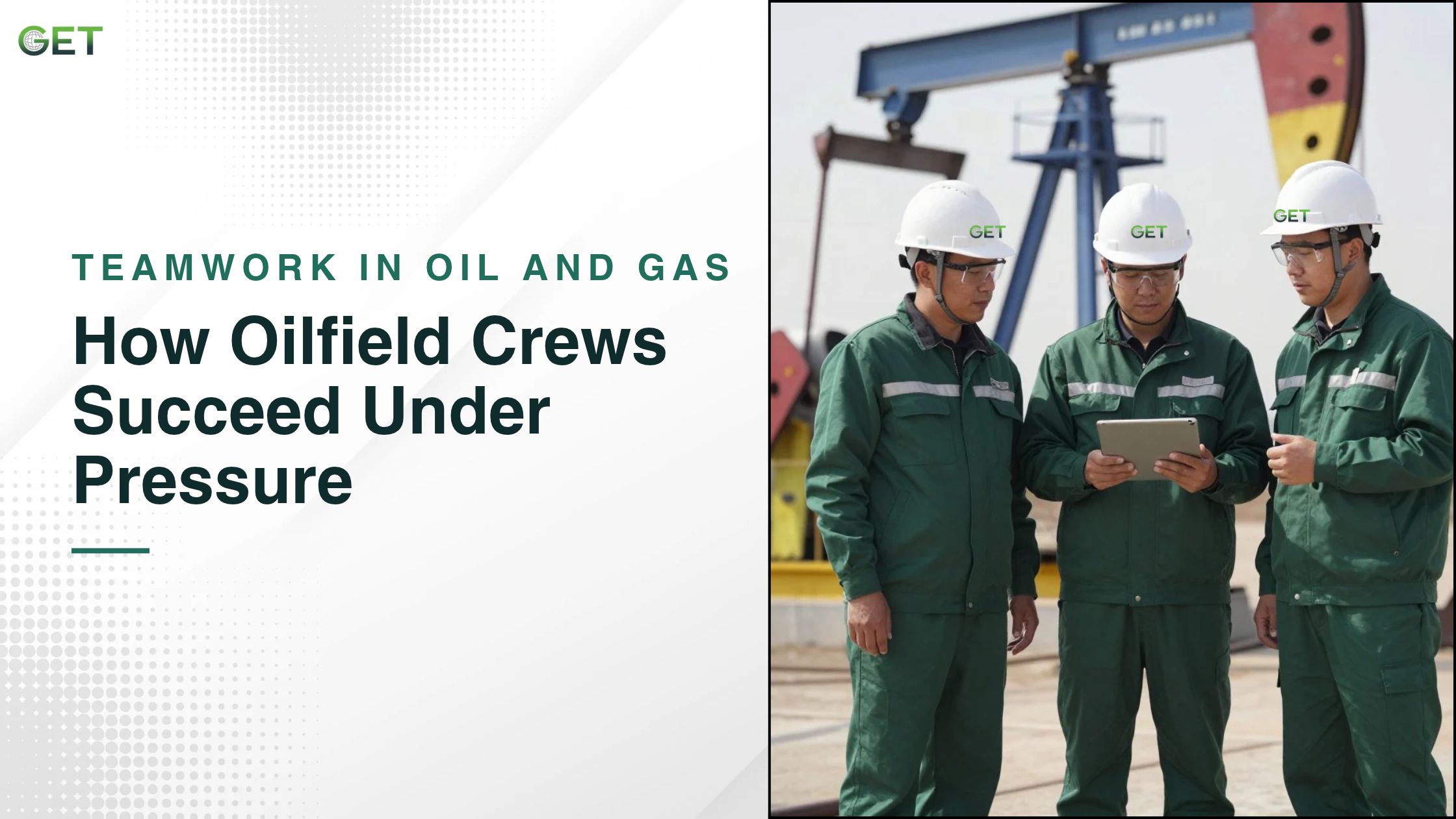
Behind every successful well is a group of people who trust each other. Rigs, pumps and pipelines are impressive, but experienced hands will tell you that the real strength of any site is its crew. When people communicate well and look out for one another, hard jobs get easier and long shifts go by faster. That is why teamwork in upstream oil and gas is a core skill.
Oilfield operations put drillers, engineers, technicians and supervisors on the same site, often from different companies and different countries. Nobody there can do the job alone. The oil and gas industry figured that out the hard way over many decades.
Most offices can survive a messy handover. Oilfield operations can’t. The work happens far from town, near heavy equipment, high pressure and flammable product, and help isn’t minutes away. If something goes wrong, the crew is the first response. Sometimes it’s the only one.
A single job like running casing or testing a well can involve a dozen roles. Drillers, derrickhands, mud engineers, electricians, a medic, a supervisor, contractors from two or three firms. Each one sees a slice. Teamwork in upstream oil and gas is what joins the slices up. People in the oil and gas industry know this, which is why hiring managers care about it nearly as much as technical skill.
It’s practical, too. Crews that talk waste less time. They catch small problems early and don’t repeat mistakes. Good oilfield crew teamwork saves money, even if nobody tracks it. And since almost every conversation on site touches oil and gas operational safety somehow, talking well pays off twice.
What Pressure Really Means in Oilfeild
People throw the word around, so let me be specific. On site, pressure comes from four directions.
Time first. A rig costs a fortune every hour, and delays hurt fast. Then conditions: heat, wind, rough seas, dust, night shifts. Then risk, because everybody knows one wrong move can injure someone. And fatigue, which creeps up after twelve-hour shifts, fourteen days in a row.
Put those together and one brilliant person isn’t enough. An engineer who hoards information can slow down a whole operation. A new hand too nervous to ask a question can put the crew at risk. When the heat is on, group habits beat individual talent. That’s true across oilfield operations, onshore, offshore or out in a desert camp. Anyone who’s put a few years into the oil and gas industry has seen it. Teamwork in upstream oil and gas gets tested hardest when conditions are at their worst.
Ask a supervisor what keeps people safe and you’ll hear about procedures, permits and equipment checks. Fair enough. Ask again, and the answer drifts to people watching out for each other. Oil and gas operational safety is built on systems, but teamwork keeps it alive.
Take a permit to work. The paper says what’s allowed. The real protection is the conversation between whoever issues it and whoever does the job. Rush that talks and the paper’s worthless. Do it properly and it works. That’s oil and gas operational safety in real life, and it runs on honest, respectful communication.
Stop-work authority is another case. Most operators let any crew member halt a job if something feels wrong. It only works if the culture backs it up. A junior roustabout won’t stop a job if the last guy who did got laughed at. Crews that thank the person who pauses the work are the ones that avoid incidents. In the oil and gas industry, that culture often matters more than the written policy.
So, are teamwork and safety two topics? Not really. Teamwork in upstream oil and gas is one of the main ways safeties actually get delivered on the ground, and strong oilfield crew teamwork gives it a human side.
Start with communication. Good crews don’t assume a message landed. They say it back. “Open valve three” gets “Opening valve three.” It feels silly in week one. By week three you don’t notice. That small habit is oilfield crew teamwork at its simplest, and it stops a lot of misunderstandings, especially on radios, in loud areas, and between people who don’t share a first language.
Then awareness. Everyone should know roughly what the whole job looks like, not only their bit. The person on the winch should know what the person on the floor is about to do. If the plan changes, say so. Don’t let people find out by surprise. Pre-job meetings exist for this. Ten minutes, and they save hours. Ask “what could go wrong today?” and the crew builds a shared map. In busy oilfield operations, that map is your best protection against surprises.
Respect matters more than people admit. An engineer with a master’s degree may be standing next to a technician who learned everything on the job over twenty years. Good crews treat both as experts, because they are. The technician spots things a model won’t. The engineer can explain why a design choice was made. When respect goes both ways, so does information. Oilfield operations are full of that mix.
Leadership sets the tone. A supervisor who stays steady during a stuck pipe or a gas alarm lets everyone else think. One who shouts makes people guess. The best supervisors in the oil and gas industry tend to talk less in a crisis and listen more. Short questions. Clear roles. Next step, not the whole problem.
And then debriefs. After a job, look back. What went well? What nearly went wrong? Tone matters here. If the debrief hunts for someone to blame, people learn to hide things. If it hunts for lessons, they share. Over a few months, that one habit shapes oilfield crew teamwork more than most courses. It feeds oil and gas operational safety as well, because a near miss shared today prevents an incident tomorrow.
Few industries are as international. One crew can have people from five or six countries, each with different languages and different ideas about respect. In the oil and gas industry that mix is a strength, but only if people work at it. Multicultural crews show teamwork in upstream oil and gas at its hardest and its best.
Small things help. Short, plain sentences. No slang. Agreed words for equipment and actions. Checking someone understood without embarrassing them. Language support is a quiet kind of oilfield crew teamwork, and so is learning a few words of each other’s languages. Sharing a meal when the schedule allows. Camp life is part of oilfield operations, and friendships made over tea often carry into the next shift.
Culture touches safety too. In some places, questioning a senior colleague feels rude. A good supervisor says plainly that speaking up is expected, then rewards it. That can change oil and gas operational safety in a real way, because the person most likely to spot a hazard is often the newest one on site.
Teamwork doesn’t stop at the site fence anymore. Live data, video links and remote monitoring centres connect field crews with specialists hundreds of kilometres away. A drilling team might lean on an onshore group watching the same data, a second pair of eyes. Teamwork in upstream oil and gas now includes people you may never meet.
That needs new skills. Field crews have to describe what they see clearly. Remote teams have to ask good questions without taking over. Trust has to run both ways. When it does, oilfield operations get safer and smoother because problems show up earlier. Earlier warnings are good for oil and gas operational safety too. When trust doesn’t run both ways, people tune out. Tools are only as good as the relationships behind them, and that’s true for oilfield crew teamwork everywhere.
Nobody builds trust in a crisis. It’s built in the thousand dull moments before one. Helping carry something. Owning a mistake. Covering for a tired colleague and then asking if they’re okay. Those moments add up, and the crew draws on them when things get hard. It’s the quiet base of teamwork in upstream oil and gas.
If you’re new, you can speed it up. Ask questions in week one. Say what you don’t know. Offer help even when it’s not your job. Thank people by name. A reputation for being reliable travels fast in the oil and gas industry and keeps opening doors long after the rotation ends.
Leaders can help by keeping crews together where possible. A team that’s worked together for a year talks faster than one thrown together for a single job. Rotations and contractors make that hard, so when someone new arrives, give them a proper welcome. Names, roles, how we do things here. Those ten minutes do more for oilfield crew teamwork than most leaders expect.
Technical training gets all the attention. Team training gets less, and often does more. Courses on communication, leadership, decisions and fatigue, usually called non-technical skills, are common now. The oil and gas industry borrowed a lot of this from aviation, where similar training changed safety records. Tie it to oil and gas operational safety and the lessons stick.
Simulators help a lot. A crew can rehearse a well control scenario together without real risk and make mistakes that teach instead of hurt. They also give quieter people a chance to practise speaking up. Good programmes turn teamwork in upstream oil and gas into something people practise, not something they read about. Drills, mentoring and clear career paths all strengthen oilfield crew teamwork over time.
Companies that invest in this tend to keep their people. If you’re planning a long career in oilfield operations, pick an employer that takes team culture seriously.
No crew is perfect. A few problems keep coming back and left alone they weaken teamwork in upstream oil and gas quickly.
Fatigue is the big one in oilfield operations. Tired people communicate badly and cut corners, so good crews treat rest as part of the job. Hierarchy is next. When people fear their supervisor, they stop reporting things, and that quietly damages oilfield crew teamwork. The fix is leaders who ask questions and respond kindly to bad news. Contractor gaps matter too, since different employers on one site can mean different procedures. Joint briefings help. And then there’s complacency. After months with no incident, attention drifts. Reminding people why the routines exist keeps oil and gas operational safety on their minds.
None of this is unique to one site. It comes with working in the oil and gas industry, and most of it eases with honest conversation.
Teamwork in upstream oil and gas is daily practice, not a poster on the wall. Want to be the teammate every crew asks for? A few habits go far.
Listen first. Repeat back instructions. Speak up early, politely, with facts. Own mistakes quickly. Help new starters find their feet. Keep your work area tidy, because a messy station affects everyone. Look after your sleep, food and water, and be honest about stress. Learn the basics of other roles, because knowing what the electrician or the medic does makes you better to work with. Treat oil and gas operational safety as everyone’s job, not only the safety officers.
Employers hiring for oilfield operations often say they’d take a solid team player over a brilliant loner. Newcomers to the oil and gas industry sometimes worry that only technical qualifications count. They don’t. People notice reliability, and over a career it does more for you than a polished CV. Every habit above feeds oilfield crew teamwork, and it makes long rotations far more bearable.
Leaders shape culture more than they think. Set clear roles. Keep briefings short and useful. Reward people who speak up. Share lessons from near misses openly. Keep rotations fair. Ask crews for input when planning oilfield operations. Praise good teamwork in public, not just output, because that shows everyone what’s valued. Leaders who model teamwork in upstream oil and gas, by listening and admitting their own errors, set the pattern. Over time that builds oilfield crew teamwork that holds under stress.
Treat oil and gas operational safety as a team goal and not a compliance chore, and you’ll get better reporting. There’s a business case too. Fewer incidents, less rework, better morale, lower turnover. For any company in the oil and gas industry, culture isn’t a side project. It’s part of how the work gets done.
Automation, remote operations and analytics are changing the work. Some jobs that once needed several people on the rig floor are now handled by machines. Does that make teamwork less important? Probably the opposite. When routine tasks go to machines, what’s left is judgement, coordination and communication. Teamwork in upstream oil and gas will stretch across sites, time zones and disciplines, and people who collaborate well will be in demand.
Younger people are entering the oil and gas industry with different expectations: more openness, more feedback, more flexibility. Smart employers welcome that and blend it with veteran experience. Mixed-age crews with good mentoring are a real strength in oilfield operations.
The energy transition adds another layer. Crews will work on gas, carbon capture and lower-emission projects alongside traditional production. Whatever the mix, the need for trust and clarity stays. Oil and gas operational safety will remain the shared priority, and the oil and gas industry will keep depending on people who work well together.
It’s easy to be impressed by the size of a rig. The real story, across the oil and gas industry, is the people around it. Oilfield crew teamwork turns equipment into results and risk into routine. It comes from clear communication, respect, calm leadership and honest debriefs, and from a culture where anyone can speak up, which is what protects oil and gas operational safety.
Whether you’re new to oilfield operations or you’ve done it for decades, there’s room to grow as a teammate. Start small. Repeat back an instruction. Thank a colleague. Ask a question at the next briefing. Do it often enough and you’ll see what experienced crews already know. Teamwork in upstream oil and gas isn’t just a nice idea. It’s how people get home safely and how good work gets done.
Read Also- Beyond the Rig: The People and Skills Driving Oil and Gas Operations
FAQs
It’s how crews coordinate, communicate and trust each other while doing exploration and production work. Good teamwork in upstream oil and gas means clear roles, shared awareness and the confidence to speak up.
2. How does oilfield crew teamwork improve safety?
When crews communicate openly, hazards get spotted earlier and stop-work calls happen without hesitation. That makes oil and gas operational safety stronger on every shift.
3. What skills matter most in oilfield operations?
Clear communication, situational awareness, respect for every role, calm decisions and fatigue awareness, alongside technical ability. Many employers in the oil and gas industry rate these as highly as qualifications.
4. How can a new worker build oilfield crew teamwork quickly?
Ask questions early, repeat back instructions, offer help and thank colleagues. Small habits build trust faster than most people expect.
5. Will automation reduce the need for teamwork in the oil and gas industry?
Unlikely. As routine tasks are automated, judgement and coordination matter more, so teamwork in upstream oil and gas will stay central to oilfield operations.
By Get global | November 4, 2026
By Get global | October 29, 2026

By Get global | October 27, 2026

By Get global | October 26, 2026
Oil and Gas industry have always been in an environment that is capital intensive and where operational efficiency, safety, and cost management take precedence. But there have been instances where supply chain management within energy sector had issues like poor communication, disjointed tracking, lengthy vendor onboarding process, and reactive procurement […]
By Get global | October 19, 2026