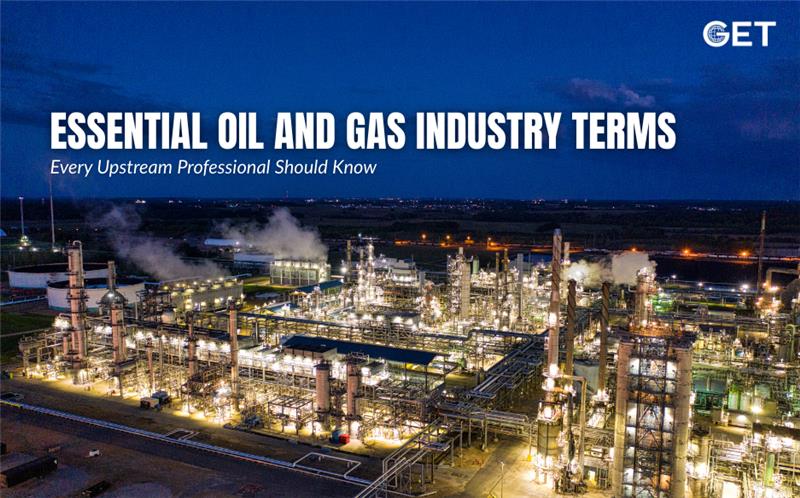
The upstream oil and gas industry is thrilling, quick-moving, and rich with opportunities—but let’s face it, it also has a lot of technical language. If you are a newcomer to the industry, changing jobs, or just wanting to enhance your knowledge about the industry, mastering the right terms can facilitate your work and boost your confidence. Even experienced people occasionally require a reminder since the industry is always changing due to the introduction of new technologies, methods, and systems.
Thus, we present a list of the most important upstream oil and gas terms that every professional must know. No explanations that confuse. No language like that of a heavy textbook. Only clear, simple, and practical meanings—what you want.
Let’s go section by section, the way things usually happen in real operations.
A seismic survey is practically the initial real step before drilling. Vibrations are sent into the ground in a controlled manner by teams and how those waves are reflected is recorded. Geologists get a rough picture of the subsurface from those reflections. It is not exact but still it is the best starting point we got.
A reservoir is thought of as the subterranean rock layer that has been the home of oil and gas for millions of years. Properties such as porosity and permeability are crucial since they aid in forecasting the well output, whether it is small or large.
This is a “let’s see what happens” type of well drilled in an unexplored area. High risk, but sometimes these wells are the ones that surprise everyone.
A rig is the entire structure built to drill the well—equipment, machinery, pipes, everything. You’ll find rigs onshore, offshore, floating, and sometimes in very tough environments.
The wellbore is the perforated hole. That may sound very basic, but in reality, it is very much correct to say that keeping that hole stable is indeed the single most crucial issue in accomplishing the drilling process.
Casing is the steel pipe that surfaces throughout the entire drilled hole or wellbore. By doing this, it supports the hole and hinders the mixing of rock layers. On the other hand, if the casing fails, the well would be in jeopardy; thus, it is a very serious step.
A BOP is a massive safety device mounted on top of the well.
Its entire purpose is to control pressure and prevent blowouts. It’s one of the most important safety tools in the whole operation.
LSI: well control, pressure control.
Mud logging means checking the drilling mud and rock cuttings that come back up.
It gives useful clues about what the drill bit is cutting through in real time.
To “spud” a well means we officially start drilling.
It’s a big moment for every project team.
ROP basically tells you how fast the drill bit is moving downward. Higher ROP saves time, but it also needs to be balanced with safety and stability.
A kick happens when formation fluids sneak into the wellbore. If not controlled quickly, it can turn into a blowout—so crews keep a close eye on pressure changes.
The drillstring is the long series of pipes and tools that rotate the bit at the bottom.
It carries drilling mud, weight, and movement all the way down.
After drilling, the well doesn’t automatically start producing. Completion is the process where the well is “finished” so hydrocarbons can flow safely.
This involves tubing, perforations, and other steps.
Perforation uses small explosive charges to make holes in the casing so oil and gas can enter the wellbore.
It’s a delicate job but extremely important.
Sometimes the reservoir’s own pressure isn’t enough to push fluids to the surface.
That’s where artificial lift—like ESPs and gas lift—comes in. They help the product reach the top.
Flowback occurs immediately after drilling or stimulation.
The well is opened up to flow in order to get rid of the remaining fluids, sand, and debris.
It provides a picture of the well’s performance in production.
These tools help measure which zones are contributing how much to the total output.
It’s important for long-term planning and reservoir management.
HSE is about keeping people, equipment, and the environment safe.
Every oil and gas site has strict HSE rules that everyone follows.
Read Also- Essential HSE Guidelines for Upstream Oilfield Workers
A PTW is a formal approval for specific tasks—like hot work or working at heights.
It ensures that risks are checked and controlled before work begins.
PPE includes helmets, gloves, goggles, fire-resistant coveralls—everything needed to protect workers on site.
Hydrocarbons are the oil and gas we’re working to extract. Simple as that.
Upstream covers everything from exploration to drilling to production.
It’s the “start” of the oil and gas lifecycle.
Downhole means anything happening inside the well.
Tools, pressure, flow—it all falls under this term.
A shut-in is when the well is intentionally closed for safety or maintenance.
A workover is a major intervention done on an existing well to repair, improve, or restore production.
In the upstream operations sector, minor misinterpretations may escalate into various negative outcomes such as delays, safety concerns or wrong communication among different parties. If all the people present at the location or in the meetings use the same language, then the work will definitely be much more efficient and safety will not be compromised.
The newcomers’ confidence is quickly raised when they learn the terms. On the other hand, the veterans will be able to maintain their good communication skills and clarity if they are also using the same terms.
Communication and technical understanding are the pillars on which the upstream oil and gas industry stands. Familiarity with expressions like seismic survey, BOP, ROP, artificial lift, and reservoir will not only make you understand the operations better but also engage your co-workers with more confidence.
These terms are the basic knowledge of the upstream sector and will be your stepping stones in the industry whether you are already there or just about to make a move.
By Get global | October 16, 2026

By Get global | October 12, 2026

By Get global | October 9, 2026
Ask any person working night shifts in rigs and compressor stations what holds the industry back, and you will seldom hear anything about geology. Disconnected information, delayed decision-making, and machinery breaking down at the wrong moment – all these factors are more common causes of productivity losses in the industry. […]
By Get global | October 5, 2026
Specialized expertise turns a hard project in the oil and gas industry into a workable one. Every oilfield has its own geology, risks, and surprises. The teams that handle them the operations on field have usually met something similar before. In the modern world, upstream oil and gas companies are […]
By Get global | September 30, 2026