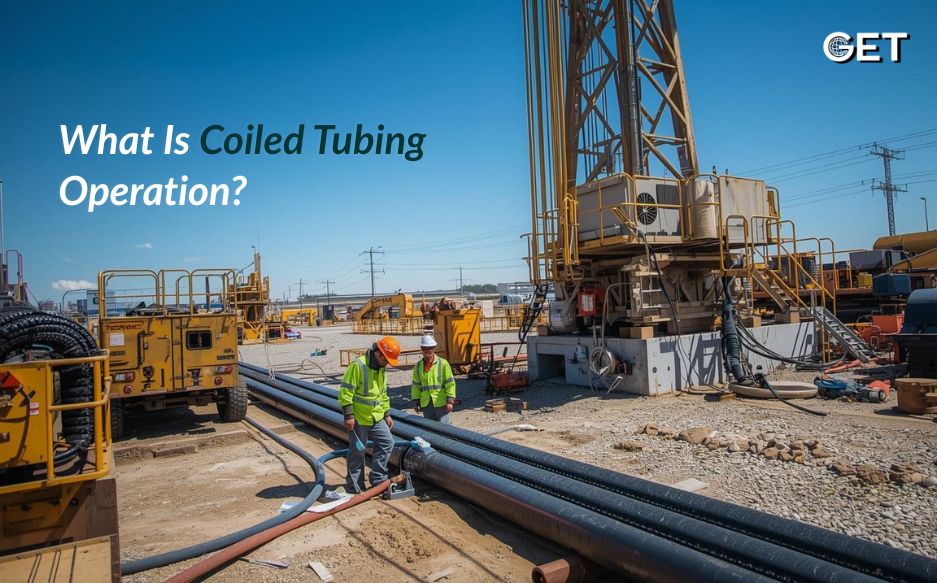
In the oilfield, every minute counts. Wells don’t wait — pressure builds, sand plugs up, production slows. Yet, shutting down a well just to fix a problem can cost thousands of dollars per hour. That’s where coiled tubing operations come in — a solution built on the simple idea that you can work on a live well without killing it.
Imagine a long and flexible steel pipe that is tightly wound on a gigantic reel – as an industrial size garden hose. This pipe is known as coiled tubing (CT), and is robust enough to drive through miles of wellbore and is also flexible enough to coil and uncoil without breaking. In its deployment, it glides perfectly in the well with fluids, chemicals or tools passing through its hollow core to do the job.
In the right hands, coiled tubing is one of the most efficient, cost-saving, and versatile tools in modern oil and gas operations.
A coiled tubing setup might look complicated at first glance, but it’s built on a simple system of precision and power.
From the outside, the operation looks like choreography — reels spinning, hoses hissing, pumps rumbling — all synchronized to keep the well under control and production steady.
Read Also- Top 5 Oil and Gas Job Roles in Dubai in 2026
Before coiled tubing became common, any maintenance or stimulation job required a workover rig. Crews had to pull the entire tubing string out, section by section, which could take days. Coiled tubing changed that forever.
Now, operators can perform cleanouts, acid jobs, plug milling, or even small drilling operations without dismantling the completion or halting production. That means less downtime, smaller teams, and lower costs — three words every production manager loves to hear.
As Schlumberger notes, coiled tubing is now used in nearly every phase of a well’s life, from drilling to decommissioning, precisely because it can do so much with so little disruption (source).
Here’s how a typical operation unfolds:
It’s fast, controlled, and efficient — the very reason CT has become a cornerstone of well intervention.
The list is long, but here are the most common uses:
Each job is different, but the principle stays the same — deliver tools and fluids exactly where they’re needed without stopping production.
Working on a live well means there’s no room for error. Coiled tubing crews rely on pressure control equipment to keep everything sealed and stable.
The CT blowout preventer stack and stripper packer ensure that even while the pipe moves, well pressure stays contained. Crews test these barriers before every job and monitor them constantly during the operation.
Another key concern is fatigue. Each time the tubing bends over the reel and gooseneck, it flexes — like bending a paperclip again and again. Too much bending, and it could weaken. That’s why every inch of tubing has its life cycle tracked digitally. Once it reaches its fatigue limit, it’s retired.
Safety guidelines like API RP 16ST set global standards for coiled tubing operations — covering everything from design and testing to emergency response. They exist to make sure CT jobs are not just fast, but safe.
Coiled tubing has earned its place because it simply makes sense. It delivers:
For operators, that combination of speed, safety, and precision translates to real production gains — and less waiting around for results.
Read Also- Top 5 Oil and Gas Trends Driving Innovation
At GET Global Group, coiled tubing isn’t just about running pipe — it’s about solving problems. We start by understanding your well’s story: why production dipped, what obstacles are downhole, and what outcomes you’re after.
From there, we design an operation that fits like a glove. Whether it’s a scale cleanout, a stimulation job, or a plug milling campaign, our engineers map every detail — pressure profiles, fluid programs, tool selection, and fatigue tracking.
Our CT units are tailored to your environment — compact land spreads for tight pads or modular offshore setups where space is at a premium. Each job runs under strict safety standards, and every post-job report includes data-driven insights so you know exactly what value was delivered.
The result?
Less downtime. Safer operations. Higher production. Tangible results you can measure.
Coiled tubing may appear to be any other oilfield equipment, but it is more than that. It is what allows the operators to wake the wells without the expensive and time-consuming workover. It’s what lets operators bring wells back to life without the heavy cost or delay of a full workover. It’s the bridge between efficiency and control — technology that keeps the energy flowing.
At GET Global Group, we’ve built our expertise around that principle: to help operators maintain well performance through smarter, faster, and safer intervention.
Have a well that needs attention?
Let’s talk about how coiled tubing can make the difference.
Contact GET Global Group and we’ll build a plan that works for your field, your budget, and your production goals.
By Get global | October 5, 2026
Specialized expertise turns a hard project in the oil and gas industry into a workable one. Every oilfield has its own geology, risks, and surprises. The teams that handle them the operations on field have usually met something similar before. In the modern world, upstream oil and gas companies are […]
By Get global | September 28, 2026
By Get global | September 28, 2026
Technology has touched every corner of modern oil and gas operations—from upstream exploration and drilling to midstream pipelines, downstream facilities, maintenance, and performance monitoring. One area where digital transformation delivers exceptional value is HSE (Health, Safety and Environment), a core priority for GET Global Group and the wider energy industry. […]
By Get global | September 22, 2026
By Get global | September 21, 2026
Regulators are tightening the screws on emissions. Investors are asking harder questions about ESG performance. And communities near production sites have gotten a lot less patient with flaring, leaks, and spills that used to get a shrug. For upstream operators, environmental performance isn’t a side conversation anymore. It’s sitting right […]