Picture this: a tax-free salary, a global team, and a career at the heart of one of the world’s biggest energy hubs. That is why thousands of engineers, technicians, and rig crew look at Dubai every year. But breaking in isn’t just about sending out CVs. You need the right certifications, a clear picture of the job market, and a plan for the visa process.
This guide walks you through all of it, step by step, in plain and simple language.
The UAE has some of the biggest oil and gas reserves in the world. Even though Abu Dhabi is home to the major producers of the oil and gas, it is Dubai that plays host to all the activities such as head offices of the region, oilfield services, EPC contractors, marine services, trading, and logistics.
Many professionals actually reside in Dubai while being transferred to other locations on rotational basis either onshore or offshore. Sometimes professionals are even transferred to projects in Middle East and Africa. An example is GET Global Group, a Dubai based company in oil and gas sector providing integrated crew services, procurement & supply chain management, and training & consultancy services.
The industry is much bigger than rigs and drilling. It breaks down into three parts.
Upstream is about finding and producing oil and gas. Jobs include petroleum engineers, drilling engineers, geologists, mud engineers, cementing specialists, coiled tubing and wireline engineers, and rig crew such as roughnecks and toolpushers.
Midstream covers moving and storing it. Think pipeline engineers, terminal operators, marine coordinators, and oil traders.
Downstream turns crude into products. This is where you’ll find refinery operators, process engineers, petrochemical technicians, and lab analysts.
Then there are the roles that keep everything running: HSE officers, NDT inspectors, QA/QC engineers, welders, electricians, instrumentation technicians, procurement and supply chain staff, project managers, and finance, HR, and IT teams. If you don’t work on a rig, there is still a place for you.
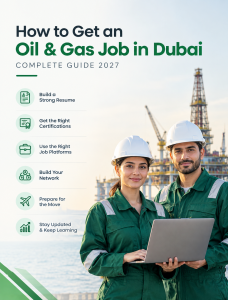
Employers in this industry are strict about safety, so certifications often decide who gets shortlisted. Here are the big ones.
For safety and survival
For drilling and rig work
For inspection and quality
For engineers and managers
Check expiry dates before you apply. Most safety certificates need renewing every few years, and an expired one can cost you an interview.
Read Also- Common Mistakes to Avoid When Applying for Oil and Gas Jobs in Dubai
Getting hired usually involves clearing several hurdles.
First come the certification exams themselves. IWCF, NEBOSH, API, and NDT all have their own tests, so book a preparation course with an approved training centre.
Next, many employers use technical assessments, either written or online, covering basics like fluid mechanics, drilling calculations, or electrical theory. Welders, fitters, and technicians may also take a practical trade test on site.
Some companies add aptitude or psychometric tests to check numerical reasoning and safety mindset. Then come the interviews, which often include questions about how you handle unsafe situations and work in multicultural teams. Finally, expect a medical fitness check, and for offshore roles an offshore medical certificate as well.
Most people enter the UAE on an employer-sponsored visa, and a good employer handles most of the paperwork. Here is how it typically works:
Prior to all of this, you may need to attest your degree and other documents via your home country’s government and UAE embassy, which could take weeks of time, so don’t delay. You will also be able to sponsor your spouse and children after fulfilling some salary and accommodation criteria.
However, do keep in mind that rules and fees can differ from time to time, so it is always advisable to visit UAE government websites for updated information. In fact, many companies hire special employees who deal with these formalities exclusively. An example is GET Global Group, which had a recent job advertisement for a PRO, which requires knowledge of UAE visa process, labour regulations, etc.
Begin with the career section of ADNOC group companies and ENOC, as well as international service and EPC companies. Follow this up with alerts on LinkedIn, Bayt, GulfTalent, Naukrigulf, and Indeed UAE.
Do not overlook specialist recruiters, who conduct many of the hires in the oil and gas industry. Also work hard on your networking skills, and try to attend SPE chapters, industry trade fairs, and message industry professionals on LinkedIn.
One important caution: reputable employers never ask you to pay anything in order to apply to the job, have an interview, or obtain a visa. If you see such requests, move on.
Recruiters skim through hundreds of applications, so make yours easy to scan.
Keep your LinkedIn profile in line with your CV, because many Gulf recruiters search there first.
Things move at a very rapid pace in the oilfield industry. Being skilled in digital technology such as data analysis, automation, and preventive maintenance becomes highly beneficial; knowledge about emission reduction, hydrogen fuel cell technology, and carbon capture also becomes more useful. Additionally, the employer values soft skills – communication and safety leadership, cross-cultural communication.
An oil and gas career in Dubai can easily be achieved as long as you know how to prepare. Select the position that suits your background, get the necessary certificates, get ready for the exams, and learn about visas even before receiving the offer letter. You should apply directly to companies, make connections, and consider companies like GET Global Group among others. What matters most is keeping yourself abreast with knowledge. This is because professionals who always upgrade themselves and their certificates are the ones who rise fast in the industry.
Read Also- Creating a Workforce That Prioritizes Safety Everyday
FAQ:
Disclaimer: Visa rules, fees, and hiring requirements change over time. Always verify current details with official UAE sources and your employer.
By Get global | October 19, 2026
By Get global | October 16, 2026
By Get global | October 12, 2026
By Get global | October 12, 2026
Saudi Arabia is traditionally considered a key country where people work in the oil and gas sector. As there is quite a lot of drilling, well intervention and production processes in this country, many engineers, technicians and specialists from the field try to find suitable positions there. However, not all […]

By Get global | October 9, 2026
Ask any person working night shifts in rigs and compressor stations what holds the industry back, and you will seldom hear anything about geology. Disconnected information, delayed decision-making, and machinery breaking down at the wrong moment – all these factors are more common causes of productivity losses in the industry. […]