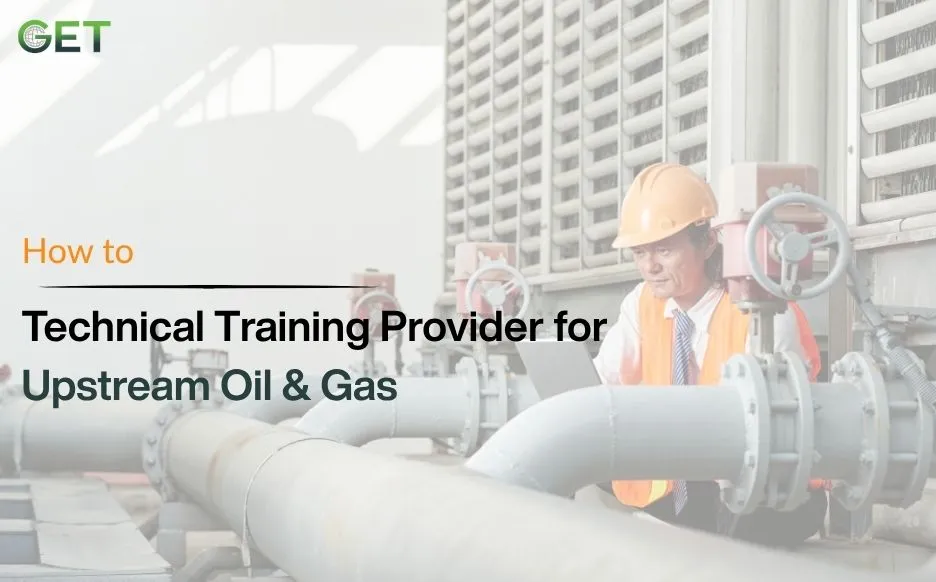
Ask any operations manager what keeps them up at night, and “who’s training my crew” will come up more often than you’d expect. It’s not glamorous. Nobody puts a training decision on a company scorecard next to barrel targets or NPT reduction. But get it wrong, and you’ll see the consequences show up in both of those numbers within a quarter.
Upstream oil and gas aren’t a forgiving environment for undertrained personnel. A rig hand who doesn’t fully understand pressure control procedures, or a technician who’s shaky on downhole tool handling, isn’t just a productivity risk. They’re a safety risk, a compliance risk, and eventually, a cost that lands on someone’s desk in the form of an incident report. So how do you actually vet a training provider before you sign a contract, not after something goes wrong?
A lot of training providers can hand you a stack of certifications and accreditation logos. That matters, sure. But credentials tell you the provider met a baseline standard. They don’t tell you whether the instructor has actually stood on a wellsite during a kick, or whether the curriculum reflects how frac tanks are managed in the field today versus how they were managed a decade ago.
Plenty of training sessions are technically accurate and practically useless, because the material was written by someone who never had to explain a procedure to a crew mid-shift with a supervisor breathing down their neck. That’s the gap operators are trying to close. Ask providers directly: how recently has your instructor worked in upstream operations, and in what capacity?
It usually is best to have a few questions ready to go through the marketing rubbish before signing on a provider.
This is something that is often overlooked. Training is not just a standalone initiative, it’s part of a larger chain of procurement, scheduling, and vendor coordination – and it can work well or it can cause conflict. If they have a bad history of punting on late arrival, communicating changes in schedules, or coordination with an existing operations calendar, it will come back and bite you on the ass in lost productivity more times than you will find a penny for your invoice.
It’s here that many operators see the benefit of partnering with a company that already knows how to work with an upstream vendor, and not as just an add-on to everything else. If the training service provider is part of the “big picture” of your operation, the overhead for coordination is greatly reduced.
Anyone can talk a good game about safety culture in a proposal meeting. What you actually want to know is how a provider has handled things when training didn’t prevent an incident, because eventually, somewhere, it won’t. Do they conduct root cause reviews and adjust curriculum? Or do they just issue a new certificate and move on?
Ask for references, and when you call them, don’t just ask “were you happy.” Ask what happened when something went sideways. That answer tells you more about a provider’s actual value than any brochure will.
It’s tempting to compare providers purely on day rate or per-seat pricing. Resist that instinct. The real cost comparison is training investment against reduction in non-productive time. A slightly more expensive provider whose graduates require fewer supervisory interventions and cause fewer equipment mishandling incidents will save you money well past the invoice.
If you’re not currently tracking NPT attributable to personnel error versus equipment failure, that’s worth setting up before your next training review, because it’s the clearest signal you’ll get on whether your current provider is actually moving the needle.
No one’s got a perfect scorecard when it comes to this decision. Many of the factors involved are judgment, references, and, quite honestly, a gut instinct that comes from attending a sample session. However, it’s the operators who see the greatest results from their training dollar who take it as a business decision, not an HR one. It’s a matter of asking tougher questions at the outset, looking at real-world experience, not just polished pitch decks, and finding a partner who knows that training isn’t a specialty that’s in isolation; it’s a speciality that’s integrated.
Integrated approach to building technical training and competency programs based on actual field conditions, with the same integrated approach to maintenance, procurement, and vendor management as applied to operators, through GET Global Group. If you’re looking at evaluating your existing training service, this is generally the first conversation you should have.
Read Also- How Technical Training Courses Are Shaping Oil & Gas Careers in 2026
By Get global | October 5, 2026
Specialized expertise turns a hard project in the oil and gas industry into a workable one. Every oilfield has its own geology, risks, and surprises. The teams that handle them the operations on field have usually met something similar before. In the modern world, upstream oil and gas companies are […]

By Get global | September 30, 2026

By Get global | September 28, 2026
By Get global | September 28, 2026

By Get global | September 28, 2026
Technology has touched every corner of modern oil and gas operations—from upstream exploration and drilling to midstream pipelines, downstream facilities, maintenance, and performance monitoring. One area where digital transformation delivers exceptional value is HSE (Health, Safety and Environment), a core priority for GET Global Group and the wider energy industry. […]