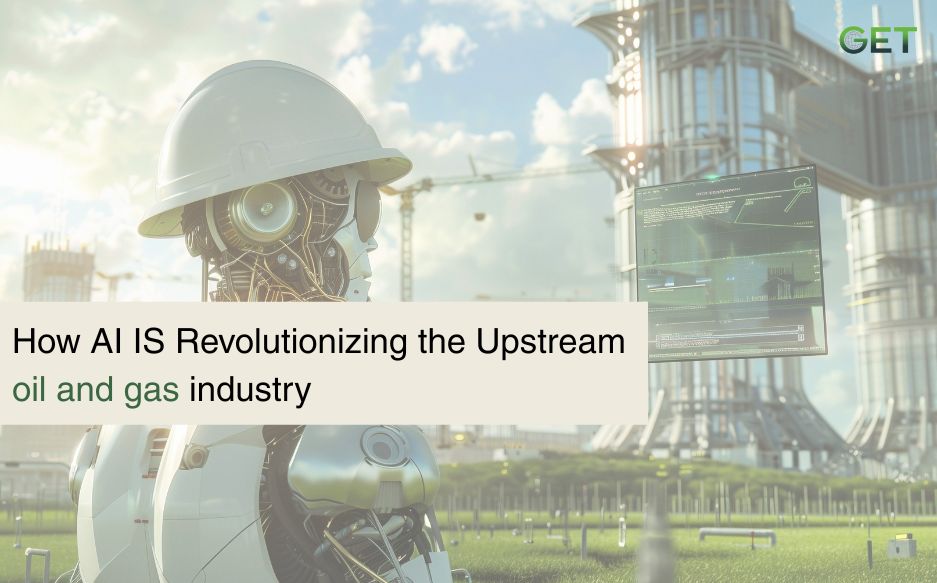
AI has stopped being a buzzword in upstream oil and gas and started being a genuine operational shift. Exploration, drilling, production monitoring – artificial intelligence is touching all of it, and the results show up as faster decisions, lower costs, and fewer people getting hurt on site. Companies still running on purely traditional methods are starting to feel the gap.
Upstream, if you’re new to the term, covers the earliest part of the energy chain – finding oil and gas reserves and getting them out of the ground. It’s expensive, it’s risky, and it’s about as complex as industrial work gets. That’s exactly the kind of problem AI is good at chipping away at.
This piece looks at what AI actually means for upstream work, the benefits that are showing up in practice, and how companies are already putting it to use.
Strip away the jargon and it comes down to this: machine learning, computer vision, predictive algorithms, and natural language processing, all pointed at the mountains of geological and operational data upstream companies generate. The point is to swap slow, manual analysis for fast, reliable insight – so companies find oil faster, drill smarter, and squeeze more out of what they’ve already found.
A few technologies tend to show up again and again. Machine learning spots patterns in geological and production data that a human would take weeks to notice. Natural language processing chews through technical reports and field logs. Computer vision keeps an eye on equipment and flags anomalies on-site. Digital twins build virtual models of reservoirs and infrastructure so engineers can test changes without touching the real thing. And predictive analytics tries to catch equipment failures before they actually happen.
None of this works in isolation, either – it depends on real-time data from sensors, satellites, and IoT devices feeding in constantly. Companies investing in proper AI development services are essentially building the data foundation that makes all of this possible.
Finding reserves has always involved a fair amount of guesswork. Traditional seismic analysis is slow and leaves plenty of room for human error. AI processes that same seismic data in a fraction of the time and reads reservoir characteristics with noticeably more precision – which means fewer dry wells and fewer wasted exploration campaigns.
Drilling eats up a huge share of the upstream budget. AI optimizes drilling paths, cuts non-productive time, and reduces wear on equipment. Some companies report cost savings in the 10–20% range just from applying AI to drilling alone – and those savings compound year over year.
Oil and gas sites are dangerous by nature, no way around it. AI-powered sensors and cameras catch hazardous conditions in real time and alert people before something goes wrong. That matters a lot for anyone working an oil and gas job out in the field, where the margin for error has always been thin.
Once wells are drilled, keeping output steady is its own challenge. AI watches well performance continuously, flags early signs of decline, and suggests interventions before things slip – which keeps downtime to a minimum.
ESG isn’t optional anymore, and AI helps here too – cutting flaring, optimizing water use, trimming the overall footprint of operations. Smarter operations tend to mean fewer emissions almost as a side effect, and that’s something companies can actually show investors and regulators.
It starts with data – sensors on rigs, pipelines, and wellheads pulling in thousands of data points a second, with satellites and drones adding geospatial and visual layers on top. Without solid data, none of the rest of this functions.
That raw data feeds into machine learning models trained on historical operations. The models look for patterns, correlations, anomalies – mostly in real time or close to it – and what engineers get back isn’t a data dump, it’s an actual recommendation.
From there, systems either suggest a decision or, increasingly, just take one. A predictive maintenance system might schedule a pump inspection on its own. A reservoir tool might recommend adjusting injection rates. Bigger calls still go through human engineers, but the routine stuff is being automated more and more.
And the systems keep improving. Every new data point sharpens the model. More wells, more production data, better predictions – which is why AI turns into a long-term asset rather than something you deploy once and forget about.
Shell and Exxon Mobil are using AI to build sharper reservoir models – ones that predict how oil and gas move through rock formations more accurately, which means fewer surprises during production and more efficient extraction overall.
BP has rolled out AI-driven predictive maintenance across its upstream assets, catching potential equipment failures weeks ahead of time. That kind of lead time avoids expensive unplanned shutdowns and stretches the life of equipment that isn’t cheap to replace.
Halliburton and SLB (formerly Schlumberger) have built AI platforms that optimize drilling as it happens – adjusting bit speed, weight on bit, and mud flow automatically. Drilling gets faster, complications drop, and wellbore instability becomes less of a risk.
And production forecasting has gotten a real upgrade too – AI models now read production history alongside current well data to project future output, which feeds directly into infrastructure planning, maintenance scheduling, and, ultimately, investor confidence.
Not every company needs to tear up its operations tomorrow. But a few signals are worth paying attention to. If your exploration success rate has been sliding, AI-powered seismic analysis is worth a look. If equipment failures or non-productive time keep creeping up, predictive maintenance probably belongs on your radar.
Companies already running digital oilfield tech and IoT sensors have a head start – the data’s likely already there. Working with upstream oil and gas services providers who specialize in AI can speed up the transition considerably.
A few honest questions worth asking first: Do we actually have enough clean data to train models on? Do we have people in-house who can manage these systems, or do we need a partner? What specific problem are we trying to solve – not in general, but concretely? Can this integrate with what we’re already running? And what’s a realistic budget and ROI timeline?
AI isn’t a magic fix, and treating it like one is how projects stall out. The companies that get real value from it treat it as a strategic priority, not a one-off experiment.
AI is making exploration more precise, drilling more efficient, and production more predictable – and it’s doing all of that while making upstream operations noticeably safer. The real question for most companies isn’t whether to adopt it anymore, it’s how fast they can get there without cutting corners on data quality and training.
None of this happens without the right people running it, though. We at GET Global Group, connect skilled professionals – across Coil Tubing, Wireline, Well Testing, Well Intervention, Rig Operations, Frac, and Pumping – with hitch-based assignments across the Middle East, South Asia, and Southeast Asia, so the field teams keeping these AI-driven operations running are never far from the next opportunity.
Read Also- Major Upstream Oil & Gas Projects in the Middle East to Watch in 2026
FAQs
It’s already in use. Shell, ExxonMobil, BP, Halliburton, and SLB all have AI deployed across exploration, drilling, and maintenance – this isn’t a future-state technology anymore.
Companies have reported savings in the 10–20% range from applying AI to drilling operations alone, mostly through optimized drilling paths and reduced non-productive time.
Consistent, good-quality sensor and operational data – from rigs, pipelines, wellheads, and ideally IoT devices already in place. Companies running digital oilfield technology are usually further along than they realize.
No. It automates routine tasks and flags issues early, but major decisions still go through human engineers. AI is more of a force multiplier than a replacement.
It varies by use case, but predictive maintenance and drilling optimization tend to show returns faster than broader digital transformation efforts, since the cost savings are measurable almost immediately.
By Get global | October 19, 2026
By Get global | October 16, 2026
By Get global | October 12, 2026
By Get global | October 12, 2026
Saudi Arabia is traditionally considered a key country where people work in the oil and gas sector. As there is quite a lot of drilling, well intervention and production processes in this country, many engineers, technicians and specialists from the field try to find suitable positions there. However, not all […]
By Get global | October 9, 2026
Ask any person working night shifts in rigs and compressor stations what holds the industry back, and you will seldom hear anything about geology. Disconnected information, delayed decision-making, and machinery breaking down at the wrong moment – all these factors are more common causes of productivity losses in the industry. […]