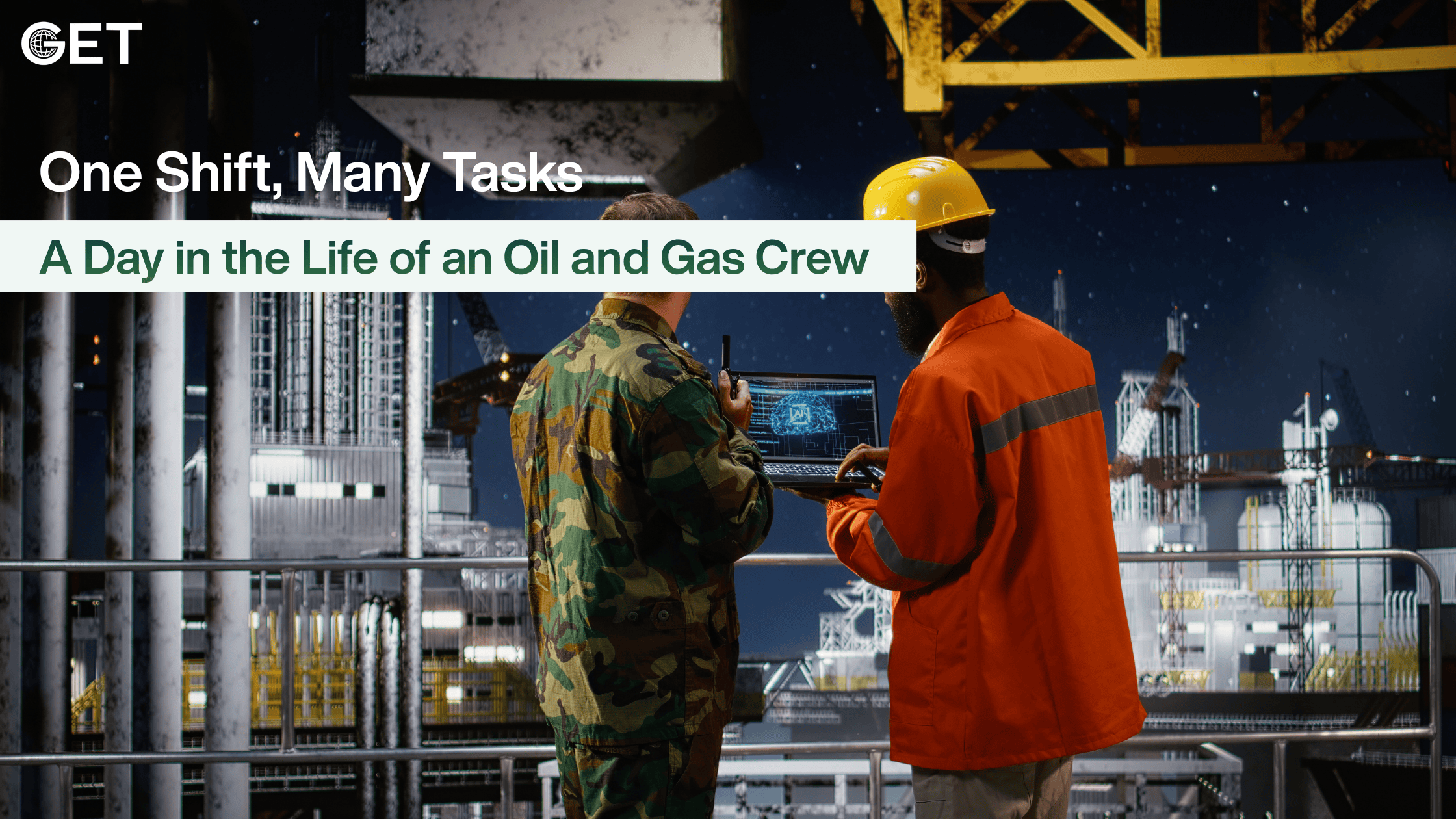
Ask anyone outside the oil and gas industry what a rig crew does all day and the answer is usually some version of “drilling.” Fair enough. But drilling is the headline, not the story. One crew can go through a safety meeting, pipe trip, pump repair, crane lift and a stack of paperwork that never even makes it onto the recruitment poster in one 12-hour tour on an upstream oil and gas site.
The walkthrough below follows a composite day shift on a land drilling rig. It isn’t one specific crew or one specific client. It’s pieced together from how these days tend to go, and it shows why an oil and gas crew is really several jobs sharing one set of coveralls.
The day starts in camp, not on the rig. Breakfast is quick. Most hands work 12-hour tours over a 14- or 28-day hitch, so by day nine the routine runs on its own. Coffee, boots, a ride out to location.
Then comes the handover. The night driller walks the incoming driller through the last twelve hours: current depth, mud properties, anything that acted up, any permits still open. This conversation matters more than it looks. A sloppy handover is how a half-finished pump job turns into a surprise at 10 a.m.
Right after that is the pre-tour safety meeting, the toolbox talk. The toolpusher or driller runs through the day’s planned work, the hazards that come with it, and who’s doing what. Job safety analyses get reviewed for anything non-routine. On a good crew, people actually speak up here. On a weak one, they nod and stare at their boots. It doesn’t take long on a rig to figure out which kind it is.
Say the morning plan is to trip out of the hole and change a bit. That’s a pipe trip, and it’s one of the most physical, repetitive and hazard-heavy jobs on the floor.
The driller runs the drawworks from the doghouse. The derrickhand climbs to the monkeyboard, roughly 90 feet up, and racks each stand of pipe as it comes out. Floorhands work the tongs and slips below, breaking out connection after connection. It’s rhythm work. When the rhythm holds, a trip goes smoothly. When it slips, because of fatigue or a new hand who hasn’t been properly broken in, that’s when fingers get pinched and things get dropped.
Nobody stops watching the well, either. The driller keeps an eye on the trip tank to confirm the hole is taking the right amount of fluid. A mismatch is an early kick warning, and catching it early is the whole point.
While the floor is busy, the rest of the oil and gas crew is spread across location doing work that rarely gets talked about.
Every one of those jobs needs its own permit, its own isolation, its own sign-off. That’s a lot of paper for one morning. It’s also how serious incidents get prevented, so experienced hands don’t skip it, even when they grumble about it.
This is also where maintenance and supply either hold the shift together or quietly break it. If the replacement liner isn’t in the store, the motorman’s fix turns into a workaround. If the PM schedule has slipped, a pump that should have been serviced last week fails mid-trip. Crews feel these gaps first, which is why integrated maintenance solutions and solid procurement and supply chain management matter far more on location than they ever do in a slide deck.
Lunch happens in rotation, because the well doesn’t pause. Someone always stays on the brake. Fifteen to thirty minutes in the doghouse or back at camp, then out again. On a desert location in summer, this is when hydration checks and heat stress breaks get enforced. Somewhere colder, it’s when everyone thaws their hands and checks the forecast.
New bit on, trip back in, and by afternoon the rig is drilling again. The pace shifts. Drilling ahead looks calmer from the outside, but the driller is tracking weight on bit, torque, pump pressure and returns without letup. The mud logger calls out formation changes. The company man may wander into the doghouse to ask why rate of penetration has dropped off.
Afternoons are also when the small stuff piles up. A BOP function test is due. The weekly fire drill. A visiting inspector wants to see certificates. And a new floorhand who started three days ago still isn’t cleared to work the tongs alone, so someone senior has to shadow him.
That last point deserves more attention than it gets. A crew is only as strong as its least prepared member, and on most rigs there’s always someone new. When crews come through integrated crew services with competency checks done before mobilization, the experienced hands spend their shift working, not babysitting.
The last half hour mirrors the first. The day driller writes up the tour report: footage drilled, time breakdown, equipment issues, near misses, chemicals used. Open permits get closed or formally handed over. Then the night driller gets the same walkthrough the day crew got at dawn.
The night crew is in action again, under a floodlight, and with fatigue as another hazard to deal with. Night tours typically have less of an impact on visitors and fewer interruptions, but the level of alertness decreases in the early morning. There’s a reason for good rigs to rotate tasks and be more mindful of each other after 2 a.m.
Follow a full shift and a pattern shows up. Very few of the day’s problems come down to one person’s skill. They come down to handovers, permits, parts, maintenance timing, and whether new people were ready on day one. Coordination, basically.
That’s why upstream oil and gas operators get more out of treating crew supply as an operational decision than as a headcount exercise. The strongest crews arrive competency-checked, run on rotations that don’t let fatigue stack up, and have a partner behind them who’s also watching maintenance and materials.
GET Global Group has deployed more than 800 crew across client locations and completed over 165,000 man-days in 2023 alone. Operators planning their next campaign can talk through crew scope and rotation needs with the GET team at info@getglobalgroup.com.
Read Also- From First Rotation to Experienced Professional: Building an Oil and Gas Career

By Get global | November 10, 2026
By Get global | November 5, 2026

By Get global | November 4, 2026
By Get global | October 29, 2026

By Get global | October 27, 2026