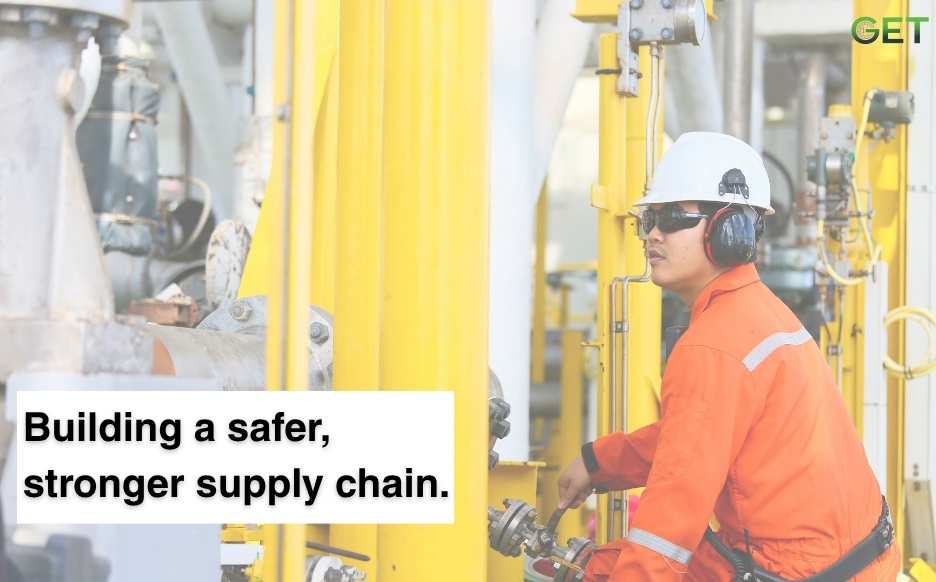
Ten years back, most HSE policies stopped at the company gate. Whatever happened past that point, subcontractors, transport, equipment vendors, was technically someone else’s problem, at least on paper. Not anymore. And the reason is blunt: trace a serious incident back far enough, and often it started somewhere in the supply chain, not inside the core operation.
GET Global Group has watched this play out first-hand, supplying skilled crews and integrated services to upstream operators across the Middle East and beyond. The moment a subcontracted crew turns up at a wellhead, or equipment lands from a supplier three countries away, an operator’s grip on safety gets thinner. That’s just the nature of upstream work. Well pads, drilling rigs, seismic crews, workover units, dozens of vendors rotating through the same site over its lifecycle. One weak link anywhere in that chain and the risk doesn’t stay put. It travels. HSE management in oil and gas simply can’t be scoped to a single company’s own four walls anymore, not if it’s going to mean anything.
Supply chain management has become nearly as important a boardroom topic as drilling technology or reserve estimates these days. Asking “is our facility safe” isn’t really the useful question anymore. The one worth asking is whether everyone working alongside you, at every stage, is held to the standard you’d hold yourself to.
Look at where HSE risk concentrates most, and you land squarely on the upstream oil and gas industry. Exploration and production sites are remote, often rough, and dependent on a rotating cast of contractors, drilling crews, logistics providers and equipment suppliers who might only be on site for a few weeks. Compare that to a refinery, with its relatively stable, long-term workforce. An upstream project can see dozens of different companies pass through a single well pad over its life.
That kind of churn makes consistency genuinely hard. A drilling contractor might run tight internal protocols, but if the crane operator subcontracted for one lift hasn’t been through the same induction, gaps show up fast. Multiply that across dozens of vendors and hundreds of workers, and you start to understand why the upstream oil and gas industry has become something of a stress test for whether supply chain safety practices actually hold up once real pressure hits.
The good news, if there is one, is that operators across the upstream oil and gas industry have learned from some painful history. Plenty now require every contractor, big or small, to meet a documented HSE standard before they’re even allowed to bid. It’s less “we’ll manage safety if something goes wrong” and more “prove you take this seriously before you get in the door.” A shift worth noticing, and one that’s steadily raising the bar for oil and gas supply chain safety across the region.
It’s easy to picture safety failures as one-off events. A slip. A spill. A piece of equipment that just gave out. But trace most serious incidents back to root cause and there’s usually a supply chain thread somewhere in there. Maybe it’s a valve made to a spec the buyer assumed but never actually confirmed. Maybe a transport company skipped a maintenance cycle to shave costs. Maybe a contractor’s workers were undertrained because that vendor had taken on too many jobs at once and stretched itself thin.
Weak oil and gas supply chain safety doesn’t just cost lives and injuries, though that’s obviously the heaviest cost by far. It shows up on balance sheets too: regulatory fines, insurance premiums that climb, project delays, a reputation that makes winning the next contract harder. In some cases, it costs the operating license outright. Investors and regulators are both paying closer attention to how companies manage risk outside their own walls now, and a weak link somewhere in the supply chain increasingly reads as a weak link in governance overall.
That’s really why oil and gas supply chain safety stopped being a compliance checkbox and became something closer to a differentiator. Companies that can actually prove, not just claim, that their whole network operates safely are the ones landing the long-term partnerships with major operators and government bodies.
Supply chain management used to sit firmly in procurement. Cost, delivery timelines, contract terms, that was the job. Safety lived somewhere else entirely, usually inside an HSE department with little say in who actually got hired as a vendor. That separation doesn’t really hold up anymore, and most companies paying attention have figured that out.
These days, supply chain management in oil and gas increasingly means folding HSE criteria into vendor selection from day one. Before a supplier even makes the shortlist, procurement teams are expected to review their safety record, training programs, incident history and certifications. It’s not unusual anymore to see safety performance weighted about as heavily as price on a vendor scorecard, particularly for critical work like drilling, transport and equipment maintenance.
This also means supply chain management now involves watching vendors on an ongoing basis, not a one-time box tick at contract signing. Audits happen periodically. Incident data gets shared across the network instead of staying siloed inside one company. A handful of operators have gone as far as building shared databases where contractor safety history is visible to multiple clients, so a company with a poor record can’t just hop from one operator to the next without that record following.
None of this is about micromanaging suppliers, or at least it shouldn’t be. It’s about recognizing that supply chain management and safety performance are really two sides of the same coin. You can’t optimize one while ignoring the other, not for long anyway.
So, what does effective HSE management in oil and gas actually look like once it’s built to cover an entire network, not just one site? A few patterns keep showing up among the companies doing this well.
Standardization is one. Instead of letting every contractor bring its own version of a safety manual, leading operators are pushing for a shared baseline: common induction training, common reporting formats, common incident classification. That makes it possible to compare performance across vendors and catch patterns that would otherwise sit buried in disconnected paperwork.
There’s also a heavier lean on real-time data now. HSE management in oil and gas used to be mostly retrospective. You found out about a problem after someone filed a report, sometimes days later. Now sensors, mobile apps and centralized dashboards let near-misses and unsafe conditions get flagged almost as they happen, whether that’s inside the company’s own operations or three tiers down the supply chain.
Accountability is being pushed further down the chain too. It’s no longer really acceptable for a prime contractor to hand off safety obligations to a subcontractor and call it done. Contracts increasingly bake in shared responsibility for HSE outcomes, with penalties and incentives tied to safety performance, not just to whether things showed up on time.
And then there’s training that travels with the worker rather than staying tied to a single site. A contractor’s employee moving between five different operators in a year should ideally carry a consistent safety competency record instead of starting over each time. Digital credentialing and shared training platforms are starting to make a real dent here, though there’s still a long way to go.
It’s easy, once you’re deep into systems and audits and scorecards, to lose sight of the fact that occupational health and safety is fundamentally about people. Every incident rate statistic is a worker who either went home safely or didn’t, and that holds whether they’re a permanent employee or a contractor on a three-week job.
Occupational health and safety in this sector cover a lot of ground: physical hazards like heavy machinery and working at height, chemical exposure from hydrocarbons and processing agents, and increasingly, fatigue and mental health for workers running demanding rotational schedules. Extend that conversation to the supply chain and the challenge multiplies, because the company sitting at the top of the chain usually has less visibility into how a contractor handles occupational health and safety for its own crew.
That’s part of why operators now ask for proof of occupational health and safety programs during vendor qualification, not just proof of insurance or financial stability. Are workers getting proper PPE. Is there an actual documented fatigue policy for long shifts. Can workers flag a hazard without worrying about retaliation. These questions matter just as much for a contractor’s crew as they do for a company’s own staff, and companies that keep asking them to tend to show measurably better outcomes across the network.
There’s a cultural piece too, one that’s easy to underrate. Occupational health and safety improves faster when it’s part of how people actually talk to each other on site, not just what’s written in a policy binder somewhere. Supervisors who stop a job the second something looks off. Workers who feel fine flagging a concern regardless of whose payroll they’re on. Building that across a fragmented supply chain takes real, deliberate effort, but it’s probably the single biggest lever available for cutting incidents.
Collaboration Over Control
Experienced HSE professionals in this industry will tell you the same thing if you ask: trying to control every vendor purely through enforcement rarely produces lasting results. Collaboration tends to work better, treating suppliers and contractors as partners working toward the same safety goal rather than outside parties to be policed.
In practice that looks like joint training sessions, where operator staff and contractor staff learn side by side instead of separately. It looks like sharing lessons from incidents openly instead of treating them as liabilities to bury. Some operators even invest in smaller suppliers’ safety capabilities directly, occasionally subsidizing training or equipment upgrades, because a weak link anywhere in the chain eventually becomes everyone’s problem.
Some of the stronger oil and gas supply chain safety programs now run supplier safety councils, where reps from multiple vendors sit down regularly with an operator’s HSE team to talk through emerging risks and align on new regulatory requirements. Forums like that do more for real-world safety behaviour than another round of paperwork ever will.
Technology’s Growing Role
Digital tools are quietly reshaping how HSE management in oil and gas plays out across supply chains. Cloud platforms let operators track contractor certifications, training expiry dates and incident history in one place instead of a dozen scattered spreadsheets. Mobile apps let field workers report hazards on the spot, with photos and location data attached, cutting the lag between spotting an unsafe condition and doing something about it.
Predictive analytics are starting to play a part as well, flagging vendors or equipment types whose history suggests elevated risk before an incident happens. That fits naturally with how supply chain management has always tried to anticipate disruption in the first place. The same logic that predicts a shipping delay can, given the right data, help predict where a safety failure is more likely to crop up. This is proving useful for smaller operators in the upstream oil and gas industry too, who now have access to tools that used to be out of reach on cost alone.
This kind of visibility is becoming table stakes across the upstream oil and gas industry, not just something a handful of large operators experiment with. None of this technology replaces judgment or a genuine safety culture. It does give companies a lot more visibility into a supply chain that used to be something of a black box the moment materials or people left direct company control.
A few concrete habits keep showing up among companies that are serious about improving HSE outcomes across their networks:
None of these are complicated ideas on paper. What’s hard is keeping them up, consistently, across dozens or hundreds of vendor relationships, in different countries and under different regulators, year after year.
The direction is clear at this point. HSE management in oil and gas can’t really be managed inside one company’s boundaries anymore. The upstream oil and gas industry, especially, has shown how fast risk travels across a network once standards aren’t aligned. Supply chain management and safety performance have basically merged into one conversation, and companies still treating them as separate issues are likely falling behind on both compliance and reputation.
Oil and gas supply chain safety will keep evolving as more data becomes available and regulators keep tightening expectations around contractor accountability. But none of that progress means much without a genuine commitment to occupational health and safety underneath it, the simple recognition that every person working somewhere in that chain, contracted or not, deserves to go home safely at the end of the day. Companies that keep that at the centre of their supply chain decisions tend to find everything else, compliance, reputation, even cost efficiency, follows from it.
This is precisely the standard GET Global Group holds itself to when placing crews and delivering integrated services across upstream operations in the Middle East and beyond. Every contractor and crew member supplied through GET Global Group is vetted against documented HSE criteria before deployment, not after an incident forces the question. For operators looking for a workforce partner who treats HSE management in oil and gas as a shared responsibility rather than a line item, that’s the difference worth asking about.
Read Also- HSE Excellence in Oil & Gas: Building a Safer, Sustainable and Compliant Workplace
Frequently Asked Questions
Because a supply chain involves multiple companies, each running its own training standards, equipment and safety culture. One facility can enforce a single consistent protocol. A supply chain means aligning many independent organizations toward the same safety expectations, which is a very different problem.
2. What makes the upstream oil and gas industry particularly vulnerable to supply chain safety gaps?
Upstream work leans heavily on short-term contractors, remote sites and personnel that change often. That transient workforce makes it much harder to hold consistent training and oversight compared to more stable downstream operations.
3. How does supply chain management directly influence occupational health and safety outcomes?
When safety criteria get built into vendor selection and ongoing monitoring, contractors are held to a higher bar from the outset. That cuts down the chances of underqualified or undertrained workers ending up on high-risk tasks.
4. What role does technology play in improving oil and gas supply chain safety?
Tools like real-time reporting apps, centralized contractor databases and predictive analytics help companies catch risks earlier and track safety performance across vendors that would otherwise be tough to monitor by hand.
5. Can smaller suppliers realistically meet the same HSE standards as large operators?
Yes, particularly when larger operators actually invest in helping them get there, through shared training programs, safety councils or subsidized equipment upgrades. Collaboration tends to close that gap faster than strict enforcement alone ever does.
By Get global | September 14, 2026
Health, safety and environment in the oil and gas sector was long treated as a back-office function, running quietly alongside the core work of drilling, extraction, and processing. That is no longer the case. Extreme pressures, volatile materials, remote sites, and heavy machinery mean the risk in this industry has […]
By Get global | September 14, 2026
By Get global | September 9, 2026
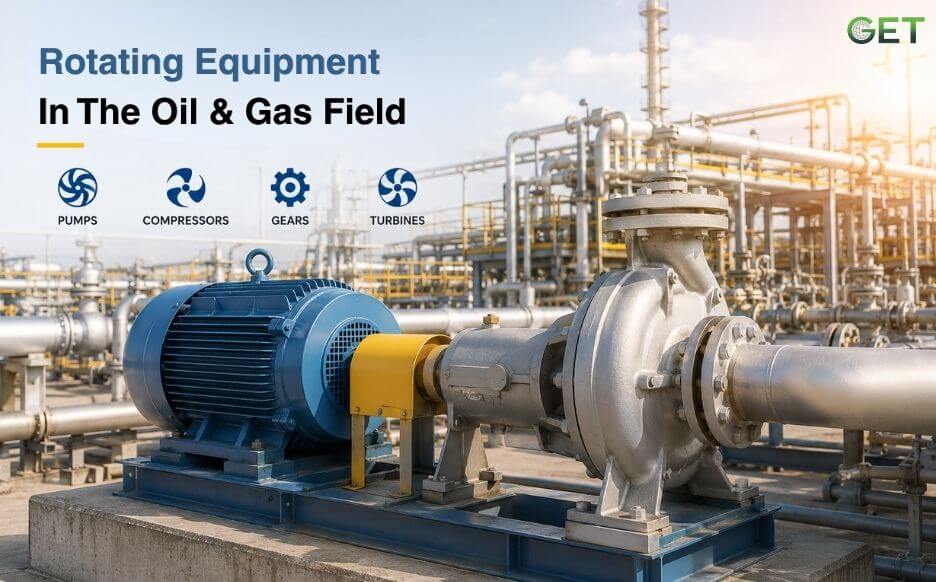
Walk onto any rig floor, production platform, or gas processing plant, and the first thing you notice isn’t the pipework – it’s the sound. That low, constant hum coming from somewhere in the facility is almost always rotating equipment doing its job. Pumps pushing fluid through miles of pipeline. Compressors […]

By Get global | September 9, 2026

By Get global | September 9, 2026
An offshore rig losing production can bleed staggering sums for every hour it sits idle. On the other end of the same industry, a well-run inspection or maintenance contract just keeps collecting steady, contract-locked revenue for a decade, without ever touching a barrel of crude. Same industry. Same oil underneath […]