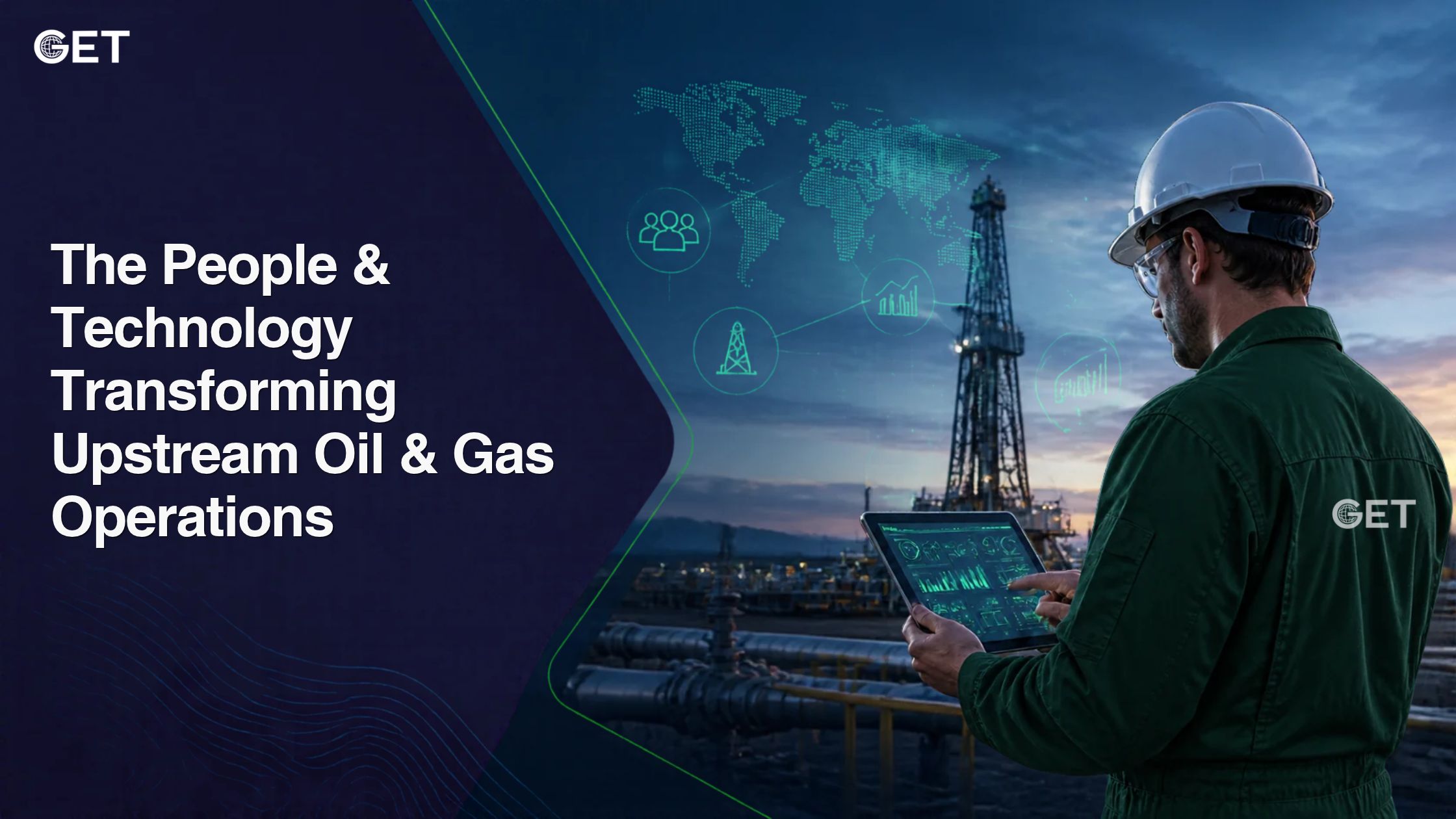
Walk through any conference hall in the upstream oil and gas industry and you’ll hear the same words on repeat: digital twins, machine learning, autonomous drilling. Fair enough, they’re interesting. But every sensor in the field was picked by somebody, bolted on by somebody else, argued over during calibration and eventually trusted by a crew. Those people are the real subject of this post.
Look at how digital transformation in upstream oil and gas is changing the working day, which technologies are earning their keep, what skills are worth building, and where projects tend to go wrong. Most of it ties back to oil and gas operational efficiency, since that’s what most budgets are really aimed at
The upstream oil and gas industry has always picked up new tools. Seismic imaging and horizontal drilling both rewrote the economics of whole basins. The speed is what’s new. Sensors are cheap, storage is cheap, and a reading from a wellhead can land on an engineer’s laptop in seconds instead of at the end of the week.
Pressure comes from every side. Operators want a lower cost per barrel. Investors ask about emissions on every earnings call. A big chunk of the experienced workforce is heading for retirement, while the people replacing them expect software that doesn’t feel like 2005. For plenty of companies, digital transformation in upstream oil and gas is now less a choice than a requirement.
It’s fair to remember that earlier waves overpromised. Most people have seen a pilot that produced one nice dashboard and no change in behaviour. So the useful question is whether a tool fixes something real in oil and gas operations, whether that’s onshore, offshore or out in a desert field.
The phrase gets thrown around a lot. Digital transformation in upstream oil and gas means changing how decisions are made, using data that’s current, accurate and visible to everyone involved. Software is just the starting point. It’s working when a crew lead, an engineer and a manager look at one set of numbers and agree on the next move.
Where it fails, it usually fails on people. Picture a field fitted with new sensors where nobody changes their morning round, so the readings just stack up and no one opens them. In oil and gas operations, habits beat hardware.
When it works, oil and gas operational efficiency improves in dull, measurable ways. Wells produce closer to what they can. Equipment breaks less. Crews spend less time on paperwork and more on the actual job.
Start with connected equipment. Pumps, compressors and pipelines report their own condition all day. Teams used to inspect on a calendar. Now they can see which machine is drifting and go there first. That move to condition-based maintenance probably contributes more to oil and gas operational efficiency than anything else on this list.
Next come the predictive models, which feed off that steady stream of readings. Train one on past failures and it can say a seal looks likely to go within a few weeks, which turns an emergency into a planned job. Unplanned shutdowns rank among the costliest events in the upstream oil and gas industry, so even a model that’s right most of the time earns its keep.
Digital twins are the part people enjoy explaining. It’s a virtual copy of a well or a platform, kept in sync with the real one, so an engineer can raise a flow rate on the copy and watch what happens. A lot of teams say this is where digital transformation in upstream oil and gas stops sounding abstract. Engineers can make their mistakes on the copy instead of on the wellhead.
Machine learning speeds up seismic interpretation, and on the rig a model can sometimes pick up a drilling pattern well before the crew would. Still, the driller or geoscientist makes the decision. The best oil and gas operations treat the model like a colleague with a second opinion.
Drones and crawlers take over the jobs nobody misses: looking over a flare stack or a tank roof, going inside a pipe. Fewer climbs and fewer confined-space entries means fewer injuries, which won’t show up on any cost sheet but matters across the upstream oil and gas industry.
Remote operations centres pull the threads together. Specialists onshore watch several sites at once and talk crews through problems as they happen. One expert covers more ground, and it opens the upstream oil and gas industry up to people who don’t want to live offshore. That helps oil and gas operational efficiency, and it helps hiring too.
None of this runs without reliable cloud links, and those links need protecting. Every connected pump gives an attacker one more door to try, so cyber security now sits inside everyday oil and gas operations rather than off to the side with IT.
Read Also- How Innovation and Growth Are Driving the Global Energy Sector in 2026
Technology changes nothing alone. Think of an operator with twenty years in the field who can hear a pump and know it’s off. An analytics system that flags the same fault hours earlier can feel like a threat or a gift, and the difference is how it’s introduced. If it saves them a call-out at 2 a.m., they’ll fight for it. If it arrives unexplained, alongside rumours of cuts, they’ll find ways around it.
So the sensible programmes bring field staff in early. Ask them what bugs them about the way things run today. Design the fix with them, test it at one site, and expect some grumbling. Doing it this way respects their knowledge, and the rollout of digital transformation in upstream oil and gas ends up matching how shifts really run, which in turn helps oil and gas operational efficiency.
Some job titles are brand new: data engineer, automation specialist, remote operator, cybersecurity analyst, twin developer. A decade back you would rarely have seen them in the upstream oil and gas industry. Today a computer science graduate can build a full career there.
Older roles are shifting too. A production engineer who can script a little Python and put together a dashboard gets through more than one who can’t, and a drilling supervisor at ease with live data usually decides faster. You don’t need to become a coder. But some data literacy is turning into a baseline across oil and gas operations.
Soft skills count as much. Explaining a model to a crew in plain words, doubting a number that looks wrong, working with people from other departments. That’s why digital transformation in upstream oil and gas rewards people who communicate and not only people who calculate.
Tablets replace clipboards. Permits go digital, handovers use a shared log, and a maintenance job lands on a phone with the machine’s history attached. Individually these are small. Add them up and a crew gets hours back every week that used to vanish into forms, which is where digital transformation in upstream oil and gas gets personal. Managers get a clearer view of oil and gas operations without waiting for the Monday report.
There’s a catch, though. More data brings more alerts, and a system that pings all day ends up ignored. Good design cuts the noise. It’s a quiet detail with a big effect on oil and gas operational efficiency.
Gas detectors, wearable monitors, automatic shutdowns and video analytics give crews earlier warning of trouble, and running a site remotely means fewer people stand near it at all. When a mistake can cost lives, as it can across the upstream oil and gas industry, that benefit counts for more than any saving on the budget.
Emissions get plenty of attention too. Methane leaks get caught sooner with continuous monitoring, and optimisation software can trim flaring and energy use. Less burned and less leaked is good for the environment and for the accounts, so digital transformation in upstream oil and gas earns its place twice over.
None of it replaces safety culture. A sensor warns, a person acts, and the best sites make sure anyone can stop work. Tools support oil and gas operations. They don’t excuse anyone from paying attention.
Talk about AI for long enough and you end up discussing data quality. Messy or mislabelled data gives messy answers. Sensors drift over time, tags get renamed without telling anyone, and a key spreadsheet sits on one person’s desktop. It’s dull to fix, but in oil and gas operations it decides whether the clever stuff works at all. Firms that sort it early tend to see faster gains in oil and gas operational efficiency than those who rush to buy the shiniest software.
Before any analytics project I’d ask three things. Who is responsible for the data? When was it last checked? Who acts on the output? If nobody can answer, wait. The upstream oil and gas industry has a graveyard of pilots that never scaled for exactly this reason.
Certain errors show up again and again. Some companies start with a tool they like rather than a problem they have, launch a dozen pilots without any way to scale them, skip training, leave security till later and want payback in a month. Any one of these slows digital transformation in upstream oil and gas more than a technical limit would.
A better route starts with one painful problem you can measure, such as unplanned downtime on a single pump type. Fix that, show the savings, then widen out. Small wins build trust, and trust carries oil and gas operations through bigger changes. Dropping these habits does more for oil and gas operational efficiency than another platform purchase.
Before you start, settle on a handful of plain measures such as downtime hours, cost per barrel, how long a maintenance job takes to close, and incident rates. Compare the numbers afterwards and be upfront if they disappoint. Real gains in oil and gas operational efficiency are the ones that both the crew and the finance team can see in the figures.
Vanity metrics are a trap too. Sensors installed tells you nothing about whether decisions got better. What counts is whether people in the upstream oil and gas industry choose faster and better than they did last year.
Anyone wanting in should aim to cover both sides. Start with the business itself, meaning reservoirs, wells, facilities and safety. Then add data skills, starting with spreadsheets and moving to basic programming and visualisation. Employers in the upstream oil and gas industry often say they can’t find people who understand both worlds.
Courses are useful, though a real project beats them. Grab some public data, analyse it, write up what you found, and try explaining it to a friend who knows nothing about wells. That says more about your readiness for oil and gas operations than a stack of certificates
Experienced people needn’t worry. Knowing the field is what gives the data meaning. A data scientist who has never stood beside a well can produce a flawless model of the wrong thing, so plenty of companies pair them with veterans on purpose. Those pairings often deliver the biggest jumps in oil and gas operational efficiency.
Geoscientists, engineers, data specialists and field crews used to work in separate silos, each with a different picture of the same asset. A shared model puts everyone in front of one version. Once that’s in place, handovers go wrong less often and decisions stop bouncing between departments, and oil and gas operational efficiency rises as a result. People newly hired into the upstream oil and gas industry expect to work like this, so companies that offer it find recruiting easier.
None of this is easy, and oil and gas operations bring their own hurdles. Legacy systems don’t talk to each other, remote sites have patchy connectivity, budgets swing with oil prices, and every connected device adds cyber risk. Change fatigue is real too. Staff who’ve seen three new systems in five years can be forgiven for rolling their eyes at a fourth.
Price cycles hurt most. When crude falls, the technology budget is usually the first line to be cut, even though these tools could help the upstream oil and gas industry ride out the lean years. The leaders who keep paying for the projects with the clearest returns tend to come out ahead. Training takes money and time as well, yet tools nobody can use cost far more. Digital transformation in upstream oil and gas depends on investing in people as much as platforms.
More autonomy is on the way. Some wells will adjust their own settings inside safe limits, drilling systems will steer with little human input, and facilities will run with small onsite teams backed by large remote ones, with production data tied more closely to emissions reporting. A few roles will shrink while others grow. The upstream oil and gas industry has always changed shape with technology and has always needed curious, skilled people.
A lot of the tooling built for oil and gas operations is already being tried on carbon capture, geothermal and hydrogen projects, which means the skills people pick up now won’t go to waste. Whatever arrives next, good information in capable hands will keep producing better decisions. That sits at the heart of oil and gas operational efficiency, and it’s why digital transformation in upstream oil and gas still has plenty of growing left to do.
Where should a leader begin? Pick a problem that’s real. Look at the data before anything else, get field staff involved early, run a pilot at one site, measure it honestly, train the people who’ll use it, and scale only after that. Nobody will write a headline about it, but companies that stick with this order usually get steady gains in oil and gas operational efficiency instead of a launch that fizzles.
People watch what senior leaders do. When a director opens the dashboard and asks about it in the weekly meeting, the rest of the company follows; when it’s handed to IT, that’s how everyone treats it. Then there’s communication. Staff need to hear why the change is coming, how it touches their own job and what support they’ll get. If nobody says anything, rumours fill the gap, and in an industry that has been through layoffs that happens fast. A clear explanation is what lets digital transformation in upstream oil and gas read as a chance rather than a risk.
The headlines suggest machines are taking over. What’s going on in the upstream oil and gas industry is closer to a partnership than a takeover. Machines deal with volume and speed. Judgement, context and accountability stay with people. Spend on data and on people, begin small, and learn from whatever fails. The aim hasn’t changed: safer, cleaner and more dependable oil and gas operations.
The promise isn’t a futuristic site with nobody on it. It’s better days for the people who are there. Digital transformation in upstream oil and gas is a long road, and each step that makes a crew’s work clearer is a step toward stronger oil and gas operational efficiency.
Read Also- How Specialized Technical Training Opens Doors to Upstream Oil & Gas Job Opportunities
FAQs
By Get global | November 19, 2026

By Get global | November 16, 2026
Dubai is famous for its skyline, its shopping and its world-class airlines, but there is another side to the city that deserves more attention. Energy professionals from around the globe have made it their base, and for good reason. An oil and gas career in Dubai offers the international exposure […]
By Get global | November 12, 2026
By Get global | November 10, 2026

By Get global | November 10, 2026