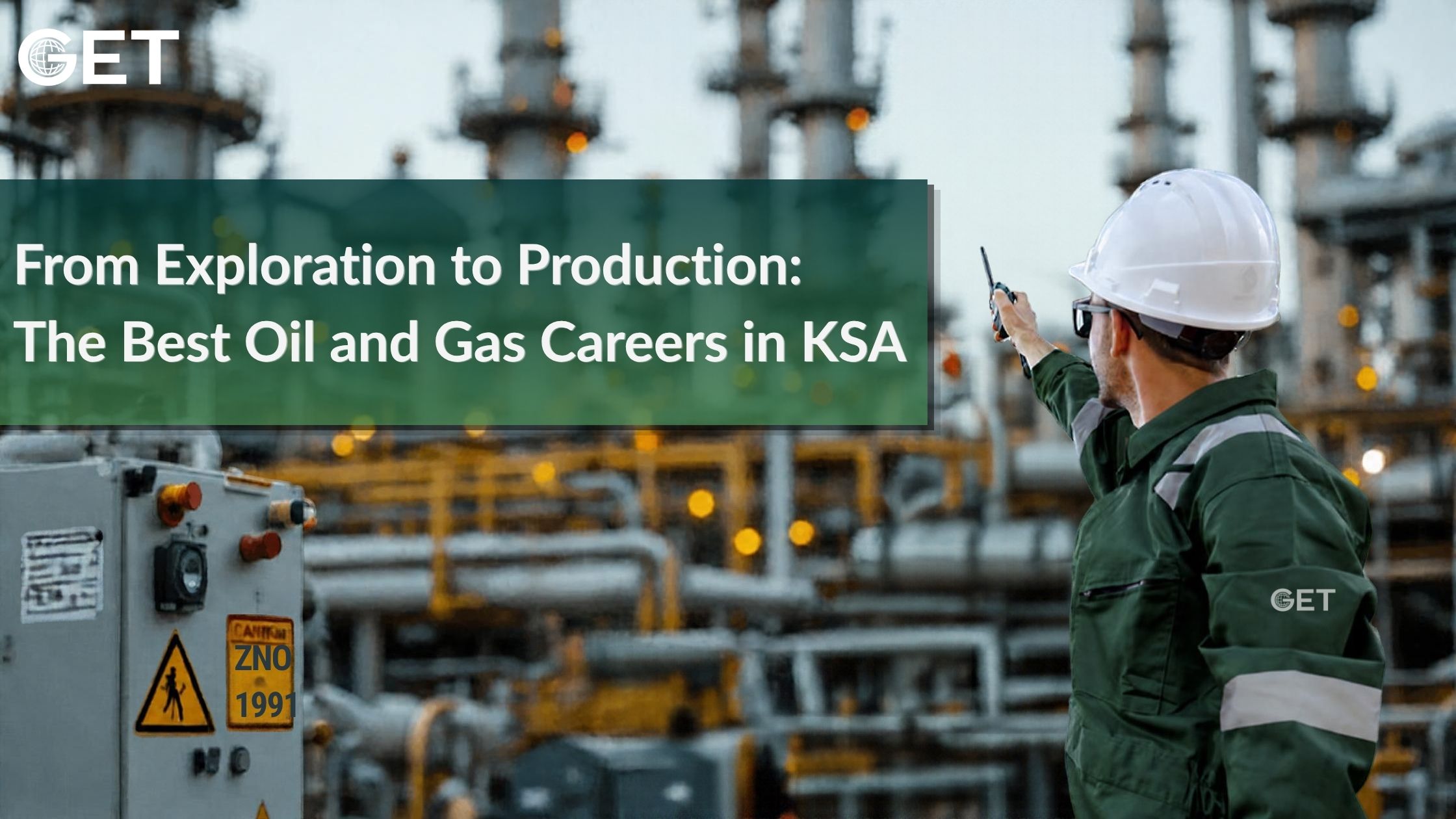
Nobody films the seismic room. The rig gets the photos, the hard hats, the sunrise over the sand. But by the time a rig shows up, a few geologists have already spent months squinting at data and disagreeing about where to drill. That’s upstream oil and gas jobs in KSA in short: a lot of careful guessing, then a lot of heavy steel.
So who does the work? Engineers, mostly, plus geoscientists and technicians who’d rather be at a wellsite than stuck in office traffic. Upstream oil and gas careers in the Kingdom cover all of them. Exploration and production jobs stretch from the Eastern Province desert out to platforms in the Gulf, and oilfield jobs in Saudi Arabia usually come with proper on-the-job training, which not every market bothers with.
Upstream is the start of the chain. Find the oil or gas, drill for it, get it out. Midstream moves it and downstream refines it. People in upstream oil and gas careers tend to say the same thing about why they stay: they like being near the source, with rock and pressure and machinery instead of spreadsheets.
Most hiring sits under E&P, so exploration and production jobs are the biggest slice. Ghawar is the world’s largest conventional oil field. Safaniya is the largest offshore one. Khurais and Shaybah matter too. In practice, upstream oil and gas jobs in KSA are anchored in the Eastern Province, usually around Dhahran, Al Khobar and Dammam, with crews heading out to site on rotation.
Fields here run for decades, so a project you join may outlast your contract. That’s a big reason upstream oil and gas jobs in KSA attract people who plan to settle. Gas is another. Vision 2030 leans on it for power and industry, which keeps money moving into drilling and subsurface work. Local content programmes like IKTVA have also pulled more suppliers and service firms into the country, and more oilfield jobs in Saudi Arabia came with them. Most packages are free of personal income tax too, which nobody complains about.
Nothing has been drilled yet, and the aim is to cut the odds of a dry hole. Geologists build a picture of the rock and where hydrocarbons might be trapped. Geophysicists run and read seismic surveys. Petrophysicists work out how much fluid the rock actually holds from well logs. Seismic processors do the cleanup that makes all of it usable, which is dull work but it matters.
Most exploration and production jobs at this stage want a geoscience degree and comfort with Petrel or similar software. A strong portfolio of interpretation work usually counts for more than a fancy title.
Once a target is approved, drilling takes over, and this is where a big share of oilfield jobs in Saudi Arabia sit. The range is wide. Drilling engineers design the well and watch cost. Directional drillers and MWD/LWD engineers steer the bit through the target. Toolpushers and supervisors run the rig. Drillers, derrickhands and roughnecks do the physical side. Mud engineers and loggers track fluids and cuttings, and completion engineers get the well ready to produce.
Rig life isn’t gentle. Summer temperatures in the Eastern Province can sit in the mid-40s Celsius, shifts are long and rotation is hard on family time. Still, few exploration and production jobs build hands-on experience faster, and good crews rarely sit idle.
When a well starts flowing, a different group takes over, and they’re usually in it for the long run. Fields need tuning for years, which is why so many upstream oil and gas careers settle into something stable at this stage.
Reservoir engineers forecast how a field behaves and plan how to recover more of it. Production engineers chase down wells that underperform. Operators look after wellheads, separators and gathering lines. Wireline and intervention technicians service wells without a full rig. Maintenance and instrument techs keep compressors and controls alive, and HSE officers are everywhere, as they should be. Plenty of exploration and production jobs here come with settled postings rather than constant moves.
Onshore is the bigger pool, with camps handling accommodation, and it’s the easiest way in for most people. Offshore work around Safaniya usually pays more, but it asks for extra safety tickets, helicopter transfers and tighter living quarters. A common route is onshore first, offshore once the certificates are in. If you’re comparing upstream oil and gas jobs in KSA, decide this early, because it shapes your training, your rotation and your daily life. Offshore adds a different flavour to upstream oil and gas careers, and it isn’t for everyone.
Jafurah is the name to know. It’s the flagship of the Kingdom’s unconventional gas push, and it needs a different toolkit: long horizontal wells, hydraulic fracturing, geomechanics, big water and facilities systems. Engineers who prefer newer technology to mature fields will find these exploration and production jobs a real growth route. They’re also one of the more interesting corners of oilfield jobs in Saudi Arabia right now.
Start with a relevant degree or recognized technical qualification, then certifications: IWCF or IADC WellSharp for drilling, NEBOSH or IOSH for HSE, H2S awareness, and BOSIET/HUET for offshore. Provable field experience matters, ideally with numbers, and so do software skills like Petrel, Techlog or Eclipse. Solid English is expected, and a bit of Arabic goes down well. You also need to be fine with rotation.
A frequent CV problem is a list of duties with no outcomes. Wells delivered, downtime cut, incidents avoided: that’s what moves a CV forward for upstream oil and gas jobs in KSA.
Ignore salary figures from random websites. They swing too much by role, seniority and employer to be useful. What’s more consistent across oilfield jobs in Saudi Arabia is the package around the pay: housing or an allowance, medical cover, annual flights, end-of-service benefits and rotation allowances for field staff. Compare the whole package, not just the basic. If you’re building upstream oil and gas careers abroad with a family, things like schooling support can matter more than a few extra riyals on the payslip.
Saudization is the national drive to raise employment of Saudi nationals across sectors. For Saudi graduates it means plenty of programmes and apprenticeships feeding upstream oil and gas jobs in KSA. For expats, demand holds in specialist and senior technical roles where local supply is thin. Work out where your profile fits before you apply, rather than spraying applications at everything.
Choose a lane first: subsurface, drilling, production or support. Check which certificates your target role needs and book them before you apply. Rewrite your CV around results. Then shortlist employers, meaning operators, drilling contractors, service companies and specialist recruiters. A firm like GET Global Group knows which exploration and production jobs are open and how clients like candidates presented, so it’s worth talking to one. Last, prepare for technical interviews. Scenario questions are standard, so revise your safety basics.
Upstream oil and gas careers reward patience. A junior geologist can become a senior interpreter, then an asset team lead, then a subsurface manager. A roughneck can become a driller, then a toolpusher, then a rig manager, a well-trodden path in oilfield jobs in Saudi Arabia. Operators move up into supervision and planning. Because operations are so integrated, sideways moves between exploration, drilling and production are common, and they often speed things up.
Global energy is shifting, no question. But Saudi Arabia is putting money into capacity, gas and efficiency at once, which keeps upstream oil and gas jobs in KSA relevant. People who pair technical depth with newer skills like digital oilfield tools, data analysis and emissions management will do best. Exploration and production jobs are changing too, with more automation and remote monitoring, so learning doesn’t stop after your first posting.
From the first seismic survey to the last barrel a well ever gives up, the Kingdom offers more variety than most markets. Upstream oil and gas jobs in KSA suit people who like solving physical problems at scale. Upstream oil and gas careers here are well paid and technically rich, and the strongest ones go to people who prepared early and can show results. Ready to look at oilfield jobs in Saudi Arabia? Get in touch with GET Global Group.
Read Also-
FAQs
What are upstream oil and gas jobs in KSA?
Roles that find and produce crude oil and natural gas, from exploration through drilling to production. Geologist, drilling engineer, reservoir engineer, production operator and wireline technician all fall under upstream oil and gas careers.
Which exploration and production jobs are most in demand?
Experienced drilling engineers, reservoir and production engineers, petrophysicists and skilled rig crew come up most often across oilfield jobs in Saudi Arabia. Unconventional gas specialists are increasingly sought. Pay depends on seniority, location and whether the work is offshore.
Can foreigners apply for oilfield jobs in Saudi Arabia?
Yes, and many do, especially in specialist and senior positions. The Kingdom does prioritize Saudi nationals, though, and visa, medical and certification rules for upstream oil and gas careers differ by employer.
What qualifications do I need for upstream oil and gas careers?
It depends on the role. Engineering and geoscience posts usually want a relevant degree. Field-based exploration and production jobs may ask for technical diplomas, safety certificates and rig or plant experience. Offshore adds survival and helicopter training.
Can fresh graduates get upstream oil and gas jobs in KSA?
Yes, mostly through graduate programmes at operators and service companies, plus internships and trainee roles. Contractors also hire junior field engineers and technicians, which is another way into oilfield jobs in Saudi Arabia.
By Get global | October 12, 2026
Saudi Arabia is traditionally considered a key country where people work in the oil and gas sector. As there is quite a lot of drilling, well intervention and production processes in this country, many engineers, technicians and specialists from the field try to find suitable positions there. However, not all […]

By Get global | October 9, 2026
Ask any person working night shifts in rigs and compressor stations what holds the industry back, and you will seldom hear anything about geology. Disconnected information, delayed decision-making, and machinery breaking down at the wrong moment – all these factors are more common causes of productivity losses in the industry. […]
By Get global | October 5, 2026
Specialized expertise turns a hard project in the oil and gas industry into a workable one. Every oilfield has its own geology, risks, and surprises. The teams that handle them the operations on field have usually met something similar before. In the modern world, upstream oil and gas companies are […]
By Get global | September 30, 2026
By Get global | September 28, 2026