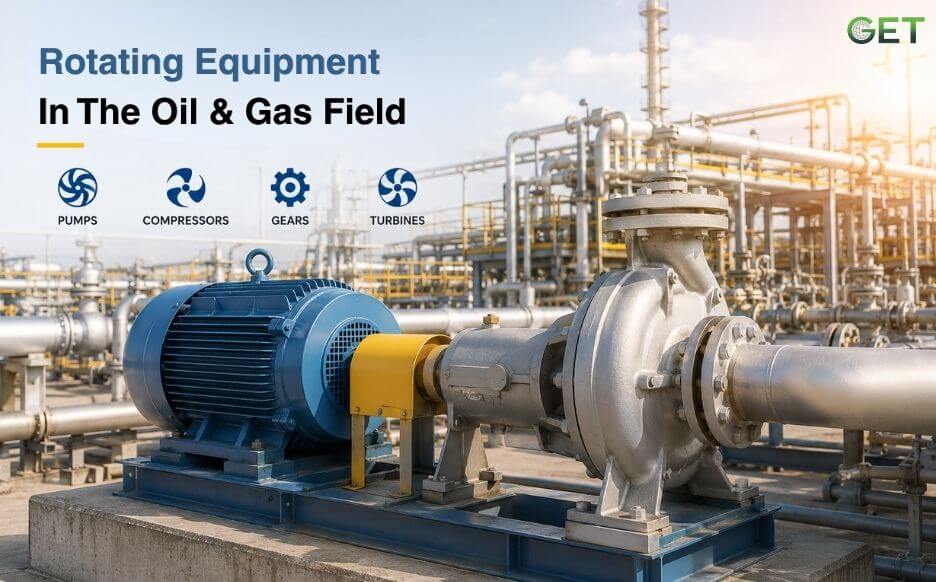
Walk onto any rig floor, production platform, or gas processing plant, and the first thing you notice isn’t the pipework – it’s the sound. That low, constant hum coming from somewhere in the facility is almost always rotating equipment doing its job. Pumps pushing fluid through miles of pipeline. Compressors squeezing gas into a pipeline-ready state. Turbines spinning fast enough to generate the power an entire platform runs on. Most of it is buried under insulation, tucked into skid packages, or sitting quietly in a pump house nobody visits unless something’s wrong. But take it away, and upstream operations stop within hours.
For anyone new to the industry – or for professionals brushing up before an interview or a site posting – understanding rotating equipment isn’t optional. It’s one of the first things a hiring manager or site supervisor will expect you to know cold. At GET Global Group, we work closely with upstream oil and gas companies and crew across the Middle East, South Asia, and Southeast Asia, and this equipment comes up in conversation constantly – whether it’s a hiring brief, a site audit, or a technical interview prep session. Here’s why upstream operators depend on it so heavily.
Rotating equipment is any machine with parts that spin around a central axis to move fluid, gas, or generate power. That’s the textbook definition, but on a rig or plant floor, it means something more practical: it’s the equipment that has bearings, shafts, seals, and vibration – and therefore the equipment most likely to need a vibration analyst, a lubrication schedule, and a maintenance crew on standby.
This is different from static equipment – tanks, vessels, piping, heat exchangers – which mostly sit there and do their job without moving parts. Rotating machinery is dynamic by design, which is exactly why it delivers so much value and why it fails in ways static equipment rarely does. A pump bearing wears. A compressor seal degrades. A turbine blade erodes over thousands of operating hours. Reliability engineers spend entire careers just keeping this category of equipment running.
Upstream oil and gas companies deal with a basic physical problem: hydrocarbons don’t move themselves. Crude sitting in a reservoir three kilometres underground has no interest in reaching the surface on its own once natural reservoir pressure declines. Gas doesn’t compress itself into a pipeline-ready state. Water used for injection doesn’t push itself back down an injection well. Every one of those steps needs a machine that adds energy to the fluid – and that machine is almost always rotating.
This is why capital budgets for upstream projects allocate such a large share to rotating equipment packages. A single centrifugal compressor train for a gas plant can run into millions of dollars, and that’s before accounting for spares, condition monitoring systems, and the specialist technicians required to run it. Get the equipment selection wrong at FEED stage, and an operator is stuck with an asset that underperforms for the next twenty years. Get it right, and rotating equipment becomes one of the quietest, most dependable parts of the entire operation.
There’s also a workforce angle worth mentioning. Rotating equipment technicians, reliability engineers, and rotating equipment specialists are consistently in demand across the Middle East, South Asia, and Southeast Asia, precisely because every upstream facility – onshore or offshore – needs people who understand how this machinery behaves under load, under pressure fluctuation, and under years of continuous duty.
There isn’t a single “rotating equipment” category – it’s a family of machine types, each doing a different job. Here’s how the main types break down.
Pumps move liquids – crude, produced water, injection water, chemicals, condensate – from one point to another. In upstream operations, you’ll commonly come across:
Where pumps move liquid, compressors move and pressurise gas. This equipment shows up at nearly every stage from wellhead to export terminal.
Turbines convert the energy in steam, combustion gas, or expanding process gas into rotational mechanical energy – usually to drive a compressor, pump, or generator.
Not every rotating machine handles a process fluid directly. Electric motors drive pumps, compressors, and fans, converting electrical energy into rotational mechanical energy. Generators do the reverse – turning mechanical energy from a turbine or engine into the electrical power that keeps a platform’s lighting, control systems, and instrumentation running. On many offshore installations, gas turbine generators are effectively the only power source available, which makes their reliability a safety issue as much as an operational one.
Rounding out the list are the machines that rarely get mentioned but matter just as much day to day – cooling fans for heat exchangers and air coolers, blowers for combustion air supply, and agitators used in chemical treatment and tank mixing. None of these carry the glamour of a gas turbine, but a failed cooling fan can shut down an entire compressor train just as fast as a bearing failure on the compressor itself.
Between these categories, most upstream sites end up running a fairly consistent mix of the same types of rotating equipment, just scaled to the size of the operation – a small onshore pad might have a handful of pumps and a compressor skid, while a large offshore platform will run dozens of machines across every category above.
It helps to think about rotating equipment by where it sits along the value chain, rather than just by machine type.
At the wellhead and in artificial lift, electric submersible pumps, progressive cavity pumps, and beam pumping units (the classic “nodding donkey” is itself a piece of rotating and reciprocating machinery) bring hydrocarbons to surface once natural pressure alone isn’t enough.
In gas gathering and processing, compressors dominate – pulling gas from multiple wells, boosting it to the pressure required for processing, and preparing it for pipeline export. This is where centrifugal compressor trains, often driven by gas turbines, do the heaviest lifting.
On offshore platforms, power generation is almost entirely dependent on rotating equipment. Gas turbine generators, backed up by diesel generator sets, keep everything from drilling systems to living quarters running. A platform losing its generation package isn’t an inconvenience — it’s an emergency shutdown scenario.
In water injection and pressure maintenance, large centrifugal pumps push treated seawater or produced water back into the reservoir to maintain pressure and improve recovery – a process that can involve some of the highest-horsepower pumps found anywhere on an upstream site.
In midstream transport, pipeline pump stations and compressor stations use the same core equipment types, scaled up, to move crude and gas across hundreds of kilometres to terminals and processing hubs. Across all of these settings, the rotating equipment used in the oil and gas industry follows the same logic – add energy to a fluid, move it somewhere useful, and do it reliably for years without stopping.
Here’s the part that doesn’t make it into equipment brochures: rotating machinery in oil and gas field operations is also the leading source of unplanned downtime across the industry. Bearing failures, seal leaks, vibration-induced fatigue, and misalignment account for a large share of maintenance spend on any upstream facility. That’s exactly why reliability engineering, vibration analysis, and condition-based monitoring have become such critical disciplines rather than optional extras.
A field technician who understands rotating equipment isn’t just running routine checks – they’re reading vibration signatures, tracking bearing temperatures, and catching the early signs of a problem before it becomes a shutdown. Predictive maintenance programmes built around this equipment have measurably cut unplanned downtime across operators who’ve invested in them properly, and that’s a big part of why demand for skilled rotating equipment specialists hasn’t slowed down even as the industry pushes toward automation and digital monitoring.
There’s also a safety dimension that’s hard to overstate. A compressor seal failure isn’t just a maintenance ticket – depending on the gas involved, it can be a process safety event. This is why HSE competency and rotating equipment competency tend to be assessed together during technical interviews for upstream roles, and why operators are increasingly selective about the crew and consultants they bring onto a site to look after rotating machinery in the field.
Rotating equipment isn’t standing still, technologically speaking. Digital twins, real-time vibration monitoring, and AI-assisted failure prediction are being layered onto machinery that, in some cases, has run on the same basic mechanical principles for decades. The equipment itself – pumps, compressors, turbines, motors – hasn’t fundamentally changed. What’s changed is how much operators now know about the condition of that equipment before it fails, and how much earlier they can intervene.
For anyone building a career in upstream oil and gas, that’s worth remembering. The machines aren’t going anywhere. What’s evolving is the skill set needed to keep them running – and that’s exactly where the opportunity sits for engineers, technicians, and reliability specialists entering the field today.
FAQs:
By Get global | September 18, 2026
By Get global | September 14, 2026
Ten years back, most HSE policies stopped at the company gate. Whatever happened past that point, subcontractors, transport, equipment vendors, was technically someone else’s problem, at least on paper. Not anymore. And the reason is blunt: trace a serious incident back far enough, and often it started somewhere in the supply chain, not […]

By Get global | September 14, 2026
Health, safety and environment in the oil and gas sector was long treated as a back-office function, running quietly alongside the core work of drilling, extraction, and processing. That is no longer the case. Extreme pressures, volatile materials, remote sites, and heavy machinery mean the risk in this industry has […]
By Get global | September 14, 2026

By Get global | September 9, 2026