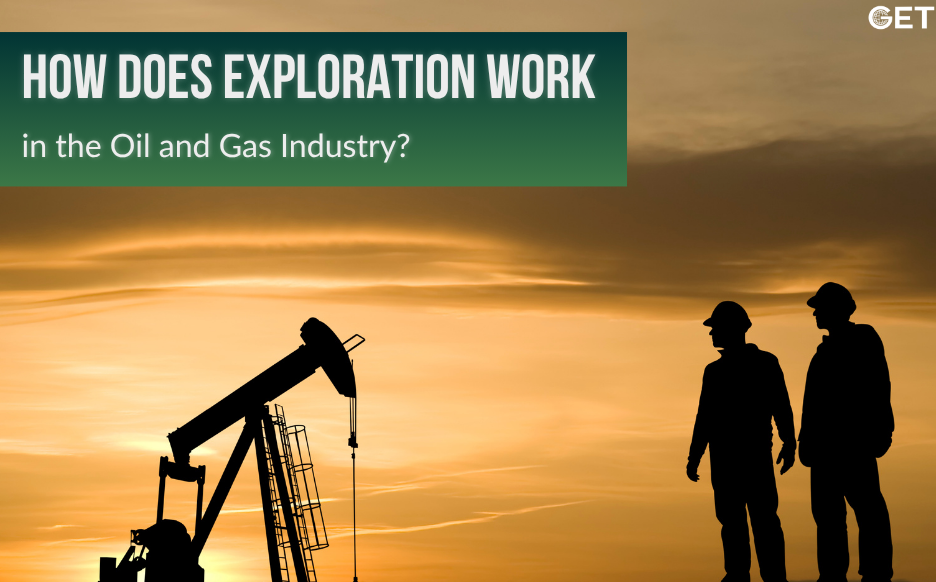
Every barrel of crude used for powering cars, heating homes, and refining oil begins with an unanswered question, one which is critical but cannot be answered with certainty: Is there hydrocarbons below ground, and do we have access to it in an economic manner? This question is what makes up the essence of the need for exploration within the upstream oil & gas industry.
At Get Global Group, individuals working within exploration and production (E&P) projects refer to this period of exploration as “investing in verifying whether or not your guesses were correct.” Not far from the truth. This process can be seen as an exercise in minimizing geological uncertainty, step-by-step, through data sets, until companies feel comfortable enough to invest in the drilling process.
Well before any mention of drilling takes place, geologists and geophysicists will examine sedimentary basins, which are large, deep depressions in the Earth’s crust containing millions of years’ worth of layered rocks. While not all basins are sources of oil or natural gas, what determines their potential value is whether or not they possess all of the necessary elements of hydrocarbon generation: source rock, reservoir rock with sufficient porosity and permeability for hydrocarbons to remain stored within them, and a trap and seal to prevent migration or seepage of those hydrocarbons.
This is where the importance of geological surveys comes into play. Corporations or national geological institutions will compile decades of data collected from wells drilled in the area to create an image of which basins contain sufficient value to merit additional attention. It may be tedious work, but it limits the area being searched from an entire continent to much less.
If the selected basin or block looks interesting, the next step is seismic surveying. Seismic surveys are performed with special trucks that have vibrating plates installed or with controlled explosions generating sound waves onshore. The offshore seismic surveys use special seismic vessel pulling along air guns and long streamers with sensors – hydrophones. After the sound waves reflection from different rock layers to the surface, the information obtained is processed to form 2D seismic lines or 3D seismic maps – an image of the underground formations without drilling. Interpretation of such images helps to find structural and stratigraphic traps in the form of anticlines and fault blocks.
With the help of 4D seismic surveys operators now can see how the reservoir behaves during its production, but the technique is used mostly after discovery of the field. Seismic surveying is not an infallible method. It provides information about the underground structures only, not about the existence of oil and gas in the formation. The presence of hydrocarbons in the seismic surveys can be recognized through some anomalies named “bright spots”. That is why the geophysical surveys usually are complemented by gravity and magnetic surveys.
All of this geophysical and geological data eventually gets compiled into what the industry calls a prospect — a specific, mapped location believed to have a reasonable chance of containing commercially viable oil or gas. Petroleum geologists and reservoir engineers then run probabilistic assessments, often expressed as a “chance of success” or “geologic risking,” weighing the probability that each essential ingredient — source, reservoir, trap, seal, and timing — actually lines up in that one spot.
Before any drilling can happen, a company needs the legal right to explore. Exploration licenses or production sharing agreements are typically awarded by national governments or regulatory bodies through bidding rounds, negotiations, or open acreage programs. These agreements spell out the block boundaries, the minimum work commitments (such as how much seismic must be shot or how many wells must be drilled within a set period), and the fiscal terms — royalties, taxes, and how any eventual production gets split between the company and the host government.
Firms like Get Global Group frequently work at this intersection of technical assessment and commercial strategy, helping evaluate acreage, assess regulatory frameworks, and structure partnerships before a single exploration well is spudded.
Eventually, all the mapping, modeling, and licensing leads to one moment of truth: drilling an exploration well, sometimes still called a wildcat well when it’s testing entirely new territory. This is the single most expensive and highest-risk activity in the exploration phase, and it’s the point where a purely interpretive science becomes a physical, mechanical undertaking.
As the well is drilled, engineers run wireline logging tools down the borehole to measure rock properties — resistivity, density, porosity — directly. If those readings look promising, the well may be tested to measure actual flow rates of oil or gas, and rock and fluid samples are brought to the surface for lab analysis. Only at this stage does “possible hydrocarbons” become “confirmed hydrocarbons,” assuming the well finds anything at all. Dry holes, where no commercial hydrocarbons are found, remain a normal and expected part of the exploration process, even for the most sophisticated operators.
If the exploration well is successful, it doesn’t immediately mean a field will be developed. Appraisal wells are usually drilled next, spaced around the discovery to define the size of the reservoir, estimate recoverable reserves, and understand how the hydrocarbons are distributed. Only after appraisal do companies move toward a final investment decision and, if the numbers work, into full-scale field development and production.
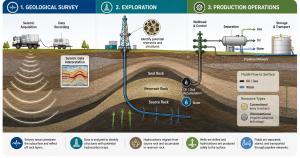
Exploration is often invisible to the public, overshadowed by more visible parts of the industry like refining or retail fuel prices. But it’s the foundation everything else rests on. Without disciplined basin analysis, seismic interpretation, licensing strategy, and carefully appraised exploration wells, there would be no new reserves to develop, and existing production would simply decline as older fields mature and deplete.
Organizations like Get Global Group operate across this spectrum, bridging technical geoscience with the commercial and regulatory realities that determine whether a promising basin ever becomes a producing field. It’s a long, patient process, often stretching a decade or more from the first regional survey to first oil, and it’s built almost entirely on managing uncertainty rather than eliminating it. In an industry defined by billion-dollar decisions made on incomplete information, that’s really the whole game.
Read Also- Preventive vs. Predictive Maintenance: Which One Actually Protects Your Barrels?
FAQS
There is. Exploration refers to the search process, which involves basin studies, seismic and the drilling of exploration wells to determine whether commercial hydrocarbons are present. Production starts after the discovery is appraised and developed; wells have started producing oil or gas for sale.
They don’t have definite information. The geologists try to visualize the subsurface through geological regional surveys, seismic imaging, and sometimes gravity and magnetic surveys. Structures capable of trapping hydrocarbons are identified in the process. Even with excellent seismic imaging, a prospect remains a probability.
A wildcat well is an exploration well drilled in an area where there is no production history. It is an exploration well drilled without the advantage of nearby wells and therefore is a gamble.
By Get global | October 5, 2026
Specialized expertise turns a hard project in the oil and gas industry into a workable one. Every oilfield has its own geology, risks, and surprises. The teams that handle them the operations on field have usually met something similar before. In the modern world, upstream oil and gas companies are […]
By Get global | September 30, 2026
By Get global | September 28, 2026
By Get global | September 28, 2026
By Get global | September 28, 2026
Technology has touched every corner of modern oil and gas operations—from upstream exploration and drilling to midstream pipelines, downstream facilities, maintenance, and performance monitoring. One area where digital transformation delivers exceptional value is HSE (Health, Safety and Environment), a core priority for GET Global Group and the wider energy industry. […]