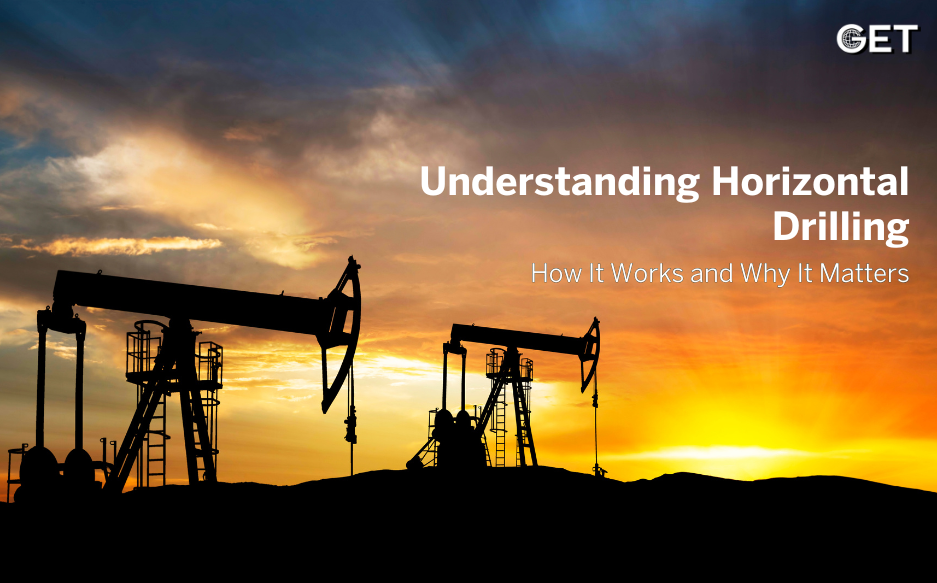
Horizontal drilling has changed how the oil and gas industry reaches its reserves. A well no longer has to end at the top of a reservoir. It can turn underground and follow the producing rock for kilometres, which means more oil and gas from fewer wells. This blog explains what horizontal drilling is, how a horizontal well is drilled, and why it has become central to modern upstream operations.
Every horizontal well starts as a vertical one. Deep down, the drillers change course. The bit leans into a gentle curve, keeps bending, and finally settles into a sideways path that follows the rock layer holding the oil or gas.
Directional drilling is the umbrella term for any well steered off the vertical. Horizontal wells are the most extreme case, and the most productive.
Try picturing a layer cake. Push a skewer through it and you touch each layer for a second. Now slide a knife in from the side and run it along one layer. That is the difference. If the layer holds oil, the horizontal well can be in contact with it for thousands of metres.
Engineers were experimenting with angled wells back in the 1920s. Results were poor. Nobody could see where the bit was, so steering was largely guesswork.
Two tools changed that in the 1980s and 1990s: rotary steerable systems and measurement while drilling (MWD). Both let a drilling team follow the bit’s path as it moved. Operators also started aiming horizontal wells at tight formations that vertical wells could barely drain.
Fracking was the other half of the story. In the early 2000s, operators in North America began completing horizontal wells with hydraulic fracturing, and shale that had sat untouched started to produce. The United States went from importing heavily to producing more oil than any other country. Horizontal drilling did much of the work.
The technology is complex. The sequence is not. A horizontal well goes through six stages.
Drilling starts vertically, using standard bits and casing. The depth depends on where the target formation sits, typically somewhere between 1,500 and 4,000 metres.
2. The Kickoff Point: Starting to Turn
This is where the well leaves the vertical. A downhole mud motor paired with a bent sub, a short piece of angled pipe, pushes the bit off its straight line at a depth the team has planned in advance. The angle grows from there.
3. The Build Section: Curving to Horizontal
Over a few hundred metres, the well goes from vertical (0°) to horizontal (90°). Engineers track how fast the angle changes with the build rate, measured in degrees per 30 metres.
4. The Lateral Section: Drilling Sideways
Now the bit is level, moving through the target formation. This is the lateral. Lateral lengths vary widely, from around 1,500 metres up to more than 4,500. The longer the lateral, the more rock the well can drain.
5. Steering and Monitoring Underground
The crew can’t see the bit, so they rely on data. MWD and Logging While Drilling (LWD) tools send readings up through pulses in the drilling fluid. With those readings, the team steers the bit toward the best rock and away from the worst.
6. Completion and Fracturing
When drilling ends, the well is usually completed with hydraulic fracturing. High-pressure fluid cracks the rock so oil or gas can flow. A long lateral with many frac stages is what pushes output so high.
Vertical wells still work well in conventional reservoirs, where thick, porous rock lets oil move freely. The trouble is that much of the world’s remaining hydrocarbon sits in tight rock such as shale, tight sandstone, and carbonate. A vertical well in that kind of rock often can’t pay for itself. Horizontal drilling changed the economics for six reasons.
Vastly More Reservoir Contact
Imagine a formation only 30 metres thick. A vertical well goes through those 30 metres and is done. A horizontal well can keep going for thousands of metres inside the same layer. More contact means more production.
Better Economics Per Well
Yes, a horizontal well costs more to drill. It also produces far more, so the return over its lifetime is stronger.
Smaller Surface Footprint
One horizontal well can drain an area that once needed five or ten vertical wells. That means less land cleared, fewer access roads, and a lighter impact on the surroundings.
Drilling Under Obstacles
What if the oil sits under a city, a coastline, or protected land? The rig stands somewhere else, and the well is steered underneath.
Unlocking Tight Formations
Pair horizontal wells with fracking and shale oil and gas became commercially viable. Global supply changed as a result.
Enhanced Recovery
Old fields still hold oil that vertical wells left behind. Horizontal wells can reach those pockets and extend the life of the field.
Put the two approaches side by side and the industry’s choice makes sense.
A vertical well meets the formation for a few metres. A horizontal well can stay inside it for kilometres. Drilling a vertical well is quicker, cheaper, and easier to plan, though it yields less. A horizontal well demands a bigger budget and more specialised steering and monitoring equipment up front, and the extra output usually makes up for it.
Geology usually decides. Vertical drilling suits conventional, porous rock. In tight, low-permeability rock a horizontal well does better, especially once fracking is added. It also covers the same ground with fewer wells, so less land is disturbed.
The extra upfront spend on a horizontal well makes sense when the geology supports it, because output is so much higher.
Horizontal wells turn up on land and offshore, in shale, in coal seams, and in ageing conventional fields.
Shale Plays in the United States
Few places show the impact better than the American shale plays. Texas’s Permian Basin, North Dakota’s Bakken, and South Texas’s Eagle Ford all rely on long horizontal wells with many fracturing stages. Rock that producers had long treated as not worth drilling began delivering commercial volumes. The shale boom that followed made the country an energy superpower.
Offshore Platforms
Offshore platforms are expensive to build. Once one is standing, operators can drill dozens of horizontal wells from it in different directions and reach reservoirs across a wide area of seabed. One platform ends up serving a large part of the field, which spreads its cost over many wells.
Drilling Beneath Protected Land
Wetlands, coastlines, and national parks sometimes sit right on top of a reservoir. Operators can place the rig outside the protected zone and use an extended-reach well to get underneath, so no equipment goes onto the sensitive ground. The last stretch of the well simply travels sideways underground.
Coal Bed Methane
A coal seam is thin and lies almost flat, so a well that follows it stays in the gas-bearing coal for its whole length. That is why coal bed methane (CBM) projects favour horizontal wells: a single well can drain a wide area and leave little mark on the surface.
Read Also- Navigating the Global Energy Workforce
Horizontal wells deliver more, but they are harder to drill, and several problems keep drilling teams busy.
Money is the first problem. A horizontal well takes longer to drill than a vertical one of similar depth, uses more equipment, and needs tighter steering control, and each of those adds to the bill.
Stability is another issue. In some rock types, the walls of a horizontal hole collapse or swell, and the drill string gets stuck. Freeing it is expensive.
Then there is hole cleaning. As the bit cuts, it breaks off small pieces of rock. In a vertical well the drilling fluid lifts them out. In a horizontal section they tend to drop onto the low side of the hole, and if they collect into a bed they can block the well. Crews plan the fluid and flow rates carefully to keep them moving.
Cementing is harder as well. Getting cement to fill the space around the casing evenly is tougher in a horizontal well, and poor cementing can cause well integrity problems.
Fracturing a long lateral takes skill too. The stimulation has to reach every section evenly, and any section that misses out produces less.
Finally, horizontal isn’t always the answer. In a thick conventional reservoir, a vertical well may still be the cheaper choice. Geology decides.
The technology keeps improving, and a few directions stand out.
Longer Laterals and Multilateral Wells
Operators keep stretching horizontal sections. Laterals beyond 5,000 metres are becoming more common in productive shale plays, and a longer lateral means more production per well. Multilateral drilling takes another route: several branches come off one main wellbore into different parts of the reservoir. Recovery goes up, and fewer surface well pads are needed.
Automation and Artificial Intelligence
AI and machine learning are starting to change how wells are drilled and steered. Automated systems can adjust in real time to keep the bit in the best part of the reservoir, and sometimes they react faster than a driller could.
Geothermal Energy and Carbon Capture
Horizontal drilling is not only for oil and gas anymore. Geothermal projects use the same techniques to run wells through hot rock and bring heat up for power. Carbon capture and storage uses them too, since injecting CO₂ into deep formations calls for accurate well placement. Skills built over decades in oil and gas are finding a second use.
Horizontal drilling is among the most transformative technologies the oil and gas world has produced. It opened up resources that seemed out of reach and reshaped global energy markets. It helped the United States become the world’s largest oil producer. And since it allows more production from fewer surface locations, it shrank the footprint of drilling.
Behind the numbers, it is a story about ingenuity. Engineers worked out how to steer a bit thousands of metres underground, in real time, with remarkable precision. A simple question, why not drill sideways?, grew into a technology that changed the world.
The story isn’t finished. As the energy transition speeds up, horizontal drilling will keep evolving, serving geothermal development and carbon storage as well as hydrocarbon production. The technology built by the oil and gas industry has a future beyond it.
Whether you’re a student, an investor, a policy maker, or simply curious about how energy works, understanding horizontal drilling helps explain how the modern world gets its power.
Looking for skilled professionals for drilling and upstream projects? Contact GET Global Group.
Read Also- How Oilfield Service Companies Support Upstream Operations in the Middle East
FAQs
What is horizontal drilling in oil and gas?
It is a method where the well starts vertically, then curves and runs sideways through a target formation. That gives the well far more contact with the reservoir than a vertical well has.
Is horizontal drilling better than vertical drilling?
Not always. In tight, low-permeability formations such as shale, horizontal is usually the better choice. In thick, porous conventional reservoirs, a vertical well can still be the more economical option.
Why is horizontal drilling combined with fracking?
Tight rock doesn’t let oil and gas flow easily. A long lateral exposes a big stretch of that rock, and fracturing opens pathways through it. Together they produce far more than either would alone.
By Get global | September 30, 2026
By Get global | September 28, 2026
By Get global | September 28, 2026
By Get global | September 28, 2026
Technology has touched every corner of modern oil and gas operations—from upstream exploration and drilling to midstream pipelines, downstream facilities, maintenance, and performance monitoring. One area where digital transformation delivers exceptional value is HSE (Health, Safety and Environment), a core priority for GET Global Group and the wider energy industry. […]

By Get global | September 22, 2026