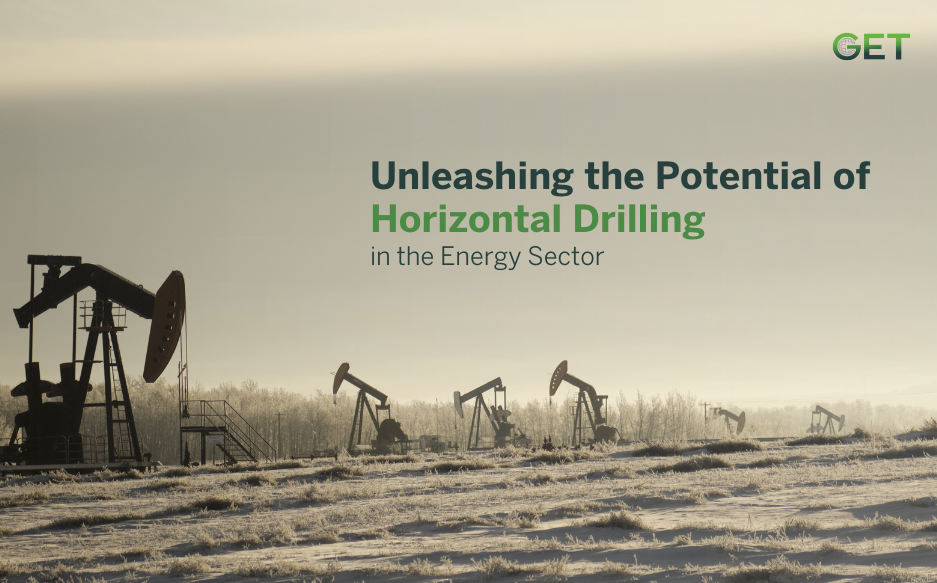
The energy industry is continually changing, with new technology redefining how oil and gas are drilled. One of the greatest advancements of the last few decades is horizontal drilling—a method that has transformed oilfield operations globally. Through the ability to reach more resources with less wells, horizontal drilling has made production more efficient, less costly, and more environmentally friendly.
At GET Global Group, we recognize the significance of utilizing innovative drilling methods to maximize production and sustainability. Through our experience in workforce solutions, training, and technology integration, we assist oilfield operators in adopting the most effective industry practices. In this blog, we will deconstruct what horizontal drilling is, why it is significant, and how it is defining the future of energy production.
Historically, oil and gas wells were drilled vertically—down straight into the ground to access underground reserves. But this was limited, as it could only recover resources immediately below the wellbore.
Horizontal drilling is a game-changer. The operation begins with a vertical well, but after reaching the target depth, the drill bit is slowly rotated to drill horizontally across the rock layer in which oil or gas is sequestered. These horizontal segments, referred to as laterals, may stretch for miles beneath the earth’s surface, greatly expanding the volume of recoverable resources from one well.
| Feature | Vertical Drilling | Horizontal Drilling |
| Well Path | Straight down | Starts vertical, then turns sideways |
| Resource Access | Limited to directly beneath the well | Covers a wider underground area |
| Efficiency | Requires more wells to extract large reserves | Extracts more from a single well |
| Environmental Impact | Higher surface disturbance | Requires fewer drilling sites, reducing footprint |
Horizontal drilling is frequently combined with hydraulic fracturing (fracking), which facilitates the release of oil and gas held captive in tight rock formations such as shale. It has been a game-changer for oil and gas production, particularly in unconventional reservoirs.
The advantages of horizontal drilling extend beyond augmenting production. Let’s take a look at why it’s become the most popular method in the new energy industry:
With a single horizontal well, operators are able to access several pockets of oil and gas distributed across a wide underground tract. This results in operators no longer having to drill several vertical wells, with the benefits being cost savings and increased efficiency.
Certain oil and gas reservoirs, particularly in shale rock, have hydrocarbons tightly trapped within rock layers. Conventional drilling is not effective to bring these resources out, but horizontal drilling enables operators to track the rock layers and recover hydrocarbons that would otherwise be inaccessible.
In a field where going green is more significant every day, horizontal drilling is key to reducing land disturbance. With fewer wells required to pump the same quantities of oil and gas, local ecosystems are not disrupted as much.
Though horizontal drilling does call for cutting-edge planning and technology, in the end it cuts the per-barrel-of-oil cost or cubic-foot-of-gas cost. They reduce drilling activities, meaning smaller infrastructure, workforce, and upkeep costs, yet increase profitability to operations.
Horizontal wells usually operate longer than vertical ones. With greater resources tapped with a single borehole, horizontal wells will extract for decades with minimal decline into depletion.
The effect of horizontal drilling can be observed all over the globe, ranging from the Permian Basin in the United States to the Middle East and Asia. Nations that were once dependent on imports are now becoming energy-independent.
At GET Global Group, we have been working diligently on assisting businesses that make use of horizontal drilling. Through our Integrated Crew Services (ICS) and training initiatives, we assist operators in making sure that field personnel are properly prepared to manage the most advanced drilling technology. Through our LMS platform, we conduct specialized training in drilling practices, safety measures, and industry best practices.
One of our areas of prime interest is making sure Saudi nationals and local workforce are developed to play the critical role of drilling operations. With the transition of the region towards developing the local workforce, our competency-based training expertise is assisting organizations in creating talented teams for contemporary drilling methods such as horizontal drilling.
The technology is leading the future of horizontal drilling. With drilling technologies evolving, firms are seeking how to:
Drill longer laterals – Wells currently reach more than 4 miles below ground level, extracting full production from a single point of entry.
Boost efficiency through automation – Artificial intelligence and machine learning are being adopted in drilling equipment to streamline well paths and cut down on mistakes.
Enhance sustainability – New techniques are being developed to reduce water usage and emissions associated with hydraulic fracturing.
As the industry moves towards more sustainable practices, GET Global Group remains committed to supporting energy companies with workforce training, skilled manpower, and operational support. Our focus is on helping companies adapt to new technologies, ensuring that their teams are well-prepared for the future of drilling.
Horizontal drilling has opened a new frontier in energy production, enabling firms to reach more resources, enhance efficiency, and decrease environmental footprint. The technique has been a crucial tool in current oil and gas production, and with improving technology, it will remain a fundamental component of international energy security.
At GET Global Group, we take pride in being able to serve companies that adopt innovation in drilling technology. With our training solutions, manpower services, and technical expertise, we assist in making sure that the workforce is well-skilled to manage intricate drilling operations.
If your business is interested in improving its drilling operations and workforce capacity, GET Global Group can assist. Call us today to find out more about how we can assist your projects.
Read More- The Complete Guide to Oil & Gas Training Courses in Dubai – 2025
By Get global | October 12, 2026
By Get global | October 9, 2026
Ask any person working night shifts in rigs and compressor stations what holds the industry back, and you will seldom hear anything about geology. Disconnected information, delayed decision-making, and machinery breaking down at the wrong moment – all these factors are more common causes of productivity losses in the industry. […]
By Get global | October 5, 2026
Specialized expertise turns a hard project in the oil and gas industry into a workable one. Every oilfield has its own geology, risks, and surprises. The teams that handle them the operations on field have usually met something similar before. In the modern world, upstream oil and gas companies are […]
By Get global | September 30, 2026
By Get global | September 28, 2026