Nobody in the energy business would describe 2026 as a quiet year.
Between the explosive energy demand triggered by AI infrastructure, oil majors recalibrating their clean energy ambitions under shifting political winds, and storage technology finally delivering on its long-promised potential — it is a year that is forcing every player in the sector to revisit assumptions they thought were settled. Not just about strategy, but about what the next decade actually looks like.
What’s interesting is that disruption in energy rarely looks like a clean revolution. It’s messier than that. Old systems don’t disappear overnight. New ones take longer to scale than the press releases suggest. And the people managing real infrastructure — grids, rigs, refineries, pipelines — are dealing with constraints that analysts in boardrooms often underestimate.
Still, 2026 feels genuinely different. The pace of change has crossed a threshold that’s hard to ignore. And examining the trends shaping this year offers a clearer picture of where the global energy system is actually heading — and how fast.
The energy industry entered 2026 carrying a more complex set of pressures than it faced even three years ago.
The post-2022 energy crisis response — the rush into renewables, the policy momentum, the record investment — had done its job in many ways. Renewable capacity had grown substantially. Storage was being deployed at scale. But new pressures emerged that nobody had fully accounted for.
Artificial intelligence changed the demand equation almost overnight. The buildout of data centers to support large language models, cloud computing, and AI inference workloads created an electricity demand surge that caught grid planners off guard in multiple regions. Utilities that had been planning for modest demand growth suddenly faced requests for gigawatts of new power capacity — fast.
At the same time, the political environment shifted in ways that complicated the energy transition narrative. Policy reversals in some markets, uncertainty around clean energy incentives, and renewed interest in domestic fossil fuel production created a more fragmented global picture than the momentum of 2023 and 2024 had suggested.
That combination — soaring demand, political complexity, and maturing technology — defines the backdrop for the disruptive trends in the energy industry in 2026.
There’s a version of the renewable energy story that gets told as if it’s still a niche movement fighting for credibility. That version has been definitively buried.
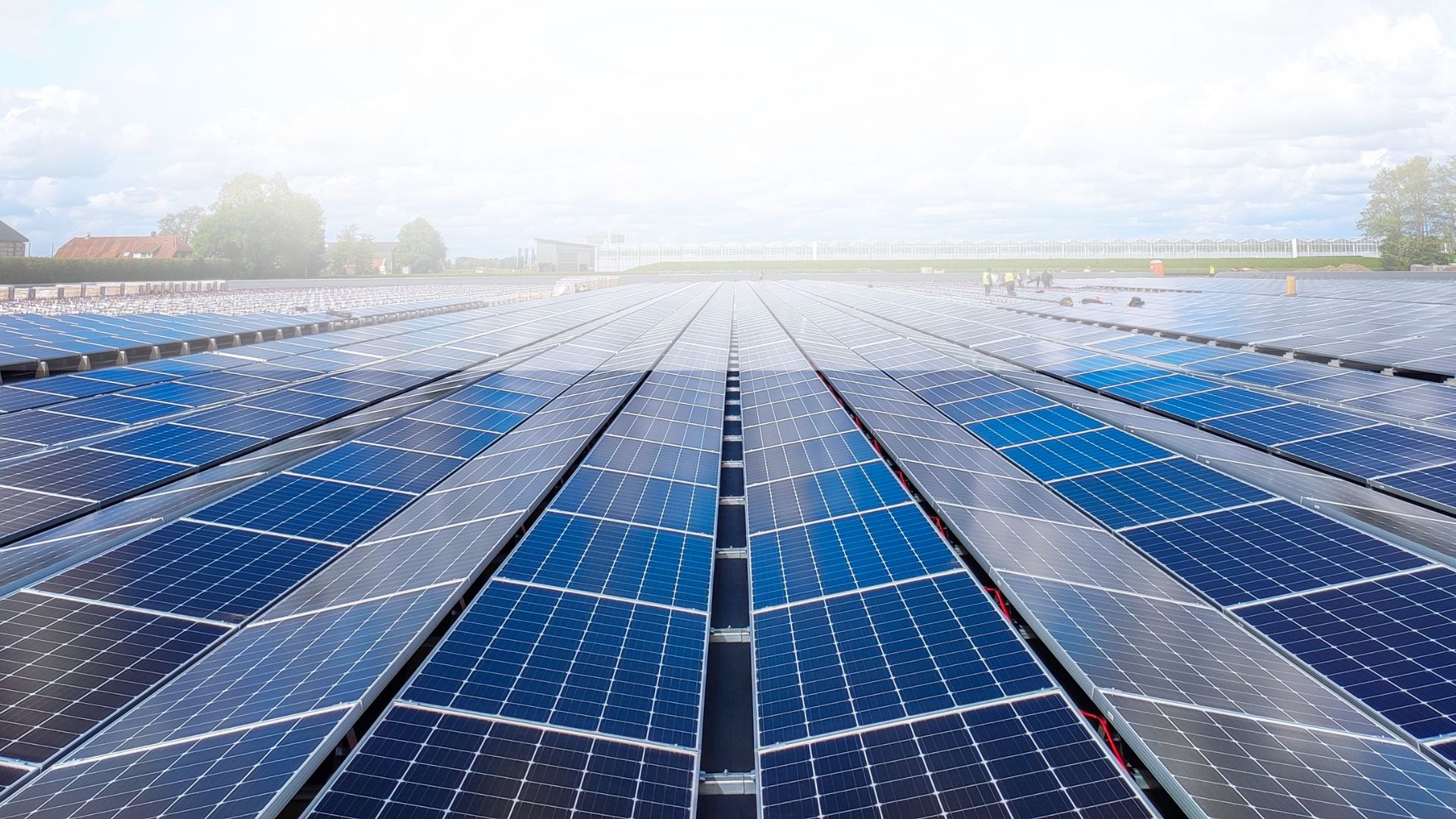
Solar and wind are now the dominant form of new power capacity being added globally. In many markets, the question is no longer whether to build renewables — it’s how to build them fast enough, and how to connect them to grids that weren’t designed for this volume or this geography of generation.
The economics are settled. Building new solar or wind is cheaper than running existing coal in most of the world. Offshore wind, despite facing real headwinds in certain markets — particularly in the United States, where policy support has been inconsistent — continues to expand strongly in Europe and Asia.
Manufacturing is no longer the constraint it once was. Panel and turbine production has scaled. The constraint is now transmission. Grids built for centralized generation from large fossil fuel plants weren’t designed to move electricity from where renewables are most abundant to where people actually live and work. Transmission permitting and construction has become the critical path for the energy transition in several major economies.
That shift in investor psychology — from “will renewables work” to “how do we connect them” — is arguably more disruptive than any technology breakthrough. It means the next chapter of the renewable energy story is as much about civil engineering and regulatory reform as it is about solar panels.
Read Also- How to Start a Career in Renewable Energy in the UAE
For all the excitement around solar and wind, there has always been an honest counterargument: intermittency.
The sun sets. The wind calms. And when that happens, you still need power. For years, critics of renewable energy used this limitation effectively to argue that fossil fuels remained indispensable for grid reliability.
By 2026, that argument has lost most of its practical force.
Battery storage deployment has reached a scale that would have seemed speculative just five years ago. Utility-scale projects storing gigawatt-hours of electricity are now commissioned routinely in the United States, Australia, the United Kingdom, China, and across parts of Africa and Southeast Asia. The economics work without heavy subsidy support in most markets. Lithium-ion costs have fallen further than even optimistic forecasts predicted.
Beyond lithium-ion, longer-duration storage technologies have moved from research settings toward genuine commercial deployment. Iron-air batteries are operating at demonstration scale. Compressed air and gravitational storage have secured financing for utility-scale projects. The conversation has shifted from “will long-duration storage work” to “which technologies will dominate at scale.”
None of this means the intermittency problem is entirely solved. It isn’t. But 2026 has established that it is solvable — and that the industry is solving it faster than its critics anticipated. That matters enormously for the credibility of a fully renewable grid.
This is where the story gets more complicated — and more honest.
The upstream oil and gas industry — the companies and operations responsible for exploration, drilling, and extraction — is navigating a genuinely difficult position in 2026. Demand for oil and gas remains strong, partly driven by the very AI and data center boom that is also accelerating clean energy deployment. Geopolitical dynamics continue to make energy security a priority for major consuming nations. And the political environment in several key markets has become more favorable to continued fossil fuel investment than it appeared it might be two or three years ago.
At the same time, the structural pressure on the sector has not gone away. It has just become more nuanced.
The application of AI, data analytics, and automation in upstream oil and gas has moved well past the pilot stage. In 2026, these tools are operational infrastructure, not competitive advantage — because most serious operators are using them.
Drilling decisions now routinely incorporate machine learning models trained on seismic data, production histories, and real-time sensor inputs. The accuracy of well placement has improved measurably across the industry. Dry holes are less common. Cost per barrel of production has come down.
Autonomous and semi-autonomous drilling systems are broadly deployed. Offshore platforms operate with leaner crews, supported by remote monitoring centers where data engineers and operations specialists watch hundreds of variables simultaneously. What felt like the future in 2021 is simply how things are done now.
Predictive maintenance — using sensor data and algorithms to flag equipment issues before they cause failures — is standard practice. On offshore platforms, where an unplanned shutdown can cost millions of dollars per day and endanger crews, this isn’t a technology investment anymore. It’s risk management.
One of the most consequential shifts in the upstream oil and gas industry over the past few years has been the move from voluntary methane commitments to enforceable accountability.
Satellite monitoring technology reached a level of precision earlier this decade that made it impossible to hide significant methane leaks. The data exposed gaps between what some operators reported and what was actually escaping from their equipment. That transparency created pressure — regulatory, financial, and reputational.
By 2026, methane performance is built into regulatory frameworks in the United States, European Union, and a growing number of other jurisdictions. It is factored into financing decisions by major institutional lenders. And it is a standard component of ESG reporting that investors actually scrutinize.
The companies that responded well to this pressure recognized early that fixing leaks and reducing flaring isn’t just compliance — it’s margin recovery. Gas that isn’t vented is gas that can be sold. The business case was always there. External accountability made it impossible to ignore.
Perhaps the most strategically significant development in the upstream oil and gas industry heading into 2026 is the visible recalibration of how oil majors are approaching clean energy investment.
The expansive clean energy ambitions announced by several major oil companies in 2021 and 2022 have been revised — in some cases significantly. Offshore wind investments were written down. Hydrogen timelines were extended. The pure economics of some clean energy projects, combined with political uncertainty around long-term policy support, caused boards to pull back.
What’s replaced the earlier, broader diversification is something more focused. Companies are concentrating on clean energy applications that directly complement their existing capabilities — carbon capture and storage at scale, blue hydrogen from natural gas, and in some cases biofuels and low-carbon fuels for hard-to-abate sectors.
This isn’t a retreat from the energy transition. It’s a more honest reckoning with where oil and gas companies can genuinely create value within it, rather than simply following the momentum of a bull market in clean energy announcements.
The disruptive trends in the energy industry in 2026 cannot be discussed without confronting something that didn’t register as a major factor just three years ago: AI has become one of the largest drivers of energy demand growth, while simultaneously being one of the most powerful tools for managing energy systems.
That tension is real, and it’s unresolved.
Data centers supporting AI workloads are being built at a pace that is straining grid capacity in multiple regions. Technology companies have signed power purchase agreements of a scale that would have been unusual even for large industrial facilities. Some are commissioning dedicated generation — including, notably, small modular nuclear reactors — to guarantee the baseload power their operations require.
At the same time, AI is doing more useful work inside the energy system than ever before.
Grid operators are deploying AI systems that balance networks incorporating millions of distributed energy resources — rooftop solar, home batteries, EV chargers, smart appliances — in real time. Energy forecasting has become dramatically more accurate. Industrial facilities are cutting consumption by 20 to 30 percent through AI-driven energy management. Cybersecurity in grid infrastructure relies heavily on AI anomaly detection as attack surfaces expand.
The net effect of AI on the energy system in 2026 is genuinely difficult to calculate. It is adding demand. It is also enabling more efficient supply. Whether the efficiency gains outpace the consumption growth is a question the industry is actively working through.
Read Also- From Automation to AI: How the Latest Oil-Rig Technologies Are Transforming Upstream Energy
Green hydrogen had been talked about seriously for the better part of a decade before the mid-2020s. The conversations were often compelling. The large-scale results were often disappointing.
The picture in 2026 is one of real but uneven progress.
Electrolyzer costs have continued to fall. Several large green hydrogen projects that were announced in 2022 and 2023 have reached final investment decision or begun construction. Industrial end-users in steel production and maritime shipping have made procurement commitments that give developers the revenue certainty they need.
But the challenges haven’t dissolved. Green hydrogen remains expensive compared to fossil alternatives in most applications. The infrastructure needed to transport and store it at commercial scale is still being built — and that buildout is slower and more expensive than early projections suggested. The energy losses involved in producing, compressing, and eventually using hydrogen mean it will never be the right answer for every decarbonization challenge.
Where green hydrogen is making genuine headway in 2026 is in the specific applications where direct electrification is genuinely difficult. High-temperature industrial heat, long-haul maritime shipping, and certain chemical feedstocks are areas where the alternatives are limited and the case for hydrogen is strongest. Progress there is meaningful, even if the broader hydrogen economy remains years from maturity.
One of the most notable shifts in energy industry thinking between 2023 and 2026 is the rehabilitation of nuclear power as a credible part of the solution.
This isn’t your grandfather’s nuclear debate. The conversation has moved on from the large, multi-decade, multi-billion-dollar construction projects that defined — and often disappointed — previous generations of nuclear development. The focus in 2026 is on small modular reactors: smaller, factory-manufactured units that promise faster build times, lower upfront capital requirements, and greater deployment flexibility.
Several SMR projects have moved from concept to permitting to early construction. Technology companies, attracted by the combination of firm baseload power and zero carbon emissions, have signed agreements to offtake power from SMR projects. Governments in North America, Europe, and parts of Asia have provided regulatory and financial support.
Whether SMRs will deliver on their promise — on cost and schedule — remains to be seen. The history of nuclear cost overruns is long. But the level of serious investment and policy support behind SMRs in 2026 is qualitatively different from what existed even three years ago.
Energy policy has always lagged behind technological reality in some places and overshot in others. In 2026, the global picture is more fragmented than the momentum of 2023 and 2024 suggested it would be.
In the United States, clean energy incentive policy has faced uncertainty. Some provisions of earlier legislation have been challenged or modified. Permitting reform has been politically contentious. The result has been a more complex investment environment, even as the underlying economics of clean energy projects remain attractive.
In Europe, the direction has been clearer. The Carbon Border Adjustment Mechanism has become operational, creating real carbon costs for goods imported from markets without equivalent carbon pricing. Renewable deployment targets remain ambitious and broadly supported. Methane and building efficiency regulations have tightened.
Across Asia, the picture varies enormously by market. China continues to dominate global renewable manufacturing and deployment. India is scaling clean energy at pace. Smaller emerging markets are building decentralized solar and storage systems that are in some cases leapfrogging grid infrastructure entirely.
The overall trajectory of global energy policy in 2026, despite the fragmentation, still points toward decarbonization. The pace is uneven. The politics are complicated. But the direction is not seriously in question.
Perhaps the most important insight from watching the energy industry in 2026 isn’t about any single technology or policy trend. It’s about the relationship between the existing energy system and the one being built alongside it.
The upstream oil and gas industry and the clean energy sector are not simply opponents in a political argument. They share engineering talent, subsurface expertise, offshore construction experience, and — critically — capital. The skills required to manage a complex offshore oil platform are not entirely different from those needed to build and operate an offshore wind farm. The geological knowledge needed for oil exploration is directly applicable to carbon capture and storage siting.
What 2026 is clarifying is that this complementarity is real, but the transformation is harder and slower than the optimistic version of the story suggested. Companies that made broad clean energy pivots in 2021 and 2022 have had to recalibrate. Companies that ignored the transition entirely are facing a different set of problems. The ones navigating this most effectively are those that have been honest about where their actual capabilities create value in a lower-carbon energy system.
The energy transition doesn’t require the destruction of the existing industry. It requires its transformation. That transformation is difficult, uneven, and politically fraught. But it is underway — and by 2026, the shape of it is clearer than it has ever been.
Looking at 2026 with honesty, the picture is one of genuine progress alongside real complexity — and some humbling corrections to earlier assumptions.
Renewable energy has won the economic argument. Storage is scaling. AI is reshaping operations across the entire value chain. The disruptive trends in the energy industry are real, measurable, and accelerating. The upstream oil and gas industry has demonstrated that it can adapt — technologically and strategically — even under sustained pressure.
But the energy system is also more strained than many expected it to be at this point. Demand is growing faster than anticipated. Grid infrastructure has not kept pace. Policy uncertainty has slowed investment in some markets. And the distributional challenges — who bears the cost of the transition, who gains access to clean energy first — remain inadequately addressed.
What 2026 is demonstrating, ultimately, is that the energy transition is neither a straight line nor a guarantee. It depends on sustained investment, regulatory competence, technological execution, and a willingness to make decisions that prioritize the long term over the politically convenient short term.
That has always been the hard part. And it remains so.
By Get global | September 14, 2026
Ten years back, most HSE policies stopped at the company gate. Whatever happened past that point, subcontractors, transport, equipment vendors, was technically someone else’s problem, at least on paper. Not anymore. And the reason is blunt: trace a serious incident back far enough, and often it started somewhere in the supply chain, not […]

By Get global | September 14, 2026
Health, safety and environment in the oil and gas sector was long treated as a back-office function, running quietly alongside the core work of drilling, extraction, and processing. That is no longer the case. Extreme pressures, volatile materials, remote sites, and heavy machinery mean the risk in this industry has […]

By Get global | September 14, 2026
By Get global | September 9, 2026
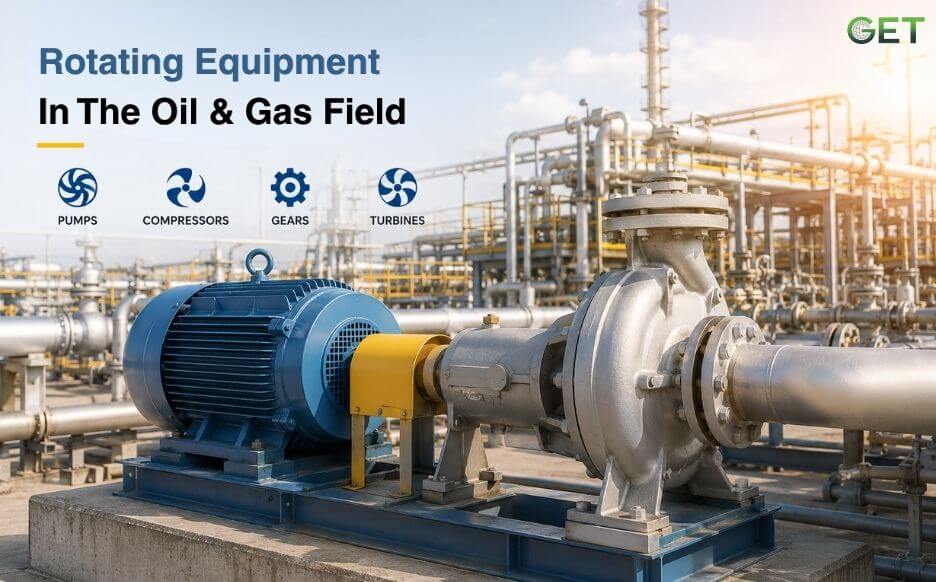
Walk onto any rig floor, production platform, or gas processing plant, and the first thing you notice isn’t the pipework – it’s the sound. That low, constant hum coming from somewhere in the facility is almost always rotating equipment doing its job. Pumps pushing fluid through miles of pipeline. Compressors […]

By Get global | September 9, 2026