One of the most important operational dependencies in oil fields is power generation. Starting drilling rigs and artificial lift systems to control rooms and worker accommodation, continuous power is needed in terms of safety, output, and the reliability of the assets. Conventionally, the upstream and midstream oil activities have relied on diesel generators as the main source of power because of their reliability and portability in inaccessible areas.
Nevertheless, increasing fuel prices, straitening of emissions rules and increasing demands on sustainability are driving operators to seek more efficient options. This is where hybrid solar-diesel power systems are infiltrating. Using solar photovoltaic (PV) generation with backup power that runs on diesel will enable oil field operators to minimize the use of fuel, reduce emissions, and stabilize the costs of energy without affecting the reliability of the operations.
This article explains what a hybrid solar-diesel power system is, how it works in oil field environments, its components, operational logic, benefits, challenges, and real-world applications in the oil and gas sector.
A hybrid solar-diesel power system is essentially a method of ensuring that power is always available in remote locations without necessarily relying on diesel. The system does not operate with generators operating 24 hours, but rather introduces solar panels into the system such that during the day, the majority of the work is performed by the sun. In the evening, when there is no sun, or in cloudy seasons or when the demand surges suddenly, the diesel generators automatically fill the load. Operationally, it is smooth sailing. Machines continue working, the lights remain on and there is no immediate power shut-off.
Power in oil fields is hardly in a clean or predictable pattern. Things sometimes are stable one hour and the next hour the pumps, compressors, or drilling machinery may cause the demand to exceed expectations. Dust, heat, long runs to the supply points, and minimal infrastructure are added to this, and you begin to understand why power systems in such locations have to be constructed differently. Hybrid structures are intended to deal with such uncertainty. In case the solar output is reduced due to dust taking over panels or a phase of cloudy weather, the diesel side does not wait until an issue occurs. It interferes before operations can even sense the difference.
Most systems installed on field sites tend to share a few common traits. These aren’t design choices made on paper alone. They usually come from lessons learned after years of running generators in difficult environments.
One thing that often gets misunderstood is that hybrid systems are not about removing diesel generators completely. That rarely makes sense in oil field conditions. Diesel remains the safety net, especially at night or during heavy operations. The real shift happens in how often those generators run.
They do not run all day as they used to be done, but only when they are needed. In months and years, such a transformation will accumulate in terms of fuel saved, maintenance minimized, and the logistical hassles associated with transporting diesel over long routes are also reduced.
Why Oil Fields Are Ideal Candidates for Hybrid Power Systems
If there’s one place where hybrid power actually makes practical sense, it’s an oil field. Most sites are far from any reliable grid connection. Some are days away from the nearest town. Power isn’t optional out there, and neither is reliability. That combination alone makes traditional diesel-only setups expensive and inefficient over time.
Moving diesel to a field site is rarely simple. It usually means long-haul trucks across rough terrain. In some cases, barges or even helicopters. Every delivery costs money, time, and risk. Roads get washed out. Weather causes delays. Security can become an issue in certain regions.
When solar handles part of the daily load, fuel deliveries don’t need to happen as often. That doesn’t just lower fuel bills. It reduces transportation pressure and the operational stress that comes with relying entirely on supply chains.
Oil field equipment doesn’t work nine to five. Pumps run continuously. Compressors maintain pressure. Monitoring systems stay active 24 hours a day. Even worker accommodations, lighting, and safety systems draw steady power.
Hybrid systems fit naturally into that rhythm. Solar covers daytime demand when the sun is available. Batteries smooth things out. Diesel steps in when required. The site stays powered without forcing generators to run at low, inefficient loads all day.
Environmental scrutiny around oil and gas operations isn’t slowing down. In many regions, emission reporting is no longer optional. Operators are expected to show measurable reductions where possible.
Hybrid power isn’t a marketing gesture. It’s a practical way to cut fuel burn and lower emissions without risking uptime. That balance matters in an industry where production cannot pause simply to meet environmental targets.
Yes, hybrid systems cost more upfront. Solar arrays, storage systems, control hardware, integration work. None of that is cheap. But diesel-only systems quietly accumulate costs over time. Fuel, transport, engine wear, maintenance cycles.
When generators run fewer hours and under better load conditions, they last longer. Service intervals stretch out. Fuel consumption drops. Over several years, those differences become significant. For long-life wells or permanent installations, the math often starts to lean toward hybrid without much debate.
At the end of the day, oil fields need power that is dependable first, efficient second. Hybrid systems manage to do both.
When people hear “hybrid power system,” it sounds complex. On site, it’s actually a combination of familiar equipment working together in a smarter way. You still see generators. You still see electrical panels and cabling. The difference is that solar and storage are added into the mix, and everything is coordinated instead of running independently.
Here’s what typically makes up the system.
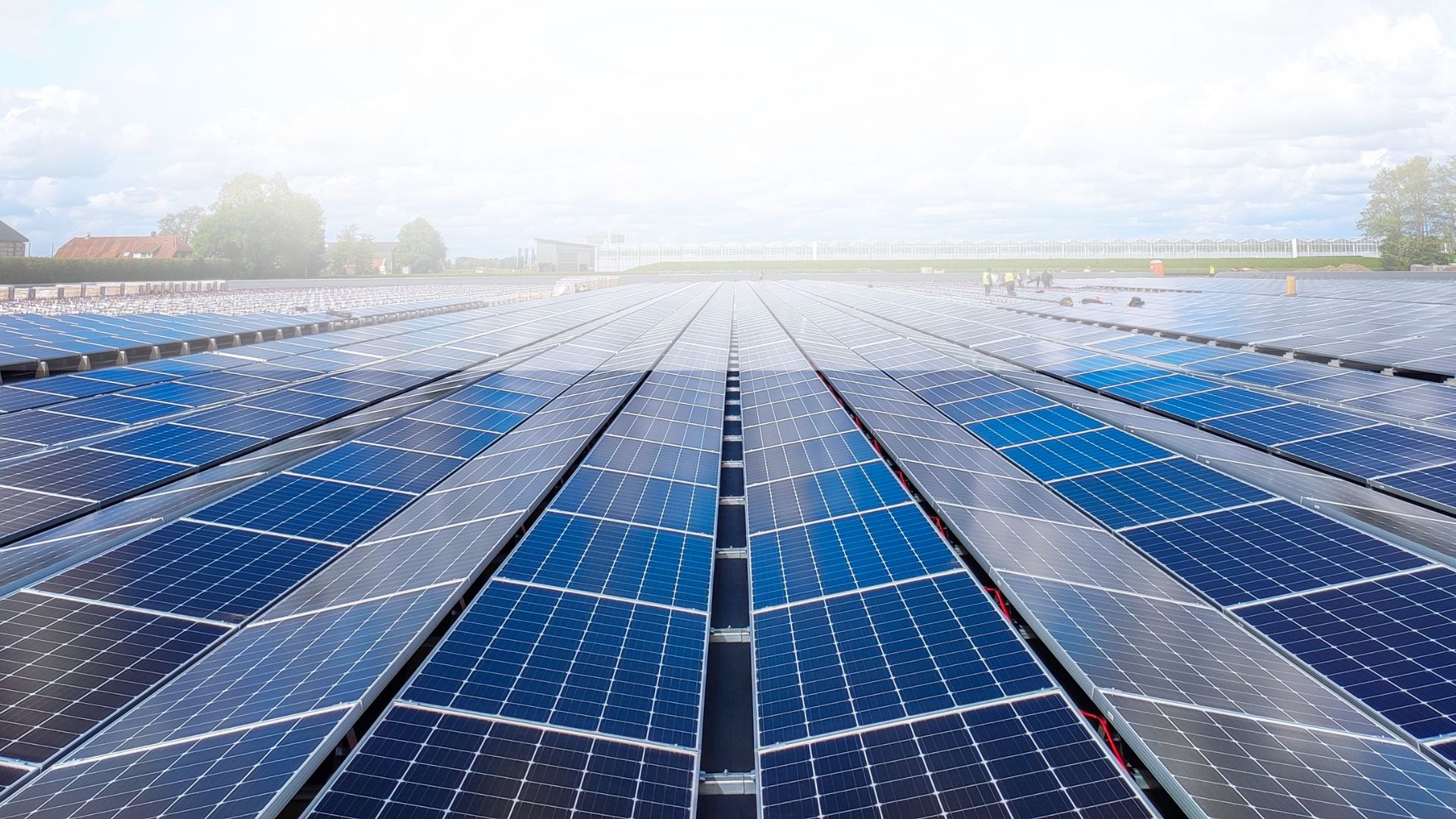
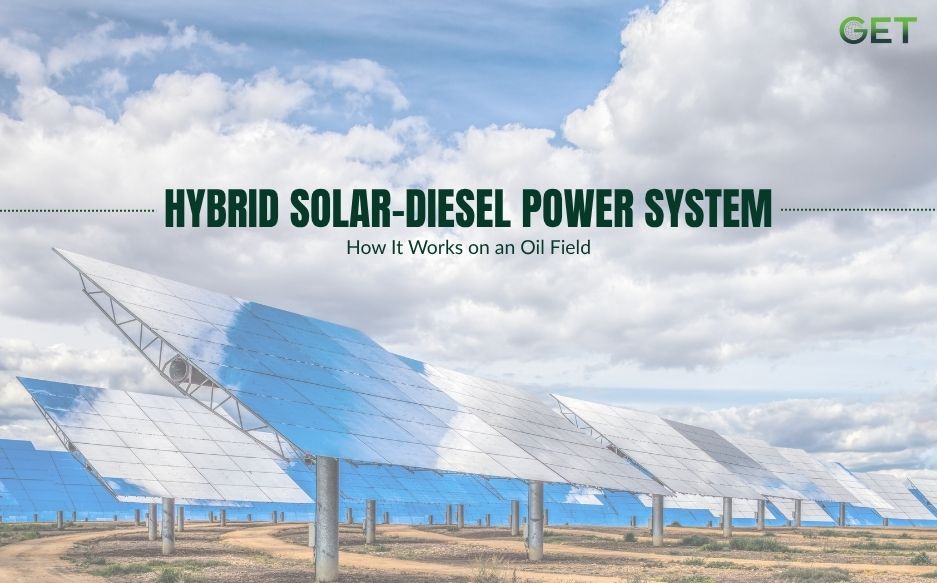
The panels are usually the first thing you notice when you enter a hybrid-powered site. Rows of modules mounted on steel frames, often positioned wherever space allows. In oil fields, they are not there for show. They are sized based on how much power the site actually consumes during the day.
During sunlight hours, they take over a significant share of the load. Pumps, lighting, control rooms, and support systems can run directly on solar as long as production is steady.
On most sites, solar panels help:
The exact array size depends on daily consumption and how much sunlight the location realistically gets, not theoretical peak values.
Generators are still the backbone of field power. No operator removes them. Hybrid does not mean diesel-free. It simply means diesel is no longer running by default.
At night, or when the sky turns overcast, generators step in. They also handle heavier loads when equipment demand increases suddenly.
In a hybrid setup, generators are used more strategically:
Instead of idling at 30 or 40 percent load all day, they run when needed and often at healthier operating levels. That alone improves lifespan.
The system itself has a feeling of stability other than responsiveness, which is caused by batteries. The system would be constantly changing between solar and diesel with each change in demand without storage.
The batteries are charged in the day with excess solar power. The stored energy is then later used at a time when solar is not available and a generator is not required to be started.
On oil field sites, batteries typically:
Most projects today use lithium-ion systems because they are compact and easier to manage in remote conditions.
If the system has a brain, this is it.
The controller monitors load demand, solar production, battery charge levels, and generator status. It decides what should run and when. No manual switching. No guessing.
Its day-to-day job usually involves:
Some advanced systems factor in load history or weather forecasts. Others simply react in real time. Either way, the goal stays the same: keep the site powered without wasting fuel.
Solar panels produce DC power. Most oil field equipment runs on AC. That conversion has to happen smoothly, or equipment can trip offline.
Inverters handle that conversion and make sure power from solar, batteries, and generators is synchronized properly.
Their role includes:
They rarely get attention, but without them, hybrid systems simply would not function.
Remote oil fields don’t allow for constant physical oversight. Operators need visibility without being on site every hour.
Modern hybrid systems include monitoring platforms that show:
Remote access helps teams respond early instead of reacting after a shutdown happens.
When you look at it practically, a hybrid solar-diesel system isn’t about replacing equipment. It’s about coordinating what’s already there with additional energy sources. Solar carries what it can. Batteries steady the flow. Diesel fills the gaps. The controller keeps everything aligned.
That balance is what makes the system workable in oil field conditions where uptime is non-negotiable.
On paper, the system looks like a clean flowchart. In the field, it’s more like a constant balancing act. Loads change. Weather changes. Equipment starts and stops without warning. The system just keeps adjusting in the background so operations don’t feel any of it.
Here’s what typically happens over a normal day.
Once the sun is up, the panels start producing power. That electricity goes straight into whatever is running at the time. Pumps, compressors, monitoring systems, lighting in work areas. There’s no dramatic switch. Solar just begins carrying the load quietly.
If production from the panels is higher than what the site needs at that moment, the extra energy doesn’t go to waste. It moves into the batteries.
Loads on an oil field aren’t perfectly steady. A motor kicks in. A compressor ramps up. Something shuts down. Those small shifts happen all the time.
The batteries take over the task of firing up a generator every time there is a slight demand increase in a few seconds. When there is too much energy they absorb it and when there is a brief spike they give it out.
That’s what keeps the system from constantly starting and stopping generators. It makes everything feel stable, even when demand isn’t.
Cloud cover rolls in. Dust builds up on panels. Or maybe the site suddenly draws more power than solar can supply.
When that happens, the diesel generator starts automatically. No one has to run outside and switch it on. The control system identifies the deficit and switches diesel on before issues of low voltage occur.
In an efficient design, the generator does not operate inefficiently at low load. It is more healthy, doing productive work rather than wasting time.
When daylight fades, solar output drops off completely. At that point, the system leans on the batteries first. If the batteries have enough stored energy, they’ll carry the site for a while.
Once the battery charge falls to a certain level, the generator starts and takes over the heavier load. The transition is automatic. From the perspective of the equipment on site, nothing changes. Everything keeps running.
There isn’t a single moment where the system stops and resets. It’s constantly adjusting. Solar output rises and falls. Load demand shifts. Batteries charge and discharge. Generators start and stop when required.
The control system watches all of it in real time and redistributes power accordingly. The goal is simple. Use as much solar as possible. Use batteries to reduce unnecessary cycling. Use diesel only when needed.
Over time, that quiet coordination is what reduces fuel burn and wear on equipment without affecting production.
From an operator’s point of view, the best hybrid system is the one you don’t notice. Power stays steady. Equipment doesn’t trip. And diesel tanks empty more slowly than they used to.
Hybrid systems must support a wide range of operational equipment.
These systems require stable high-power output.
Artificial lift methods such as electrical submersible pumps (ESPs) require a consistent power supply.
Hybrid systems help reduce generator dependency while maintaining operational stability.
Gas compressors require reliable continuous power to maintain pressure levels.
Hybrid power supports steady operations with reduced emissions.
Worker camps and safety lighting consume significant energy, especially at night.
Battery storage supports these loads efficiently.
SCADA and safety systems must remain operational at all times.
Hybrid systems ensure uninterrupted functionality.
Hybrid solar-diesel systems are not theoretical anymore. They’re already being used in places where running only on diesel started becoming too expensive, too inefficient, or just too difficult to manage long term.
You won’t see the same setup everywhere. Each site looks a little different. But certain types of operations tend to benefit more than others.
Early-stage exploration projects are often set up in areas with almost no infrastructure. Temporary camps. Mobile drilling units. Limited access roads.
In those situations, every liter of diesel has to be hauled in. Sometimes across rough terrain. Sometimes over long distances.
Adding solar to the mix means generators don’t need to run continuously during the day. Even a partial offset makes a difference. Fewer deliveries. Less fuel storage pressure. Lower noise around camp during working hours.
For exploration teams, that alone can justify the shift.
Pipeline monitoring stations usually don’t have massive loads. But they do need consistent power. Monitoring equipment, sensors, and communication systems. These can’t go offline.
Because the load is moderate and steady, solar handles a good portion of it during the day. Batteries cover transitions. Diesel remains there as backup.
In many cases, hybrid systems reduce how often someone needs to visit the station just to refuel or service a constantly running generator. That saves time and reduces maintenance rounds.
Remote oil wells using electrical submersible pumps or other lift systems draw consistent power. Traditionally, that meant generators running almost full time.
With hybrid setups, solar covers daytime base load, while diesel supports peak demand and nighttime operation. The pump doesn’t care where the power comes from. It just needs stability.
Over months, the reduction in generator runtime becomes noticeable. Fuel usage drops. Service intervals stretch out. And in remote wells, that has a measurable financial impact.
Offshore installations are a different environment entirely. Space is limited. Conditions are harsher. But fuel efficiency matters even more.
Some offshore facilities now integrate hybrid microgrids to support auxiliary loads. The solar power will not be able to substitute the main power production, but it will be able to cover some part of the load during the daytime.
Even minor decreases in the strain of generators offshore can enhance the total fuel efficiency and operational reliability. Incremental gains are important when the logistics are complicated, and the cost of downtime is high.
In most cases, hybrid systems are not about making headlines. They’re about small, practical improvements. Less fuel moved. Fewer generator hours. Smoother operations. Over time, those small changes add up in oil and gas environments where uptime is non-negotiable.
Proper design is critical to ensure optimal system performance.
Engineers must calculate:
Accurate load profiling ensures proper system sizing.
Site-specific solar potential must be analyzed.
Factors include:
Battery capacity must support:
Oversizing increases cost, while undersizing reduces reliability.
Existing generators must be integrated efficiently.
Key considerations include:
Oil field conditions can be harsh.
Systems must withstand:
Ruggedized equipment is essential.
Read Also- A deep dive on Hybrid Solutions in the energy industry – Including challenges and opportunities
Hybrid systems make sense on paper. In reality, they come with trade-offs. They are not plug-and-play solutions, especially in oil field environments where nothing is simple.
Here’s where most projects face friction.
The first shock is usually the upfront cost.
You’re not just adding panels. You’re adding:
Compared to simply installing another diesel generator, hybrid systems look expensive at the start. That’s the reality. The savings show up later, not immediately. For short-term projects, the numbers don’t always work. For long-life assets, they usually do.
This is where things can go wrong if the project isn’t handled properly.
You’re asking solar panels, batteries, and generators to behave like one coordinated system. That requires careful synchronization. Voltage, frequency, load response — all of it has to line up.
If integration isn’t done correctly, you can see:
Hybrid power is less about installing hardware and more about making everything communicate properly. That’s where experienced engineering teams matter.
Solar panels don’t have moving parts, but that doesn’t mean they’re maintenance-free.
In dusty oil field conditions, panels lose efficiency quickly if they aren’t cleaned. A thin layer of dust can quietly reduce output over time.
Battery systems also need oversight. Temperatures must be monitored. Charge cycles tracked. Connections inspected. It’s not heavy maintenance, but it’s not something you ignore either.
Solar arrays need physical space. There’s no way around that.
Some oil field sites have room to spare. Others are tightly packed with equipment, storage tanks, access roads, and safety zones. Finding usable space for panels can become a design challenge.
Sometimes that means creative layouts. Sometimes it means accepting smaller solar capacity than originally planned.
Hybrid systems absolutely work. But they’re not magic solutions. They require planning, proper integration, and realistic expectations. When those pieces are handled well, the benefits show up over time. When they’re rushed, the weaknesses show up just as quickly.
Hybrid energy technology continues to evolve rapidly.
Future systems will integrate multiple renewable sources into centralized energy networks.
This improves flexibility and resilience.
Artificial intelligence will improve energy prediction and system control.
Benefits include:
Modular hybrid systems allow flexible deployment across multiple sites.
They reduce installation time and improve scalability.
Beyond solar, future hybrid systems may incorporate:
Read Also- Career Opportunities in Drilling and Exploration
Hybrid solar-diesel systems aren’t some futuristic concept anymore. In many oil fields, they’re simply becoming a sensible adjustment to how power is managed. Diesel still does the heavy lifting when needed, but solar takes pressure off during the day. Over time, that means less fuel burned, fewer generator hours, and lower emissions without compromising production.
As fuel costs fluctuate and environmental expectations tighten, operators are being pushed to look at power differently. Not because it sounds good in a report, but because it affects budgets and long-term field performance. Hybrid setups are starting to show up more often in remote installations for that reason. They help sites run steadily while trimming avoidable inefficiencies.
They are not flawless and they cannot fit into all short-term projects. However, in places where wells are supposed to yield over time, the change is rational. Designed correctly and with discipline, hybrid systems cause no noise as they create less strain on equipment and logistics. Ultimately, it is not so much about pursuing sustainability headlines but about how to conduct oil field operations in a manner that are more difficult to disrupt and more easily maintained.
By Get global | April 3, 2026
Introduction The energy sector has never been short of ambition and neither are the people who power it. Career opportunities in drilling and exploration remain some of the most dynamic, well-compensated, and technically rewarding paths available in the global workforce today. Whether you are a recent graduate or a mid-career […]
By Get global | April 2, 2026
Introduction There is no question that AI is revolutionizing the upstream oil and gas industry. From exploration and drilling to production monitoring, artificial intelligence is changing how energy companies operate at every level. The results are faster decisions, lower costs, and safer work environments. For any business still relying on […]
By Get global | March 25, 2026
The Middle East has forever been the heart and soul of the oil and gas industry. In this day and age, the technology is advanced and ever-changing; the Middle East is also evolving. Not just by production but also innovation, diversification and investment in the workforce. As the global landscape […]

By Get global | March 25, 2026
Upstream oil and gas has never been casual work. You deal with formation pressure that does not forgive miscalculations. You operate equipment that weighs hundreds of tons. You manage projects where a few hours of downtime can cost more than a year of someone’s salary. In 2026, what’s changing is […]
By Get global | March 18, 2026
The Middle East has always been the heartbeat of the global energy industry. It holds some of the world’s largest oil and gas reserves. And for decades, it has attracted investment from every corner of the globe. But the landscape is changing. Fast. Today, oilfield service providers operating in this […]