In the energy industry, every single hour really matters. Whether you’re drilling an exploratory well or rolling out a large-scale development project, how efficiently you operate can make or break your timelines, production goals, and overall profits. Unfortunately, even with meticulous planning and hefty investments in technology, unexpected delays still plague drilling performance around the globe.
For companies in the upstream oil and gas sector, cutting down on downtime isn’t just about boosting productivity; it’s also crucial for staying competitive.
At GET Global Group, we’ve firsthand insight with operators, contractors, and project teams on complex energy projects across various regions. This experience has given us valuable insights into the operational challenges that affect drilling performance. One of the most stubborn issues being Non-Productive Time (NPT) during drilling, which can lead to skyrocketing costs if not handled properly.
While some delays are simply unavoidable, many can be prevented. By understanding the root causes and finding ways to minimize them, one can significantly enhance both operational performance and project results.
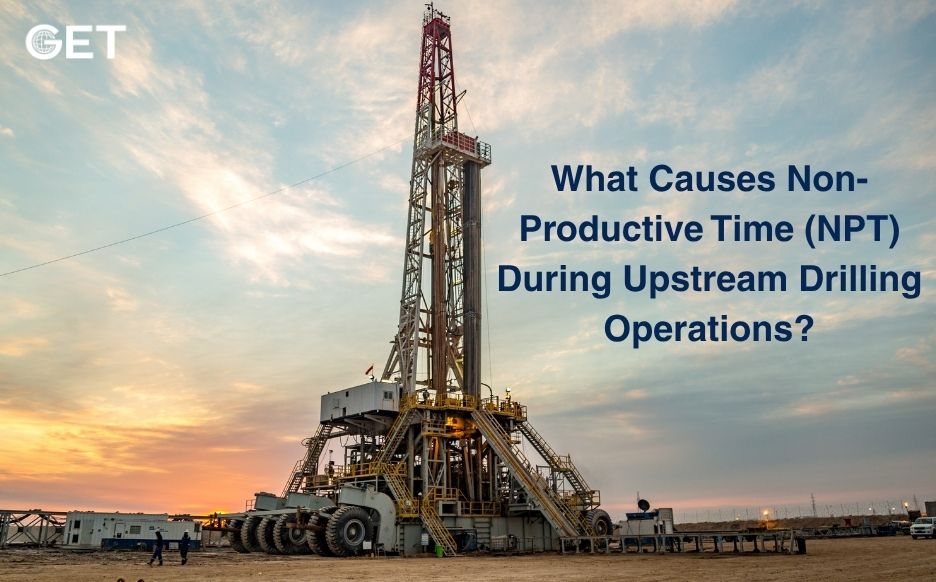
Non-Productive Time, commonly referred to as NPT, describes any period during a drilling operation when progress towards the planned objective stops unexpectedly. The rig remains active, crew is on site, and equipment is available, yet the well is no longer advancing because of a production interruption.
These interruptions can last several days depending on the complexity of the issue. A failed mud pump, stuck drill string, delayed equipment delivery, unexpected formation pressure, or severe weather event can all bring drilling activities to a temporary halt.
For large-scale oilfield operations, these interruptions further extend beyond the immediate cost of idle equipment. They influence resource allocation, project schedules, contractor availability, production forecasts, and ultimately the commercial viability of the project.
Industry studies estimate that NPT can account for 15–25% of total drilling time in some projects, making it one of the most significant cost drivers in drilling operations. While the exact percentage varies depending on location, complexity of the well, and operational maturity.
Over the past decade, the nature of drilling has changed considerably. Companies in the oil and gas sector are now exploring deeper reservoirs, harsher offshore environments, unconventional formations, and technically demanding wells that have greater precision than ever before.
At the same time, stakeholders expect projects to be delivered on schedule, with complete safely, and within constrained budgets.
This shift places huge emphasis on drilling optimization. Rather than measuring success solely by drilling speed, companies are now evaluating the entire drilling process from planning, strategizing and mobilisation to execution and well completion. Not limited to this, but also looking for ways to improving the system.
Reducing NPT is central to this approach because every unnecessary interruption affects various aspects of production.
The consequences include:
For project managers, drilling engineers, and operators, the objective is not simply to respond quickly when downtime occurs, but to build operational systems that reduce the likelihood of these disruptions occurring in the first place.
Read Also- Top Supply Chain Challenges Facing Upstream Oil & Gas Companies and How to Overcome Them
There is rarely a single reason for downtime. However, NPT is typically a result of a combination of inter-related operational, technical and logistical factors.
Grasping the root causes of the same allows oil and gas companies to move beyond reactive problem solving to long-term operational improvement.
Equipment failure remains one of the most common reasons for losing valuable rig time. The reality is simple – when a critical component stops working, the entire production operation comes to a halt until the issue is resolved.
We at GET Global Group, have seen situations where something as straightforward as a mud pump failure has made the entire operations process come to a halt. This is exactly why equipment reliability continues to sit high on the list of oil and gas drilling challenges. The repair itself is only one part of the problem. Delays affect crew schedules, equipment utilisation, project timelines and, ultimately, the overall cost of the well.
That’s also why many operators have changed the way they approach maintenance. Instead of servicing equipment only at fixed intervals, they’re using predictive maintenance to understand how equipment is performing while it’s still in operation. Sensors tracking vibration, pressure, temperature and other operating conditions help maintenance teams identify unusual patterns before they become major failures.
It won’t prevent every breakdown, but it does give operators more time to act. Over the course of a drilling campaign, those early interventions can significantly reduce unplanned downtime across upstream drilling operations.
No matter how much effort goes into planning a drilling campaign, the subsurface has a knack for throwing curveballs. Before the drill even hits the ground, operators pour their energy into seismic surveys, geological studies, and reservoir modeling to get a grip on what lies beneath and to map out the well. These insights are absolutely vital, guiding everything from the well’s trajectory to the choice of drilling fluids and equipment.
Yet, even with all that preparation, the underground conditions can still surprise you.
It’s pretty common for drilling teams to stumble upon unexpected pressure zones, fractured formations, unstable shale, or faulted areas that didn’t quite make it onto the radar during the planning phase. When that happens, operations often hit the brakes while engineers take a closer look and figure out the safest path forward. Sometimes, they tweak the drilling parameters; other times, they might have to overhaul parts of the well plan entirely.
Thanks to real-time logging, formation evaluation, and continuous downhole data, engineers can piece together a clearer picture of what’s unfolding as drilling moves ahead. This kind of visibility allows for quicker adjustments, helps minimize uncertainty, and keeps a small hiccup from spiraling into a much longer delay.
A stable wellbore is extremely crucial for maintaining drilling efficiency from spud to completion. However, changing formation characteristics, reactive shale, excessive pore pressure, or mechanical stress can cause the wellbore to deteriorate unexpectedly.
When this happens, drilling teams may experience problems such as:
Each of these events has the potential to stop drilling entirely while corrective measures are implemented.
Recovering a stuck drill string, for example, often requires fishing operations or side-tracking the well—both of which add significant cost and extend project schedules.
These issues continue to rank among the most expensive oil and gas drilling challenges faced by operators globally.
Reducing wellbore instability begins long before drilling starts. Careful well planning, appropriate mud system design, continuous monitoring of drilling parameters, and experienced workforce all contribute to maintaining borehole integrity throughout the operation.
Technology has certainly revolutionized the drilling industry, but at the end of the day, it’s the people who make the crucial decisions that ensure operations run smoothly and safely.
Even the most advanced automated rigs depend majorly on the expertise of seasoned drilling engineers, supervisors, HSE professionals, mud engineers, logistics teams, and field crews who work together at every step of the process.
There are many factors that can throw a wrench in drilling operations, some of which include communication breakdowns, slow decision-making, deviations from established procedures, and a lack of proper training.
Even small oversights, like not reporting unusual drilling parameters in a timely manner or miscommunication during shift changes, can lead to frustrating downtime.
As oilfield production operations grow more intricate, companies are beginning to understand that having skilled manpower is just as vital as having advanced technology.
Leading operators are now heavily investing in:
These initiatives are strengthening decision-making under pressure while creating a culture where potential issues are identified before they become operational problems.
Not every drilling delay is originated at the rig.
In many cases, interruptions begin hundreds, or even thousands of kilometres away.
A delayed shipment of casing, drilling chemicals, specialised tools, replacement equipment, or critical spare parts can leave an entire drilling crew waiting despite everything else being ready to proceed.
This challenge becomes even greater in remote locations where supply routes are limited and transportation windows are heavily influenced by weather, customs procedures, or vessel availability.
Efficient logistics have therefore become a strategic advantage in modern upstream oil and gas projects.
Successful operators integrate procurement, warehousing, transportation, inventory management, and project planning into a single operational framework.
Instead of reacting to shortages after they occur, project teams increasingly use digital supply chain platforms that provide real-time visibility into material availability and shipment status.
This level of coordination significantly reduces the likelihood of avoidable delays and supports more consistent drilling optimization throughout the project lifecycle.
Drilling operations have to navigate some of the toughest environments on the planet, which sets them apart from many other industries.
Offshore sites regularly deal with choppy waters, strong winds, tropical storms, and limited visibility. Onshore projects aren’t any easier, facing challenges like flooding, scorching heat, sandstorms, freezing temperatures, or seasonal downpours.
When conditions pose a risk to the safety of personnel or the integrity of equipment, operations might need to pause until it’s safe to resume.
Environmental regulations can also lead to temporary hold-ups. Things like extra inspections, permitting processes, wildlife protection measures, and spill prevention protocols are crucial for responsible operations, but they can stretch out timelines when unexpected issues pop up.
While these interruptions can’t always be avoided, there are ways to manage them more effectively.
Thanks to modern weather forecasting systems, satellite monitoring, and predictive environmental analytics, operators can keep an eye on changing conditions ahead of time. By tweaking work schedules, securing equipment in advance, or rescheduling less critical tasks, organizations can reduce disruptions while ensuring safety and staying compliant with regulations.
For decades, maintenance followed a fixed schedule. Equipment was inspected or serviced after a certain number of operating hours, regardless of its actual condition. While this approach reduced some failures, it couldn’t always prevent unexpected breakdowns.
Today, operators are taking a smarter approach. Predictive maintenance uses sensors, real-time monitoring, and performance analytics to assess equipment health while drilling is in progress. Instead of waiting for a component to fail, maintenance teams receive early warnings when vibration, pressure, temperature, or performance trends begin to deviate from normal operating conditions.
This allows repairs to be scheduled before equipment failure disrupts drilling activities.
For operators managing complex oilfield operations, predictive maintenance delivers various benefits. It improves equipment availability, reduces emergency repairs, extends asset life, and significantly lowers the likelihood of unexpected downtime. More importantly, it enables drilling teams to maintain momentum throughout the campaign instead of reacting to mechanical failures after they occur.
As drilling programmes become increasingly demanding, predictive maintenance is no longer viewed as an optional investment—it has become an essential part of operational reliability.
One of the most overlooked contributors to drilling efficiency is the quality of project support surrounding the operation itself.
Even when drilling equipment performs as expected, projects can still experience delays if workforce mobilisation, compliance, accommodation, logistics, documentation, or contractor coordination are not managed effectively.
This is where integrated project support becomes increasingly valuable.
At GET Global Group, we recognise that successful drilling campaigns depend on more than technical expertise alone. Reliable workforce solutions, efficient mobilisation, project management, logistics coordination, and operational support all contribute to keeping projects on schedule.
By ensuring the right personnel, equipment, and support services are available when and where they are needed, operators can reduce unnecessary delays while improving overall project execution.
As energy projects continue to expand into more complex environments, integrated support services help companies maintain continuity, improve responsiveness, and strengthen operational resilience across the upstream oil and gas value chain.
There’s a common misconception that reducing downtime is solely the responsibility of the drilling team. But successful projects are built on preparation that is done long before the drill bit reaches the ground.
Every stage, from geological evaluation and workforce planning to equipment readiness, logistics coordination, and risk assessment, plays a role in determining how productively and efficiently a drilling campaign progresses. Organisations that adopt a proactive approach are far better equipped to anticipate challenges rather than simply react to them.
Digital planning tools, integrated project management platforms, and predictive analytics are making it easier to identify potential bottlenecks before they affect operations. At the same time, improved collaboration between engineering, procurement, HSE, logistics, and field personnel ensures decisions are made faster and with greater confidence.
Rather than viewing downtime as an unavoidable cost of doing business, leading operators now see it as an opportunity for continuous improvement.
While no drilling programme is completely free from operational risk, organisations can significantly reduce downtime by adopting a structured approach to planning and execution.
Some of the most effective practices include:
Each of these measures contributes to stronger drilling optimization, helping operators reduce delays while improving safety, efficiency, and overall project performance.
The energy industry is entering a new era where operational decisions are increasingly supported by data rather than assumptions.
Artificial intelligence, machine learning, digital twins, predictive analytics, and remote operations centres are enabling operators to detect performance issues before they develop into costly interruptions. Instead of responding after downtime has already occurred, organisations can intervene earlier, allowing projects to maintain momentum throughout the drilling campaign.
However, technology is only one part of the solution. The greatest improvements in production performance continues to come from combining digital innovation with proficient manpower, robust planning, and disciplined execution. Organisations that successfully integrate these elements are better positioned to improve drilling efficiency while reducing operational risk across increasingly complex projects.
Every drilling operation presents unique technical, environmental, and logistical challenges. While some causes of downtime are unavoidable, many can be anticipated and managed through better planning, stronger collaboration, and smarter operational practices.
Understanding the root causes of Non-Productive Time (NPT) during drilling helps operators to move beyond reactive troubleshooting and focus on long-term operational excellence. Whether the challenge stems from equipment reliability, geological uncertainty, logistics, workforce capability, or communication, addressing these factors collectively creates more resilient and efficient drilling programmes.
As the upstream oil and gas industry continues to evolve, reducing downtime will remain utmost priority. Companies investing in digital technologies, proficient workforce, and refining operational processes will be better equipped to overcome drilling challenges while delivering safer, more efficient, and more predictable project outcomes.
At GET Global Group, we understand what makes successful projects. Through integrated workforce solutions, mobilisation services, project management, and operational expertise, we help energy companies strengthen operational continuity and improve performance across complex oilfield operations. By enabling clients to access skilled professionals and dependable project support wherever they operate, we remain committed to helping them deliver projects efficiently, safely, and with confidence.
Read Also- How to Evaluate a Technical Training Provider for Upstream Oil & Gas
Frequently Asked Questions
What is Non-Productive Time (NPT) in drilling?
Non-Productive Time (NPT) refers to periods during drilling when operations stop unexpectedly, and no measurable progress is made towards drilling the well. It typically results from equipment failures, geological issues, logistics delays, weather conditions, or operational inefficiencies.
Why is reducing NPT important?
Reducing NPT lowers operational costs, improves drilling efficiency, enhances safety, shortens project schedules, and helps operators maximise the return on investment from every drilling campaign.
What are the biggest causes of drilling downtime?
Common causes include equipment failures, wellbore instability, stuck pipe, lost circulation, workforce-related issues, supply chain disruptions, adverse weather, and unexpected geological conditions.
How does technology help reduce NPT?
Predictive maintenance, real-time drilling analytics, AI-driven monitoring, digital drilling platforms, and remote operations centres enable operators to detect potential issues early and make informed decisions before downtime escalates.
How does GET Global Group support upstream drilling projects?
GET Global Group provides integrated workforce solutions, project management support, mobilisation, logistics coordination, and operational expertise that help operators maintain project continuity, improve efficiency, and minimise disruptions across upstream energy projects.
By Get global | October 5, 2026
Specialized expertise turns a hard project in the oil and gas industry into a workable one. Every oilfield has its own geology, risks, and surprises. The teams that handle them the operations on field have usually met something similar before. In the modern world, upstream oil and gas companies are […]

By Get global | September 30, 2026
By Get global | September 28, 2026
By Get global | September 28, 2026
By Get global | September 28, 2026
Technology has touched every corner of modern oil and gas operations—from upstream exploration and drilling to midstream pipelines, downstream facilities, maintenance, and performance monitoring. One area where digital transformation delivers exceptional value is HSE (Health, Safety and Environment), a core priority for GET Global Group and the wider energy industry. […]