Innovative Safety Gear for Upstream Oil and Gas Industry

Essential safety gear for oil and gas industry

With constant threats of fire, gas leaks, equipment failure, and other safety hazards, the upstream oil and gas sector works in the most dangerous settings. Traditional safety equipment or procedures might not be very effective in these trying and important times to protect the crews from being impacted by these accidents. Thanks to technology, artificial intelligence, the Internet of Things, real-time monitoring, and automation, novel safety gear for the oil and gas industry is becoming the talk of the town or the need of the hour.  

These improvements lessen human exposure to such hazardous situations, protecting against frequent occupational dangers. Here are a few examples of the quickly embraced technologies and techniques in use: 
Safety gear for oil and gas industry

Choosing the Right Safety Gear for Harsh Environments

Selecting the right safety gear isn’t just about comfort—it’s about survival in extreme upstream environments where every detail counts.

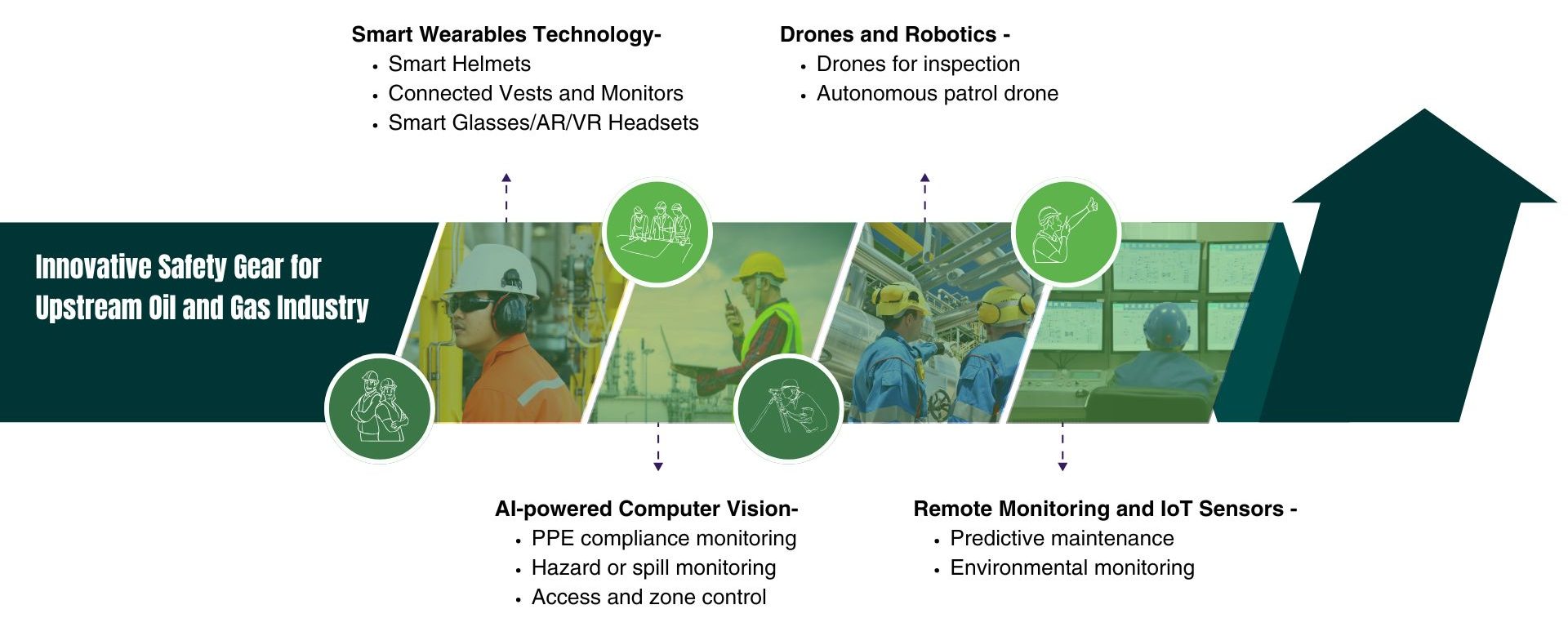
Smart Wearables Technology- 

Wearable devices with latest technology enhance efficiency on and off field by providing continuous monitoring of health conditions, location tracking and real time notifications to the field managers. 

  • Smart Helmets Smart helmets now come with inbuilt technology to detect harmful gases like Methane (CG4) and Hydrogen Sulphide (H2S). Some models also come with GPS trackers for location information and SOS button for any sort of emergency situations. 
  • Connected Vests and Monitors Continuous monitoring of crew vital signs such as heart rate, oxygen level, body temperature, and fatigue levels can help to lessen health risks in such a pressurized setting. Supervisors are automatically notified in real time about falls and injuries if there is any disparity. 
  • Smart Glasses/AR/VR Headsets  These days, there are also technologically equipped facilities that make it much easier to provide assistance by reducing travel and downtime. Field technicians can communicate with specialists who are not on site and provide live footage of the equipment and procedures. This is particularly useful for remote oil and gas fields. 

AI-powered Computer Vision - 

AI-enhanced video surveillance helps to keep a continuous check on the complex facility, something that is not possible through manual inspection routes. 

  • PPE compliance monitoring: The AI software continuously helps site managers to monitor the use of personal protective equipment (PPE) such as hard hats and high visibility apparel to flag violation of any compliance protocol. 
  • Hazard or spill monitoring: AI equipped cameras actively detect leaks, spills, and other hazards using data and advanced algorithms. Thermal cameras detect abnormal amount of heat, rising temperatures, and asset failure before they become an actual fire. 
  • Access and zone control: Several unapproved zones are indicated on fields, and any unauthorized access can be instantly alerted by virtual parameter controls using artificial intelligence (AI), saving lives. 

Drones and Robotics - 

In technologically equipped upstream oil and gas fields remotely controlled machines usually perform the high-risk functions with zero to limited exposure of people to areas of risk. 

  • Drones for inspection: Drones with good quality cameras, thermal imaging feature and gas sensors can check leaks, pipelines, corrosions and tanks without any downtime. This is comparatively cheaper and early detection of possible problems. 
  • Autonomous patrol drones: AI enabled drones are used to conduct regular security checks, keeping an eye on crucial data, especially on oil spills, repairs and maintenance in facilities around-the-clock. 

Remote Monitoring and IoT Sensors - 

Remote monitoring by transmitting real time collected data from both the equipment on the field and the environment using low power, long ranging wireless protocols through sensors help detect downtime on a timely basis. 

  • Predictive maintenance: Sensors track the key parameters of critical equipment. With technology and real time collected data and insights some potential failures can be predicted in advance, this further helps to schedule maintenance proactively and reduce the loss of production time. 
  • Environmental monitoring:  IoT sensors can be used to monitor air and water quality to indicate contamination or gas concentrations that could violate regulatory limit values or exceed regulatory compliance. This is especially important for maintaining compliance in remote and offshore operations.   

The upstream oil and gas industry will obviously always be a risky business, given its very nature, but the means of how to manage risk are changing dramatically. With the above-mentioned technologies, such as smart wearables, AI based surveillance drones and IoT sensors, in place, safety is not merely restricted to reactive; it is increasingly predictive and preventive. The automation and digital innovations keep workers out of these volatile areas while enhancing operational efficiency and minimising downtime. It means that regulatory compliance is being followed and that is why the demand for smart safety gear also has seen a massive jump. The upstream oil and gas sector is preparing for future-ready general operations that are resilient with improving people welfare and productivity. 
 

Allwyn Introduction

More Readings

Related blogs

Integrated crew services

Why Integrated Crew Services are Important in Upstream Operations

By Get global | April 21, 2026

The oil and gas sector forms a significant component of the world’s economic system, providing energy sources for transport, electricity generation, and production processes. The upstream sector entails exploration and production, which are usually carried out in difficult and dangerous conditions. Efficiency, safety, and effective management of manpower are vital […]

Certificate in Upstream oil and gas

Why NEBOSH and IWCF Certifications Matter in the Oil & Gas Industry

By Get global | April 21, 2026

The oil and gas industry is an environment full of risks. The workers are constantly facing hazardous work environments and risking their lives every single day. Injuries are reported every single year within the oil and gas industry. This is just the nature of the profession in the oilfield industry. […]

upstream oil and gas industry

What are the Benefits of Turnkey Solutions in Upstream Oil and Gas Projects

By Get global | April 15, 2026

The oil and gas industry is complex down to its core. The complexities that lie between discovery and completion of the well cannot be underestimated in any case. In such a highly challenging scenario, Turnkey Solutions – also known as Lump Sum Turnkey or LSTK – have come out as […]

Upstream oil and gas

How to Reduce Costs in Upstream Oil & Gas Operations Without Cutting Quality

By Get global | April 13, 2026

Cost pressure in the upstream oil and gas industry is not a new conversation. Every operator has, at some point, been asked to find ways to reduce costs. The instinct is usually to cut headcount, delay maintenance, or push suppliers harder on price. And more often than not, that approach […]

Crude oil in upstream oil and gas industry

Key Differences Between Light and Heavy Crude Oil

By Get global | April 8, 2026

Crude oil is a naturally occurring fossil fuel that is liquid in nature. It is found beneath the Earth’s surface and is formed due to the remains of marine animals from millions of years ago. The importance of crude oil in the oilfield industry is undeniable. It is used everywhere. […]