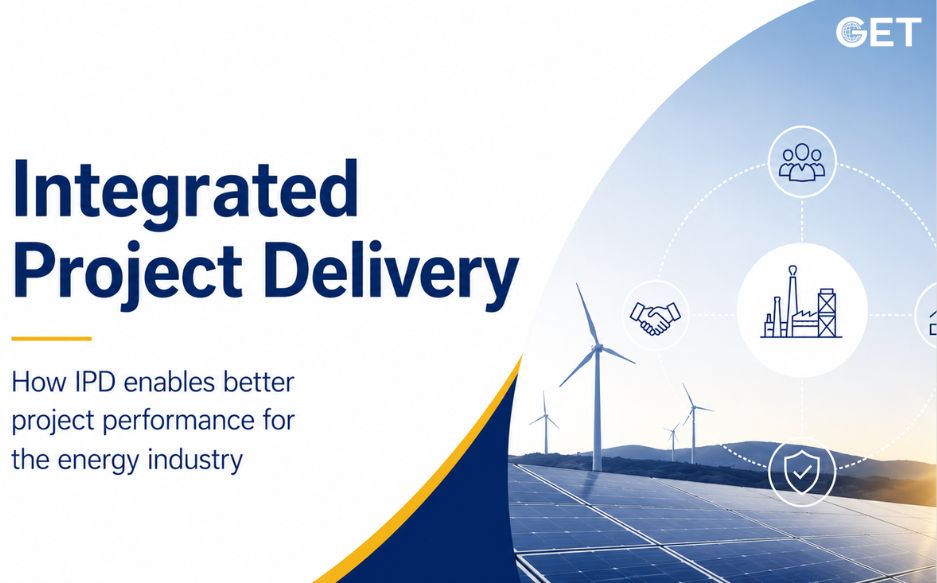
The energy industry is facing unprecedented challenges in the 21st century, including the need for sustainable and environmentally responsible solutions to meet growing global energy demands. As a result, successful project delivery has become vital for companies in the energy sector. Among the methodologies gaining prominence is Integrated Project Delivery (IPD), an innovative and collaborative approach that enhances project performance and efficiency. In this blog, we will explore how IPD is transforming the energy industry and driving positive outcomes.
IPD is a project delivery approach that brings together key stakeholders, including owners, engineers, contractors, and suppliers, in a highly collaborative and transparent environment. An integrated team collaboratively makes decisions, shares risks, and reaps rewards based on project performance.
Key Principles of IPD
The energy industry is witnessing a significant shift towards IPD due to its unique advantages in complex and large-scale projects.
Here are some key ways IPD is enabling better project performance in the energy sector:
We, at GET adopt the IPD approach in our project collaborations with the oil and gas industry. By adopting IPD, we form an integrated team comprising technical experts, civil engineers, local contractors, and suppliers. The early involvement of all stakeholders allows us to collectively plan the project, analyze the site for the project, and identify any potential environmental concerns. Through shared risk and reward, the team works cohesively, making real-time adjustments during project delivery, which reduces costly delays and design changes. Top of Form
In conclusion, Integrated Project Delivery (IPD) is proving to be a game-changer for the energy industry. By promoting collaboration, transparency, and shared accountability, IPD enables better project performance, greater efficiency, and increased innovation. With the energy sector’s increasing focus on sustainable solutions, IPD is well-positioned to revolutionize project delivery and lead the way to a greener and more efficient future. Embracing IPD in the energy industry is a significant step toward addressing the challenges of tomorrow while meeting the world’s growing energy needs responsibly.
GET Global Group (GET) employs the well-established Capital Value Process (CVP) to guide the project development stages: Appraise, Select, Define, Execute, and Operate. This structured approach ensures informed decision-making, with risks and opportunities carefully assessed as projects progress.
IPD operates on the principles of collaboration and accountability, fostering baseline predictability. By involving all stakeholders from the selection and design phases, potential challenges are identified early, allowing for proactive measures to prevent deviations. Our IPD method emphasizes collective project success through measurable outcomes, holding all stakeholders responsible to each other and empowering project teams with greater control over project performance.
Read Also- How Technical Consulting Improves Drilling Efficiency

By Get global | October 12, 2026
Saudi Arabia is traditionally considered a key country where people work in the oil and gas sector. As there is quite a lot of drilling, well intervention and production processes in this country, many engineers, technicians and specialists from the field try to find suitable positions there. However, not all […]

By Get global | October 9, 2026
Ask any person working night shifts in rigs and compressor stations what holds the industry back, and you will seldom hear anything about geology. Disconnected information, delayed decision-making, and machinery breaking down at the wrong moment – all these factors are more common causes of productivity losses in the industry. […]

By Get global | October 5, 2026
Specialized expertise turns a hard project in the oil and gas industry into a workable one. Every oilfield has its own geology, risks, and surprises. The teams that handle them the operations on field have usually met something similar before. In the modern world, upstream oil and gas companies are […]

By Get global | September 30, 2026
By Get global | September 28, 2026