Oil and Gas industry have always been in an environment that is capital intensive and where operational efficiency, safety, and cost management take precedence. But there have been instances where supply chain management within energy sector had issues like poor communication, disjointed tracking, lengthy vendor onboarding process, and reactive procurement practices.
In the current scenario, the industry is facing one of the greatest transformations ever witnessed. The use of the 4.0 industry technology such as Cloud ERP, Big Data Analytics, Artificial Intelligence, and the Internet of Things is transforming the way that energy firms procure their resources, handle their inventories, and implement their workforce solutions.
Digitization of the procurement and supply chain processes is not anymore an optional choice for progressive oil and gas companies but a fundamental principle to ensure business resilience and profitability.
Addressing these vulnerabilities required replacing static supply chains with dynamic, digitally integrated supply networks.
Internet of Things (IoT) sensors, RFID tracking, and smart warehousing systems now offer end-to-end visibility across global oil and gas supply chains. Supply chain managers can track critical assets such as specialized drill bits, valves, pressure equipment, and chemical in real time from fabrication facilities to offshore rigs.
Real-time tracking prevents asset loss, streamlines inventory management, and enables automated replenishment, ensuring materials arrive exactly when required without over-leveraging working capital.
Demand forecasting is being modernized by Artificial Intelligence (AI) and Predictive Algorithms. Through analysis of past maintenance records, weather patterns, production levels, and market dynamics, AI-based models are able to forecast the wear and tear of parts and material requirements.
Through such predictive analysis, emergencies can be eliminated through purchase planning and obtaining favourable price quotes from vendors.
Modern Cloud ERP systems act as a single source of truth by standardizing the processes of finances and operations across multiple international business units. In addition to this, smart contracts that are placed on a secure distributed ledger system enable automatic verification and payments after delivery verification.
Digital transformation extends beyond equipment and materials to encompass specialized workforce management and field operations. Turnkey energy service partners are leveraging digital platforms to streamline technical staffing, technical competency verification, and field deployment.
For instance, leaders in upstream oilfield services like GET Global Group demonstrate how digital integration accelerates specialized workforce management and project delivery. By digitizing crew onboarding, mobile profile verifications, and operational scheduling, GET Global Group enables energy companies to deploy verified field crews rapidly, ensuring operational compliance while reducing workforce overhead.
Read Also
The integration of digital tools into energy procurement yields clear quantitative and qualitative advantages:
| Key Objective | Traditional Process | Digitalized Process | Industry Impact |
| Procurement Cycle Time | Manual approvals, paper tenders | Automated vendor screening & workflows | Up to 40% reduction in cycle times |
| Inventory Carrying Costs | Buffer stock & over-purchasing | Predictive maintenance & just-in-time delivery | Significant reduction in holding costs |
| Workforce Mobilization | Manual credential checks & delayed scheduling | Mobile verification & digital staffing platforms | Accelerated field crew deployment & reduced NPT |
| Supply Chain Visibility | Disconnected spreadsheets & localized tracking | End-to-end IoT & digital twin integration | 100% real-time asset & material traceability |
While the benefits are significant, transitioning to digital supply chain systems presents distinct challenges:
Collaborating with established energy service organizations such as GET Global Group helps operators navigate these operational transitions by combining domain expertise with streamlined digital service delivery.
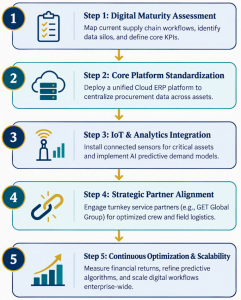
To successfully implement digital procurement and supply chain transformation, oil and gas companies should follow a structured roadmap:
The digital transformation process is revolutionizing how the oil and gas industry approaches the supply chain and procurement processes. Through leveraging cloud computing, IoT asset tracking and management, AI-powered predictive analytics, and workforce management software, energy companies are creating robust systems that will endure any market turbulence and performance challenges. By digitalizing and partnering with entities such as GET Global Group, organizations can ensure their success in optimizing costs, enhancing operations, and developing a competitive edge in today’s energy world.
Read Also- Digital Transformation in Oil and Gas: How Technology Is Reshaping Field Operations
Frequently Asked Questions (FAQ)
Q1: What is digital transformation in oil and gas procurement?
Digital transformation in oil and gas procurement involves integrating advanced digital technologies such as Artificial Intelligence, IoT asset tracking, Cloud ERP platforms, and smart contracts into traditional sourcing and supply chain workflows. This modernizes vendor selection, automates purchasing, improves inventory tracking, and reduces operational lead times.
Q2: How does IoT improve supply chain management in energy operations?
IoT sensors provide real-time location and condition tracking for critical equipment and materials as they move across global supply routes. This continuous visibility prevents misplaced assets, enables predictive maintenance, reduces emergency purchases, and optimizes warehouse inventory levels.
Q3: What role does GET Global Group play in energy service operations?
GET Global Group is a provider of turnkey outsourced solutions for the upstream oil and gas industry. They assist energy companies in streamlining field operations, specialized technical workforce mobilization, and outsourced operational support, helping operators optimize resources and maintain operational continuity.
Q4: How does AI help in reducing Non-Productive Time (NPT)?
AI algorithms analyze historical equipment usage patterns, operational parameters, and sensor data to forecast maintenance needs before equipment failures occur. By coordinating predictive maintenance with automated procurement schedules, AI ensures replacement parts and technicians arrive before disruptions happen, reducing NPT.
Q5: What are the primary challenges when digitalizing oil and gas supply chains?
Key challenges include integrating modern platforms with legacy IT/OT infrastructure, managing cybersecurity risks across connected networks, overcoming organizational resistance through change management, and ensuring field personnel are fully trained on digital applications.
By Get global | October 19, 2026

By Get global | October 16, 2026

By Get global | October 12, 2026

By Get global | October 9, 2026
Ask any person working night shifts in rigs and compressor stations what holds the industry back, and you will seldom hear anything about geology. Disconnected information, delayed decision-making, and machinery breaking down at the wrong moment – all these factors are more common causes of productivity losses in the industry. […]
By Get global | October 5, 2026
Specialized expertise turns a hard project in the oil and gas industry into a workable one. Every oilfield has its own geology, risks, and surprises. The teams that handle them the operations on field have usually met something similar before. In the modern world, upstream oil and gas companies are […]