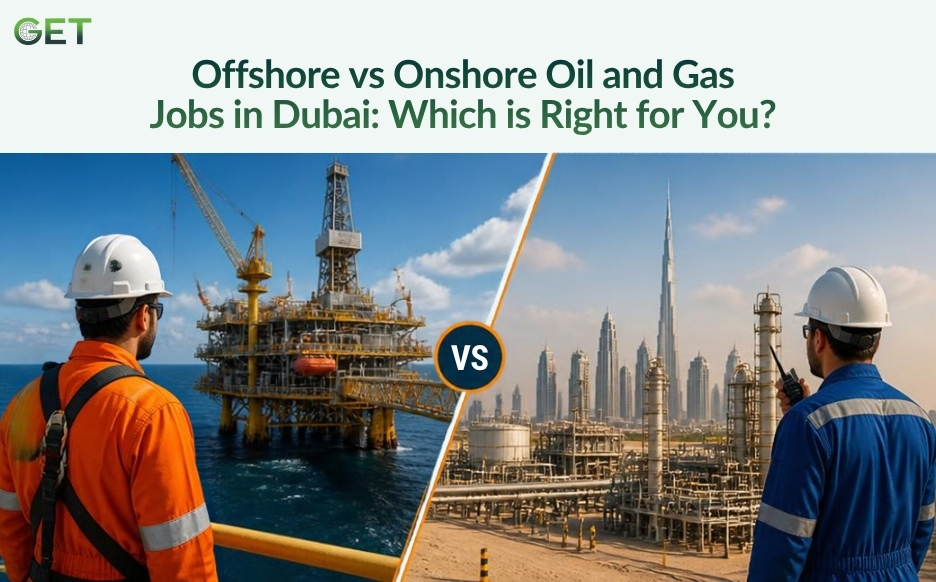
Anyone exploring oil and gas jobs in Dubai eventually runs into the same decision. Offshore or onshore. Sounds simple. It isn’t, really – it affects your schedule, your pay, your family life, how much of the year you spend at home versus somewhere out on the water. Both paths offer legitimate, well-paying careers. But they suit genuinely different people, and most of the frustration I’ve seen in this industry comes from someone picking one without really thinking through what their day-to-day life is going to look like six months in.
It’s not “offshore pays more” and that’s the end of the discussion. It’s not “onshore is easier” either. What works for a 24-year-old engineer straight out of university looks nothing like what works for someone with two kids and a mortgage. So, let’s get into it.
The UAE sits on some of the largest proven oil reserves anywhere in the world, and Abu Dhabi’s ADNOC runs operations touching nearly the entire value chain – exploration, drilling, refining, export, all of it. Dubai isn’t the country’s biggest producer. Never has been. But it’s become the regional business and logistics hub for the whole sector anyway, hosting headquarters, engineering firms, and the service companies that support operations across the wider Gulf.
Tax-free income. A genuinely international workforce. A dense concentration of major operators and contractors packed into a fairly compact city. That combination is why oil and gas jobs in Dubai keep pulling talent from Europe, South Asia, North America, Africa – you name it. It’s not a local hiring market. It’s global, and competitive, which is exactly why understanding your options before committing to offshore or onshore actually matters here more than in a lot of other places.
Read Also- How to Get an Oil and Gas Job in Dubai: A Complete Guide for 2027
Offshore work has a reputation, and it’s mostly earned. We’re talking platforms out in the Arabian Gulf, rotational schedules that keep you on-site two, three, sometimes four weeks straight, followed by a break of equal or longer length back home.
Drilling engineers. Platform operators. Subsea technicians. HSE officers. Marine crew. Maintenance specialists. The roles vary, but the environment doesn’t – enclosed, high-pressure, physically demanding, genuinely isolated. No popping out for lunch. No heading home because something came up. Once you’re on the platform you’re there until the rotation ends, full stop.
A few things tend to define offshore oil and gas jobs in Dubai specifically:
• Real pay premium over comparable onshore roles, partly to offset the isolation, partly because the work demands specialized certifications most people don’t walk in with
• Rotational schedules – two weeks on, two weeks off is common, though plenty of operators run three-and-three or longer depending on the platform
• Accommodation and meals covered while you’re out there, which changes the actual take-home math since your living costs basically disappear during the working stretch
• Long, tightly run shifts with strict safety protocols and very little downtime during an active rotation
• BOSIET or equivalent required – Basic Offshore Safety Induction and Emergency Training, non-negotiable before you’re even allowed onto a platform
People who do well offshore tend to be the ones who don’t mind, or actually like, long stretches of intense focused work followed by real, uninterrupted time off. It’s not for everyone. But for someone early in their career, or without young kids tying them to a daily routine, offshore oil and gas jobs in Dubai can be a genuinely fast way to build savings and specialized experience you just can’t get elsewhere.
Onshore covers a lot more ground than people assume going in. Refinery operations. Pipeline maintenance. Corporate roles in engineering, project management, procurement, HSE compliance, logistics. Most of it happens in office environments, processing facilities, or terminals – not out on open water.
You go home every evening. Weekends are actually weekends, most of the time. That regularity is the whole appeal for a lot of people, especially anyone with a family, or honestly anyone who just prefers a normal routine over the intensity of rotational work.
A few things tend to define onshore oil and gas jobs in Dubai:
• Standard working hours, mostly, with some overtime depending on the project, rather than the extended rotational shifts offshore requires
• Lower pay ceiling generally – not because the work matters less, but because the lifestyle trade-off just isn’t as steep, so companies don’t need to offer the same premium
• Wider range of roles across engineering, HR, finance, supply chain, and more, giving people room to shift directions over a career without starting over
• Easier to build a stable home life around – commuting, school pickups, a normal social life all stay workable when you’re not gone for weeks at a stretch
• A more realistic entry point for people switching in from adjacent industries or without offshore-specific certifications yet
Onshore oil and gas jobs in Dubai tend to suit people who value consistency, want a life built around a fixed home base, or are still figuring out which corner of the industry they want to specialize in before committing to something as demanding as offshore rotation.
Money’s usually the first thing people ask about. Offshore pays more – sometimes a lot more – and there are real reasons behind that gap, not just an arbitrary premium tacked on.
Offshore work is harder to staff. Not everyone wants weeks away from home on a platform surrounded by open water, so operators pay up to attract and keep qualified people. The certifications required – survival training, medical clearances, technical quals specific to the role – represent a real barrier most candidates have to clear first, and salary reflects that. And since housing and food are covered during rotations, offshore pay functions almost like pure savings, because your living costs during the work period basically vanish.
None of that makes onshore the “lesser” option, though. Plenty of onshore roles – senior engineering, project management, leadership positions – pay extremely well by any global measure. Factor in a normal daily life, no relocation costs tied to constant rotation travel, a more predictable long-term trajectory, and the gap between offshore and onshore often closes more than a straight salary comparison would suggest.
Offshore tends to build faster hands-on technical experience – drilling, subsea work, platform management – simply because the work is more concentrated and specialized. If you’re aiming for deep technical expertise in upstream operations specifically, offshore experience is genuinely valuable, and often expected, for the senior technical roles further down the line.
Onshore tends to offer broader exposure instead – project management, cross-departmental coordination, vendor relationships, the business side of things. A lot of senior operations managers and directors in this industry built their early careers onshore precisely because it exposed them to more than just the technical piece.
Some people move between the two entirely. Start offshore, build technical credibility and savings, transition onshore later once family circumstances shift or once the goal becomes broader organizational scope rather than deep specialization. Dubai’s mix of offshore-adjacent operators and onshore corporate headquarters makes that kind of move more realistic here than in a lot of other markets.
For offshore roles, the requirements are fixed across most operators:
• BOSIET or equivalent survival certification
• A valid offshore medical certificate
• Role-specific technical qualifications – well control certification for drilling, relevant engineering credentials depending on specialization
• Prior offshore experience, sometimes required even for mid-level roles, which can make breaking in the first time genuinely tough
Onshore generally has a lower barrier from a certification standpoint. Role-specific quals still matter, obviously – a process engineer still needs engineering credentials, an HSE officer still needs recognized safety certs – but you’re not clearing the survival-training hurdle that gates offshore entry. Worth actually checking what specific operators in Dubai are asking for, since requirements shift company to company, sometimes even project to project within the same company.
Early in your career, looking to build savings and specialized experience fast? Offshore’s probably worth a few years.
Family or existing commitments that need your regular presence? Onshore’s the more sustainable call, even with a lower ceiling near-term.
Genuinely value long, uninterrupted time off over daily routine? That’s real, and it points offshore.
Get restless or disconnected being away from normal life for weeks? Also worth taking seriously – plenty of people try offshore rotations and realize within a year or two it’s just not sustainable for them, no matter what the pay check looks like.
Both paths offer legitimate, well-compensated careers in one of the most active energy hubs anywhere. The right call is personal. It always is.
Dubai’s position as a regional hub means oil and gas careers here will likely keep growing for years – across offshore platforms out in the Gulf and onshore facilities and corporate operations across the emirate. Whether the pull is the intensity and premium pay of offshore work, or the stability and normalcy of onshore, the opportunities are real. And increasingly, so is the flexibility to move between the two as your career, and your life, changes.
Read Also- Creating a Workforce That Prioritizes Safety Everyday
Frequently Asked Questions:
1. Do offshore oil and gas jobs in Dubai pay significantly more than onshore roles?
Generally, yes – offshore carries a real premium due to the rotational schedule, required certifications, and covered accommodation, though senior onshore roles can close that gap more than people expect.
2. What certifications do I need for offshore oil and gas jobs in Dubai?
BOSIET or equivalent survival training, an offshore medical certificate, and whatever technical qualifications your specific role calls for.
3. Are onshore oil and gas jobs in Dubai easier to get into without prior experience?
Generally, yes – no offshore-specific survival certifications gating entry, which makes onshore a more realistic starting point for career switchers.
4. Can I move between offshore and onshore oil and gas careers in Dubai over time?
Yes, and it happens fairly often – usually offshore first for experience and savings, then onshore later once family circumstances or career goals shift.
5. Which builds a stronger long-term career – offshore or onshore oil and gas jobs in Dubai?
Depends what you’re after. Offshore builds deep technical expertise valuable for senior operational roles; onshore builds broader exposure better suited to leadership tracks.
By Get global | September 28, 2026
By Get global | September 28, 2026
By Get global | September 28, 2026
Technology has touched every corner of modern oil and gas operations—from upstream exploration and drilling to midstream pipelines, downstream facilities, maintenance, and performance monitoring. One area where digital transformation delivers exceptional value is HSE (Health, Safety and Environment), a core priority for GET Global Group and the wider energy industry. […]
By Get global | September 22, 2026
By Get global | September 21, 2026
Regulators are tightening the screws on emissions. Investors are asking harder questions about ESG performance. And communities near production sites have gotten a lot less patient with flaring, leaks, and spills that used to get a shrug. For upstream operators, environmental performance isn’t a side conversation anymore. It’s sitting right […]