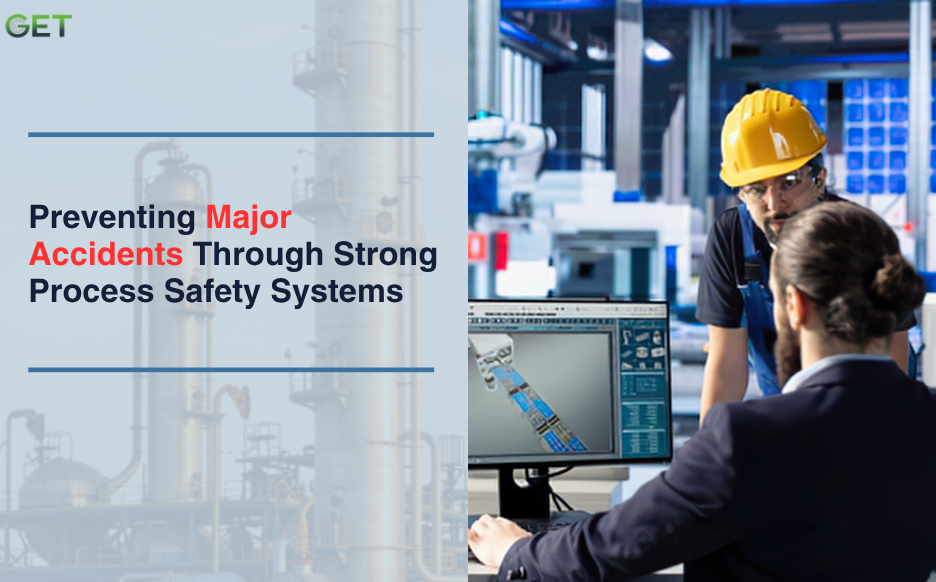
Oil and gas are at the forefront of risk management. The process of refining the raw material itself, the offshore plants, the networks of pipelines and the chemical plants, all deal with chemicals and materials which can make a perfectly normal operating day into a catastrophic one in a matter of seconds. History is full of tragic examples that have taught their lessons, Piper Alpha, Texas City, Deepwater Horizon, Bhopal are not only case studies anymore but constant warnings of the consequences of neglecting process safety in its core. This is the reason why a process safety system will always be the best investment one can make and why companies like the GE Global Group will always strive to innovate.
What Process Safety Really Means
Process safety is commonly mistaken to be occupational safety; however, these concepts are worlds apart. Occupational safety deals with individual safety and includes slips, trips, falls, and PPE. Process safety deals with safety of the whole process, including vessels, piping, valves, controls, and procedures involved in keeping hazardous chemicals confined. A plant could be having a perfect safety performance record for many years in terms of occupational safety with no recordable injuries, yet the failure of just one single gasket could result in an accident.
This is significant due to the fact that any serious accident that occurs within the oil and gas industry will not have a singular cause. It is more often than not a combination of failure of the following aspects: a safety instrumented system which has degraded; an alarm that has been bypassed; a late inspection; and management of change procedures that have not been undertaken.
The Core Pillars of Process Safety Management
Effective process safety management, or PSM, rests on several interlocking pillars that regulators such as OSHA, the EPA, and international bodies like the UK’s HSE and API have codified into standards over decades of hard-earned experience.
Process Hazard Analysis (PHA) is the starting point. Techniques like HAZOP (Hazard and Operability Study), What-If analysis, and Layer of Protection Analysis (LOPA) systematically identify what could go wrong in a process — overpressure, loss of containment, runaway reaction — and determine whether existing safeguards are adequate.
Mechanical Integrity (MI) programs ensure that pressure vessels, piping, relief systems, and rotating equipment are inspected, tested, and maintained according to rigorous schedules. Corrosion under insulation, fatigue cracking, and material degradation are silent threats that MI programs are designed to catch long before they become leaks or ruptures.
Management of Change (MOC) is one of the most frequently cited failure points in major incident investigations. Any modification to equipment, procedures, or operating conditions — even a seemingly minor one — must go through a formal review to ensure it doesn’t introduce new hazards. Skipping MOC has been a contributing factor in numerous high-profile incidents.
Safety Instrumented Systems (SIS) and their associated Safety Integrity Levels (SIL) provide automated layers of protection that shut down a process safely when parameters drift outside acceptable limits. These systems are independent of the normal control system and are tested rigorously to ensure they perform on demand.
Emergency Response and Incident Investigation round out the framework. When something does go wrong, a well-rehearsed emergency response plan limits the consequences, while a disciplined root cause analysis ensures the same failure mode doesn’t recur elsewhere in the organization.
Why Digitalization Is Changing the Game
The oil and gas sector has historically been slow to modernize its safety infrastructure, relying on manual logs, periodic inspections, and reactive maintenance. That is changing rapidly. Predictive analytics, real-time sensor data, and machine-learning-driven anomaly detection now allow operators to spot early warning signs — abnormal vibration, temperature drift, pressure fluctuations — long before they escalate into loss-of-containment events.
Companies like GET Global Group have been at the forefront of integrating industrial IoT platforms with process safety frameworks, connecting thousands of field sensors to centralized monitoring hubs. This shift from time-based maintenance to condition-based and predictive maintenance is one of the most significant advances in process safety in the last two decades. Instead of waiting for a scheduled inspection to discover a corroding pipeline, operators can now receive real-time alerts when sensor data indicates a developing problem, giving engineers time to intervene before a rupture occurs.
Digital twins, virtual replicas of physical assets, are also playing an increasing role. By simulating how a facility behaves under different stress scenarios, engineers can test the resilience of safety barriers without ever putting real equipment or people at risk. Combined with cloud-based data historians and advanced analytics, this technology is turning process safety from a compliance exercise into a genuinely predictive discipline.
Human Factors and Safety Culture
No amount of technology can substitute for a strong safety culture. Investigations into major accidents consistently reveal organizational failures: normalized deviance, production pressure overriding safety concerns, inadequate training, and poor communication between shifts. Building a resilient safety culture means empowering every worker, from the control room operator to the contractor on the platform deck, to stop work if something looks wrong — without fear of retaliation.
Leadership commitment is non-negotiable. When senior management visibly prioritizes process safety metrics alongside production targets, that signal cascades through the organization. Leading indicators — such as the number of near-miss reports, overdue inspections, or bypassed safety systems — are often more valuable than lagging indicators like incident counts, because they reveal weaknesses before an accident happens rather than after.
Regulatory Frameworks Driving Improvement
Regulations including OSHA’s Process Safety Management (29 CFR 1910.119), EPA’s Risk Management Program, API RP 754 for process safety performance indicators, and IEC 61511 for safety instrumented systems act as the basis of regulation in this industry. In terms of international regulations, Seveso III Directive in the EU and the Safety Case regimes in the North Sea of the UK and Australia apply equally demanding requirements to high-risk facilities.
However, compliance with these standards cannot be the sole objective of the industry players. The most effective companies perceive these standards as just a baseline and constantly measure up against the best practices in the industry and learn from accidents in other facilities.
Building Resilience for the Future
In light of this transition towards a more sustainable way of doing things, process safety systems need to evolve and adapt to these changing conditions, learning to handle new kinds of dangers that will arise due to the introduction of new types of energy and technology. There will be unique ways for such systems to fail, and there is a need for the same rigor which has ensured process safety in conventional oil and gas production facilities to be applied from the very beginning.
Ultimately, process safety will depend on many factors, including engineering rigor, discipline management systems, culture of safety, and increasingly, smart technology that helps operators to know much more about the processes at hand. The winners will be those who approach process safety not as an expense, but as a value.
Frequently Asked Questions (FAQs)
What is the difference between process safety and personal safety?
Personal safety focuses on preventing individual injuries like slips or falls, while process safety focuses on preventing major, large-scale incidents such as explosions, fires, or toxic releases caused by loss of containment in industrial processes.
What is a Process Hazard Analysis (PHA)?
A PHA is a systematic study, often using methods like HAZOP or What-If analysis, used to identify potential hazards in a process and evaluate whether existing safeguards are sufficient to prevent or mitigate them.
Why is Management of Change (MOC) so important in oil and gas?
Because even small modifications to equipment or procedures can introduce unforeseen hazards. MOC ensures every change is formally reviewed and approved before implementation, preventing a common root cause of major incidents.
How is digital technology improving process safety?
Real-time sensor monitoring, predictive analytics, and digital twins allow operators to detect early warning signs of equipment failure and intervene before incidents occur, shifting safety management from reactive to predictive.
What role does safety culture play in preventing major accidents?
A strong safety culture ensures that safety concerns are reported and acted upon without fear of blame, that leadership prioritizes safety alongside production, and that workers feel empowered to stop unsafe operations.
Which regulations govern process safety in the oil and gas industry?
Key frameworks include OSHA’s PSM standard, EPA’s Risk Management Program, API RP 754, IEC 61511 for safety instrumented systems, and the Seveso III Directive in the European Union.
By Get global | August 27, 2026
An offshore rig losing production can bleed staggering sums for every hour it sits idle. On the other end of the same industry, a well-run inspection or maintenance contract just keeps collecting steady, contract-locked revenue for a decade, without ever touching a barrel of crude. Same industry. Same oil underneath […]
By Get global | August 25, 2026
By Get global | August 20, 2026
By Get global | August 17, 2026
Oil and gas companies need to improve production while reducing downtime and keeping older assets running safely. Automation software helps by giving teams better control over equipment, alarms, operating data, and daily production. Different operations require different tools. Refineries may need a DCS for plant control, while pipeline operators often […]
By Get global | August 12, 2026