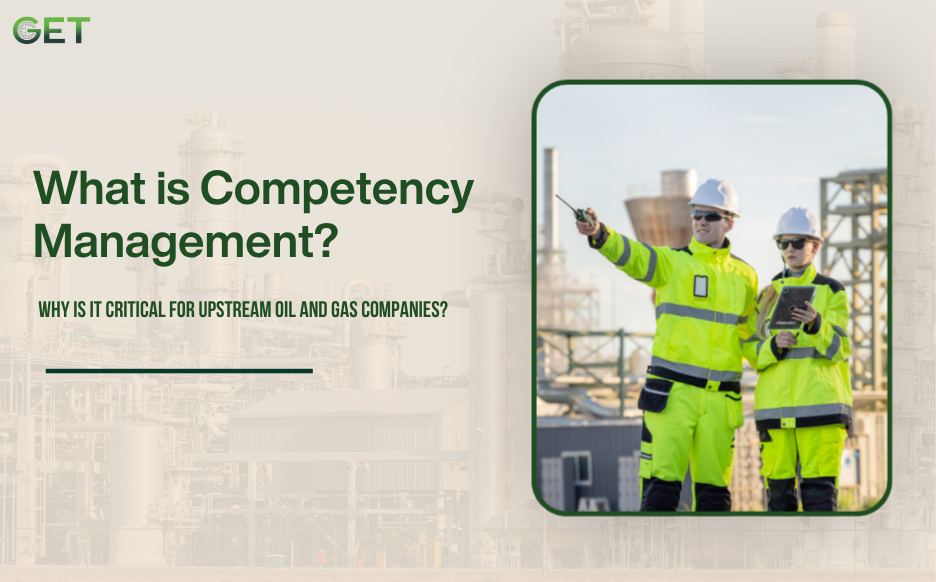
Upstream oil and gas operations are among the most technically demanding and safety-sensitive activities in any industry. From offshore drilling rigs to onshore exploration sites, every task carries operational risk, financial weight, and regulatory scrutiny. In this high-stakes environment, having the right people, with the right skills, in the right roles, is not optional. This is exactly where competency management comes in.
For companies operating in exploration, drilling, and production, a structured approach to workforce capability is now a business necessity rather than a nice-to-have. This is why more organizations are turning to specialists like GET Global Group, a name increasingly recognized in oil and gas competency management, workforce development, and training management systems for the energy sector.
Competency management is a systematic process of identifying, assessing, developing, and tracking the skills, knowledge, and behaviours employees need to perform their jobs safely and effectively. In the upstream oil and gas sector, this typically covers technical competencies (well control, drilling operations, reservoir engineering), safety competencies (HSE compliance, emergency response), and behavioural competencies (leadership, decision-making under pressure).
A robust competency management system goes beyond simple training records. It maps job roles to required skill sets, assesses current employee capability against those requirements, identifies competency gaps, and creates targeted development plans to close them. It also ensures ongoing verification, so competency isn’t just proven once but maintained and reassessed over time.
Organizations such as GET Global Group have built their reputation by helping oil and gas operators design and implement these systems in a way that aligns with international standards, operational realities, and workforce diversity across different regions and job families.
The upstream segment, covering exploration and production, is fundamentally different from downstream or midstream operations. Personnel work with high-pressure equipment, hazardous materials, complex machinery, and constantly shifting site conditions. A single lapse in competency, whether from inadequate training or an unverified skill gap, can lead to catastrophic consequences.
Safety is the most immediate reason competency management in oil and gas is treated as mission critical. Incidents on drilling rigs, wellsite, and offshore platforms are frequently traced back to human factors: a technician performing a task they weren’t fully qualified for, or a supervisor missing a critical safety step. A well-designed oil and gas training management system ensures that only competent, verified personnel are assigned to safety-critical roles, directly reducing incident rates and protecting both people and assets.
Upstream operators face a dense web of regulations from bodies overseeing health, safety, and environmental standards. Many jurisdictions now require documented proof of workforce competency for specific roles, particularly for well control, confined space entry, and process safety management. Companies that fail to maintain auditable competency records risk regulatory penalties, license suspensions, and reputational damage. A structured competency assurance program provides the documentation trail regulators and auditors expect.
Competency gaps don’t just create safety risks; they also drive inefficiency. Poorly trained crews take longer to complete tasks, make more errors, and require more supervision. By systematically closing skill gaps through skills gap analysis and targeted competency-based training, upstream companies improve productivity, reduce equipment downtime caused by operator error, and lower the cost of rework and incident response.
The upstream oil and gas industry has an ageing workforce across many regions, with a wave of experienced personnel approaching retirement. Competency management supports succession planning by identifying which employees are ready to step into more senior technical or supervisory roles and which require further development. This is particularly critical for companies managing large, geographically dispersed workforces, where visibility into skill levels across sites is otherwise difficult to maintain.
Many upstream operators run assets across multiple countries, often through a mix of direct employees, contractors, and joint venture partners. Without a centralized competency management framework, skill standards can vary wildly from one site to another. This inconsistency creates risk exposure and complicates quality assurance. Partnering with experienced providers like GET Global Group allows companies to standardize competency frameworks across regions while still adapting to local regulatory and cultural requirements.
Read Also- What to Look for in a PSCM Service Provider for Upstream Oil & Gas Operations
An effective CMS for oil and gas typically includes:
Providers like GET Global Group typically support upstream operators across all of these components, from initial framework design through digital competency tracking, making the system sustainable rather than a one-time compliance exercise.
The Business Case for Investing in Competency Management
Some upstream operators still view competency management as a compliance cost rather than a value driver. In reality, the return on investment shows up across multiple areas: fewer safety incidents, reduced insurance and liability exposure, lower turnover due to clearer career pathways, and stronger audit outcomes. As upstream projects grow more complex, particularly with the shift toward deepwater exploration, unconventional resources, and digital oilfield technologies, the competency bar for the workforce keeps rising. Companies that fail to invest in structured workforce competency development risk falling behind both on safety performance and operational competitiveness.
Competency management is no longer a peripheral HR function in upstream oil and gas, it is a core pillar of safe, compliant, and efficient operations. As exploration and production activities become more technically complex and globally distributed, the need for structured, verifiable, and continuously updated competency frameworks will only grow. Companies that partner with experienced specialists, such as GET Global Group, position themselves to meet regulatory demands, reduce operational risk, and build a workforce capable of meeting the industry’s evolving challenges.
Read Also- How Technical Consulting Reduces Project Risk
FAQ
Q1: What industries use competency management systems besides oil and gas?
Competency management is widely used in aviation, mining, nuclear energy, healthcare, and manufacturing, though upstream oil and gas has some of the strictest requirements due to safety-critical operations.
Q2: How is competency different from training?
Training is the process of delivering knowledge or skills. Competency is the verified ability to apply that knowledge or skill correctly in a real work setting. A competency management system confirms the outcome, not just attendance.
Q3: How often should competency be reassessed in upstream oil and gas?
This depends on the role and regulatory requirements, but safety-critical positions are typically reassessed annually or after significant changes in equipment, procedures, or regulations.
Q4: Can competency management systems be used for contractors, not just employees?
Yes. In fact, upstream operators often rely on large contractor workforces, making it essential that competency frameworks extend to contractors and third-party personnel working on-site.
Q5: What role does digital technology play in modern competency management? Digital competency management platforms allow real-time tracking, automated reassessment reminders, and centralized reporting across multiple sites, making it far easier for large upstream operators to maintain consistent standards globally.
By Get global | September 28, 2026
By Get global | September 28, 2026
By Get global | September 28, 2026
Technology has touched every corner of modern oil and gas operations—from upstream exploration and drilling to midstream pipelines, downstream facilities, maintenance, and performance monitoring. One area where digital transformation delivers exceptional value is HSE (Health, Safety and Environment), a core priority for GET Global Group and the wider energy industry. […]
By Get global | September 22, 2026
By Get global | September 21, 2026
Regulators are tightening the screws on emissions. Investors are asking harder questions about ESG performance. And communities near production sites have gotten a lot less patient with flaring, leaks, and spills that used to get a shrug. For upstream operators, environmental performance isn’t a side conversation anymore. It’s sitting right […]