Supply Chain Issues that Oil and Gas Upstream Companies Face and Solutions on How to Resolve Them
It’s not surprising that supply chain management has moved out of mere purchasing to becoming a competitive edge. Inability to find even a valve or OCTG shortage can ground a drilling rig for hours, sometimes even for days, resulting in losses much higher than the value of the part.
Oil and gas field supply chain management has become one of the most complicated operational issues in the industry due to the increasing number of operations taking place in hard-to-reach and technically complicated areas. The following are the main issues that operators face today along with solutions for addressing them.
The upstream players need a global network of suppliers to provide their drilling rig, OCTG materials, subsea supplies, and equipment. The geopolitical environment, port congestion, and trade sanctions can affect this supply chain at any moment and cause the delay of the drilling plans and postponement of production.
That is why supply chain risk management becomes an important factor in preventing the risk, rather than dealing with its consequences after its emergence.
How to overcome it:
2. Long Lead Times Require Better Sourcing Techniques
Specialty subsea equipment, control pressure equipment, and specialty valves take six to twelve months to be manufactured. Any spike in demand or issues with capacity from the supplier may further increase lead times, posing a risk to project timeline prior to drilling.
Good oil and gas sourcing techniques prevent this issue from becoming an emergency long before it happens by moving up supplier involvement in the project life cycle instead of leaving sourcing until the end of procurement.
How to overcome it:
Early sourcing technique will always save more time than any shipping technique out there.
Higher prices of inflation, currency volatility, and higher freight rates still keep procurement costs high in the upstream industry. The strategy of reducing costs through the procurement of the lowest quotation does not work well when it comes to the safety of equipment.
This is how proper vendor management becomes important for the oil and gas industry. Good relations with suppliers based on their performance records and not just low prices help reduce costs while ensuring the safety of equipment.
How to overcome this challenge:
Procurement teams find it difficult to answer basic queries in real time. For example, what is the current location of the shipment? Is there clearance for customs? Will the shipment be here before the start of mobilization? Lack of real-time visibility makes it difficult for oilfield supply chain management to be proactive rather than reactive.
Ways of overcoming this:
The operation of a supply chain requires people almost as much as it does machines. Procurement experts, logistics personnel, and inspection units are increasingly scarce in the upstream sector, and the problem becomes especially acute when there is a massive drilling drive going on.
How to solve it:
The availability of qualified personnel is as important as having the right vendors in place.
Transportation on oil rigs, in deserts, and at remote facilities demands exact coordination among different modes of transport, customs clearance, and local contractors. These are some of the logistic issues that are encountered by the oil and gas industry; these challenges become more pronounced when the distance increases since mistakes that arise in remote operations can easily lead to delays.
How to solve it:
Safety certifications, compliance of imports and exports, and vendor qualifications cannot be negotiated for oil and gas. Paper-based documentation is one of the most popular and preventable reasons for shipment delay and penalties related to non-compliance.
How to solve it:
Effective documentation minimizes risks and increases efficiency in all other supply chain processes.
Extra stock is a tie-on working capital, while a shortage is a risk for production halts. Both issues are based on the same thing – considering all types of inventories to have equal significance during the management of the oilfield supply chain.
How to solve it:
Proper inventory management guarantees readiness while not tying up money.
AI, predictive analytics, IoT sensors, and cloud procurement platforms are transforming the field of oilfield supply chain management. These solutions allow operators to:
Digital transformation does not mean replacement but support for procurement and logistics experts. Final Words
It is inevitable to face some difficulties related to the supply chain in upstream oil and gas, but it does not have to translate into disruptions. Organizations that improve their supply chain risk management and adopt better oil and gas sourcing techniques, visibility, and vendor management perform much better than organizations that deal with their procurement operations in a reactive way.
It’s not the organizations that avoid disruptions that win but the ones that have developed their sourcing technique, relationship with vendors, and logistics planning in advance.
Read Also- What Role Do Hybrid Energy Solutions Play in Modern Oilfield Operations?
FAQs
By Get global | September 14, 2026
Ten years back, most HSE policies stopped at the company gate. Whatever happened past that point, subcontractors, transport, equipment vendors, was technically someone else’s problem, at least on paper. Not anymore. And the reason is blunt: trace a serious incident back far enough, and often it started somewhere in the supply chain, not […]

By Get global | September 14, 2026
Health, safety and environment in the oil and gas sector was long treated as a back-office function, running quietly alongside the core work of drilling, extraction, and processing. That is no longer the case. Extreme pressures, volatile materials, remote sites, and heavy machinery mean the risk in this industry has […]

By Get global | September 14, 2026
By Get global | September 9, 2026
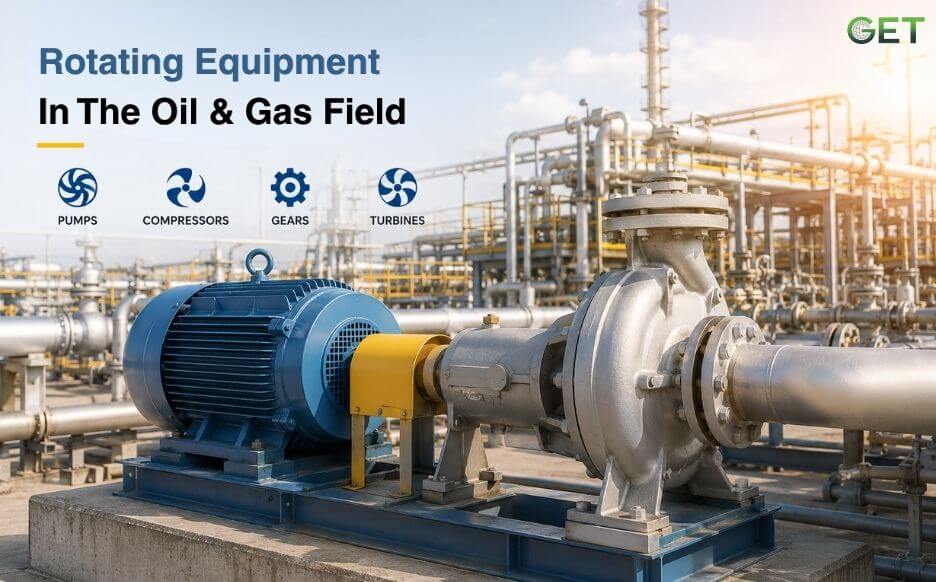
Walk onto any rig floor, production platform, or gas processing plant, and the first thing you notice isn’t the pipework – it’s the sound. That low, constant hum coming from somewhere in the facility is almost always rotating equipment doing its job. Pumps pushing fluid through miles of pipeline. Compressors […]

By Get global | September 9, 2026