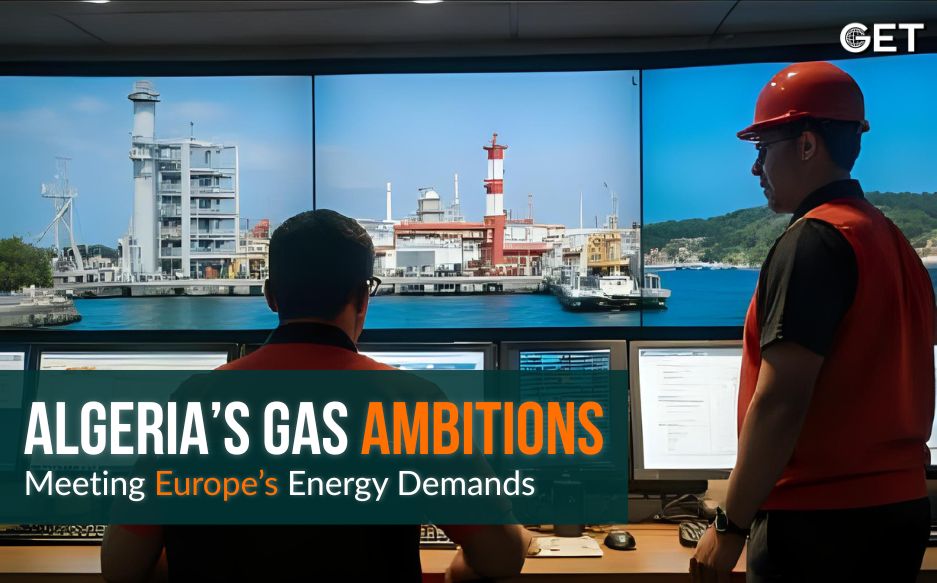
Europe’s shifting gas map has opened the door for Algeria to step in as a critical supplier. As the continent works to reduce its reliance on Russian imports, Algeria’s oil and gas resources have become central to the conversation. With strong links to Europe through pipelines and LNG terminals, the country is positioning itself as more than just a supplier, it’s shaping into an on-demand energy service provider. Backed by an evolving upstream oil and gas industry and modernized oilfield operations, Algeria is seeking to meet Europe’s energy needs while strengthening its own role in the global market for energy services.
What sets Algeria apart today is a mix of geography, infrastructure, and experience. The country’s upstream oil and gas industry has long revolved around fields like Hassi R’Mel, the beating heart of its exports. From there, gas moves through pipelines and LNG terminals that connect directly into Europe’s energy system. This isn’t just about raw production, it’s about turning those resources into a dependable energy service for neighbors across the Mediterranean.
Italy, for example, taps the TransMed pipeline, which has the capacity to push over 30 billion cubic meters a year when fully utilized. Spain relies on Medgaz, a subsea link backed by years of careful oilfield operations to keep flows steady. Then there’s the coast, where LNG hubs like Arzew and Skikda add another layer of flexibility. These terminals give Europe something it needs now more than ever, an on-demand energy service that can scale up or down depending on market conditions.
For European buyers, Algeria’s offering is more than simply oil and gas. It’s a promise of proximity, reliability, and adaptability, a partnership that blends stable pipelines with flexible LNG cargoes, ensuring that energy keeps flowing even when demand shifts overnight.
In July 2025, ENI and Sonatrach signed a new memorandum to deepen cooperation across hydrocarbons, energy transition, and security of supply, signaling that Rome and Algiers are aligning for the long haul. For Italy, already leaning on TransMed since 2022, that’s a strategic anchor. (ENI press release; Sonatrach note). eni.comsonatrach.com
Algeria’s upstream oil and gas industry is investing heavily in new compression systems at Hassi R’Mel to stabilize supply to Europe, especially during winter peaks.
Crucially, there’s headroom in the system. Despite the nameplate capacity of ~33.5 bcm/yr, TransMed carried only ~21 bcm in 2024, a reminder that demand, not just supply, sets the pace. If European consumption tightens again, volumes can scale up quickly. (Elcano data point). Real Instituto Elcano
For Spain, Algeria remains a pillar supplier via Medgaz, which was expanded in 2021–2022. The closure of the GME route through Morocco in late 2021 redirected flows, but Medgaz and LNG have kept Spanish deliveries resilient. Pricing spats and wider diplomatic tensions have occurred, yet long-term contracts with Spanish buyers (e.g., Naturgy) continue to underpin supply.
Even with Algeria’s ambitions, European demand is the swing factor. The IEA expects slower global gas demand growth in 2025 after a rebound in 2024, and Europe’s consumption remains sensitive to weather, efficiency gains, and fuel-switching. Storage levels and price signals can flip LNG cargoes into Europe at short notice, complementing pipeline gas.
For Europe, Algeria offers something rare in today’s energy market, resources that are close by, backed by pipelines and LNG terminals that can respond quickly when demand rises. But buying gas is only half the story. The bigger challenge is how to manage that supply in a world where prices swing, demand shifts overnight, and politics can change trade flows in an instant.
That’s where GET Global Group comes in.
At the end of the day, Algeria provides the gas. GET Global Group makes sure that gas works for you, reliably, flexibly, and always with the future in mind.
Algeria is hardly a fresh face in the story of European energy; it is a neighbor with the capacity and reach to be influential as never before. Some key fields are being upgraded, new agreements are in sight, and there is a significant amount of unused irrigation capacity; the country is poised to step up when Europe needs it most.
But securing energy is never just about molecules. It’s about how you plan, how you manage risks, and how quickly you can adapt when things change. That’s where we at GET Global Group come in. Through our services, like On-Demand Energy Service (ODES) for flexibility and Integrated Management Solutions (IMS) for stability, we help European buyers turn Algeria’s ambitions into reliable, day-to-day energy security.
In simple terms: Algeria can supply the gas. GET Global Group makes sure it works for you, safely, flexibly, and with the future in mind.
Read Also- Kuwait’s Digital Future: How Tech Is Shaping Oilfield Operations
By Get global | October 19, 2026
By Get global | October 16, 2026
By Get global | October 12, 2026
By Get global | October 9, 2026
Ask any person working night shifts in rigs and compressor stations what holds the industry back, and you will seldom hear anything about geology. Disconnected information, delayed decision-making, and machinery breaking down at the wrong moment – all these factors are more common causes of productivity losses in the industry. […]
By Get global | October 5, 2026
Specialized expertise turns a hard project in the oil and gas industry into a workable one. Every oilfield has its own geology, risks, and surprises. The teams that handle them the operations on field have usually met something similar before. In the modern world, upstream oil and gas companies are […]