I want to start with something I didn’t fully understand until I actually looked into it. I knew crude oil was important. I’d heard it my whole life — oil prices going up, oil prices crashing, wars fought over oil fields, pipelines getting built and protested. But I had no idea what it actually was. Like, physically. What is it? Where does it come from? Why does pulling liquid out of the ground have this insane grip on the entire world?
Turns out, the answer is both simpler and more fascinating than I expected. So let me walk you through it — from what crude oil actually is, to how upstream oil and gas companies pull it out of the earth, to why it touches pretty much every corner of modern life. I’ll keep it straightforward. No engineering degree needed.
Crude oil is a dark, thick liquid that forms deep underground. That’s the simple version. The longer version is kind of wild.
Hundreds of millions of years ago — long before humans, long before dinosaurs even — tiny marine organisms lived in ancient oceans. When they died, they sank and got buried under layers of rock and sediment. Over time, the heat from the earth and the pressure from all that rock slowly transformed those organic remains into something new. Oil. And natural gas, too.
It took millions of years. There’s no factory that makes this stuff. It’s ancient biology, turned into chemistry, turned into energy. When you fill your car with petrol, you’re technically burning something that’s older than most life on earth. That’s not something I think about at the pump, but maybe I should.
Crude oil itself isn’t uniform. It’s not one thing. Different deposits have different properties. Some crude is light and flows easily — that type is more valuable because it’s easier to refine. Some is heavy and thick, almost like tar. Some crude has high sulfur in it, which makes it “sour” in industry terms. Low sulfur crude is called “sweet.” Refiners generally prefer sweet, light crude because it produces more useful products with less work.
If crude oil formed from ancient ocean life, it makes sense that a lot of it is found in places that were once underwater — including the Middle East, which sits on some of the most geologically rich oil-bearing rock on the planet.
Saudi Arabia alone holds roughly 17% of the world’s proven oil reserves. Iraq, Kuwait, the UAE, and Iran add enormous amounts on top of that. The region became the epicenter of the global oil trade for a reason — the reservoirs there are enormous, relatively shallow, and cheap to extract from.
But oil isn’t exclusive to the Gulf. Russia has massive fields in Siberia. The United States — especially Texas and the Permian Basin — is now the world’s largest oil producer, which would have sounded impossible just fifteen years ago. Canada has the oil sands in Alberta, which hold staggering volumes of heavy crude. Brazil discovered massive pre-salt fields deep beneath the Atlantic Ocean. Nigeria, Angola, Libya, and several other African nations have significant reserves too.
It’s almost everywhere, really. The challenge is always the same — getting it out of the ground affordably.
Here’s a term you’ll hear a lot in the energy industry: “upstream.” It refers to the first part of the oil and gas chain — finding oil and getting it out of the ground. Downstream is refining and selling it. Midstream is moving it around through pipelines and tankers.
Upstream oil and gas companies handle the hard part. They’re the ones who spend years — sometimes decades — trying to find new oil deposits, then drill wells, manage production, and eventually wind down fields once they’re depleted. Think companies like ExxonMobil, Shell, BP, Chevron, Saudi Aramco, or smaller independent operators you’ve probably never heard of who work specific regions.
The work starts with geology. Before anyone drills a single hole, teams of geologists and geophysicists study the ground. They use seismic surveys — basically sending controlled shockwaves into the earth and measuring how they bounce back. The data creates a three-dimensional picture of rock formations underground. It’s sophisticated technology, but the goal is straightforward: find where oil might be trapped.
Here’s the thing though — even with the best technology, exploration is a gamble. Companies can spend $50 million or more drilling an exploratory well, only to find nothing commercially viable. Dry holes happen all the time. The economics only work because successful finds can generate returns that dwarf the cost of all the failed attempts. It’s a high-stakes business. Always has been.
Once a discovery is confirmed and deemed worth developing, the real extraction work begins. And honestly, the process is more layered than most people imagine.
The first phase: primary recovery. When a well is first drilled and connected to a reservoir, the oil often flows up on its own. There’s natural pressure in the reservoir — gas pressure, water pressure — that pushes oil toward the wellbore. Think of popping a bottle cap. This phase is the easiest and cheapest. You’re just letting physics do the work. But it doesn’t last. Pressure depletes. The flow slows. And typically, primary recovery only gets you maybe 5-15% of the oil in a reservoir.
The second phase: secondary recovery. This is where companies start injecting stuff into the reservoir to maintain pressure. Usually water. Sometimes natural gas. The idea is to push oil toward the production wells. Water flooding, as it’s called, is one of the most common techniques in the industry. It extends the productive life of a field significantly — sometimes by decades.
The third phase: enhanced oil recovery (EOR). Even after water flooding, a lot of oil remains trapped in the rock — stuck in tiny pores, clinging to mineral surfaces. EOR techniques try to loosen and recover that remaining oil. Options include injecting steam (which heats the oil and makes it flow more easily), injecting CO2 (which dissolves into the oil and reduces its viscosity), or using chemical agents that change the surface tension between oil and rock. EOR is more expensive, but as easy-to-access fields decline, it’s becoming increasingly important.
Upstream oil and gas companies are constantly making decisions about which technique makes economic sense at which stage. Push too hard and you can damage the reservoir. Don’t push hard enough and you leave recoverable oil behind. It’s a constant balancing act.
Read Also- Christmas Tree vs Wellhead: What Oilfield Teams Should Actually Know
Onshore drilling is what most people picture when they think of oil wells — a rig in a flat desert or on Texas ranch land. It’s complicated work, but logistically it’s manageable. You can drive equipment to the site. Workers can go home at night. If something breaks, you can fix it.
Offshore drilling is a different universe. You’re building an industrial facility on a platform in the middle of the ocean, sometimes in water thousands of meters deep. Workers live on the platform for weeks at a time. Hurricanes and high seas are real risks. If equipment fails, repair divers have to descend under enormous pressure. The engineering involved is remarkable — and so are the consequences when things go wrong.
The Deepwater Horizon disaster in April 2010 is the example nobody in the industry wants to talk about but everyone remembers. Eleven workers died. Nearly five million barrels of oil spilled into the Gulf of Mexico over 87 days. Entire coastal ecosystems were damaged. BP faced tens of billions in fines and settlements. It changed offshore safety regulations permanently.
And yet — offshore fields remain some of the most productive in the world. Brazil’s pre-salt layer, discovered in the mid-2000s, sits under more than two kilometers of ocean water and another five kilometers of rock and salt. Extracting oil from there is genuinely one of the most technically challenging things humans do. Upstream oil and gas companies working those fields are operating at the absolute edge of what’s currently possible.
Raw crude oil can’t go directly into your car or your gas stove. It needs to be processed first. That’s what refineries do.
The main process is called fractional distillation. Crude is heated to very high temperatures in a distillation column. Different components — called fractions — vaporize at different temperatures and separate out. Lighter molecules rise higher in the column and condense at lower temperatures. Heavier molecules stay lower.
What comes out of this process is genuinely impressive in its range:
Gasoline and diesel for vehicles. Jet fuel for aircraft. Kerosene for heating and cooking in parts of the world without gas infrastructure. Liquefied petroleum gas (LPG) for home cooking. Heavy fuel oil for shipping. And then there’s the petrochemical feedstocks — the raw materials that go into making plastics, synthetic rubber, fertilizers, pharmaceutical ingredients, adhesives, solvents, cosmetics, and synthetic fabrics.
That last category is actually where I think crude oil’s grip on modern life really shows. Most people think of oil as a fuel. But it’s also the feedstock for an enormous portion of modern manufacturing. Your phone case. The plastic packaging around your lunch. The polyester in your shirt. The fertilizers that grew the food on your plate. These all trace back, in some way, to crude oil.
Eliminating oil from global supply chains isn’t just about switching to electric cars. It’s a far deeper transformation than that.
Oil is one of those commodities where a $5 price change per barrel can send ripples through every major economy on earth. When oil gets expensive, transport costs rise. That raises the price of shipping goods, which raises the price of goods in stores. Airlines pass costs on to passengers. Farmers pay more to run equipment. Heating bills go up. Inflation follows.
When oil crashes — like it did in early 2020 when COVID-19 wiped out travel and industry demand almost overnight — entire national economies buckle. Saudi Arabia had to slash its government budget. Russia’s currency dropped. Oil-producing states in the US like Texas and North Dakota saw mass layoffs practically overnight. The price of West Texas Intermediate crude briefly went negative in April 2020. Negative. Producers were literally paying people to take oil because storage was full and nobody was buying.
That’s how central oil is. OPEC — the Organization of the Petroleum Exporting Countries — exists largely because of this reality. By coordinating production levels among member nations, OPEC can influence the global oil price. In 1973, an OPEC oil embargo caused fuel shortages across the US and Europe that genuinely reshaped political and economic thinking for a generation.
Today, OPEC+ (which includes Russia and other non-OPEC producers) is a regular feature of financial news. When they announce a production cut, markets respond immediately. That’s an enormous amount of power for a group of countries to hold over the global economy.
I don’t think it helps anyone to dance around this part. Oil has real, documented, serious environmental consequences. And I think most people who work in the industry know it, even if the public messaging from major companies has sometimes tried to obscure that.
Burning fossil fuels — oil, coal, natural gas — releases carbon dioxide. CO2 accumulates in the atmosphere and traps heat. The science on this is not contested among climate researchers. The world is warmer now than it was before industrialization, and a significant portion of that warming is from fossil fuel combustion. The downstream effects — more intense weather events, rising sea levels, shifting agricultural zones, accelerating biodiversity loss — are already visible.
Oil spills are the other obvious impact. They’re dramatic, they make headlines, and the ecological damage can persist for decades. The Exxon Valdez spill in 1989 in Alaska is still cited in environmental science literature. Wildlife populations in affected areas never fully recovered.
Upstream oil and gas companies have, to their credit, made genuine improvements in safety and emissions over the past few decades. Methane flaring — burning off unwanted gas at wellheads — has decreased significantly in many regions. Spill frequency per barrel produced is lower than it was in the 1970s. Some companies have invested seriously in carbon capture research.
But the fundamental problem remains. The business model depends on extracting and burning a substance that warms the planet. Incremental improvements don’t solve that structural issue.
There’s a reason the phrase “resource curse” exists. Countries that discover massive oil wealth don’t always end up better off for it. The revenue often concentrates in the hands of governments or elites. Democratic institutions get weaker, not stronger. Economic diversification stalls because oil money makes everything else look unnecessary — until the oil price crashes.
And internationally, oil has been the background cause or direct driver of more conflicts than most history books fully acknowledge. The Gulf War in 1991. The ongoing tensions between Iran and Saudi Arabia that play out through proxy conflicts across the Middle East. Pipeline politics between Russia and Europe. The strategic importance of the South China Sea, which is believed to hold significant untapped reserves.
The US shale revolution — made possible by hydraulic fracturing and horizontal drilling techniques that became commercially viable around 2008-2012 — genuinely changed the geopolitical equation. By 2019, the United States was producing more oil than any country in history. American dependence on Middle Eastern imports declined dramatically. That shifted negotiating dynamics in ways still playing out today.
The honest answer is: yes, eventually. But “eventually” is doing a lot of work in that sentence.
Right now, the world consumes roughly 100 million barrels of crude oil every single day. That number has barely budged for years, despite enormous growth in renewable energy. Electric vehicles are growing fast — but they’re still a fraction of the total global vehicle fleet. Aviation, shipping, and heavy industry have limited near-term alternatives to liquid fuels. And in developing countries, where hundreds of millions of people are gaining access to modern energy for the first time, fossil fuels remain the most accessible and affordable option.
Upstream oil and gas companies are in a genuinely awkward position. Investor pressure, government policy, and public opinion are all pushing toward energy transition. But actual demand for their product isn’t dropping fast enough to justify shutting down existing operations. Many companies are hedging — investing in natural gas (which they position as a cleaner “transition fuel”), funding renewable energy subsidiaries, and committing to net-zero targets several decades into the future.
Whether those commitments are genuine or mostly PR is a question worth asking. Some companies are making real structural changes. Others are doing the bare minimum required to avoid regulatory penalties and activist shareholder votes.
Peak oil demand is probably coming. Most serious forecasts put it somewhere between 2030 and 2040, depending on how quickly EV adoption grows and how aggressively governments implement carbon pricing. After that, the long, slow decline begins.
But “decline” still means enormous volume for many years. The industry isn’t going to zero in a decade. That’s not pessimism — it’s just arithmetic.
When I started reading about crude oil seriously, I expected to come away with a cleaner story. The hero (renewables) versus the villain (oil). Reality, as usual, is messier.
Crude oil is one of the most consequential substances in human history. It lifted living standards for billions of people. It also destabilized regions, funded authoritarian governments, and contributed to environmental changes that will affect every future generation. Upstream oil and gas companies sit right at the center of that story — doing work that’s genuinely extraordinary in its technical difficulty, in service of a product the world is trying, with great difficulty and urgency, to move away from.
Understanding all of this — the chemistry, the extraction, the economics, the politics, the environmental math — matters. Because the energy transition isn’t just a technological challenge. It’s a human one. And you can’t really participate in that conversation without understanding what we’re transitioning away from, and why it got such a grip on us in the first place.
Crude oil isn’t just fuel. It’s history, geopolitics, chemistry, and economics all compressed into a barrel. And knowing that makes the story of where we go next a lot more interesting.
Read Also- 5 Game Changing Facts Related to Oil and Gas Industry
By Get global | September 14, 2026
Ten years back, most HSE policies stopped at the company gate. Whatever happened past that point, subcontractors, transport, equipment vendors, was technically someone else’s problem, at least on paper. Not anymore. And the reason is blunt: trace a serious incident back far enough, and often it started somewhere in the supply chain, not […]

By Get global | September 14, 2026
Health, safety and environment in the oil and gas sector was long treated as a back-office function, running quietly alongside the core work of drilling, extraction, and processing. That is no longer the case. Extreme pressures, volatile materials, remote sites, and heavy machinery mean the risk in this industry has […]
By Get global | September 14, 2026
By Get global | September 9, 2026
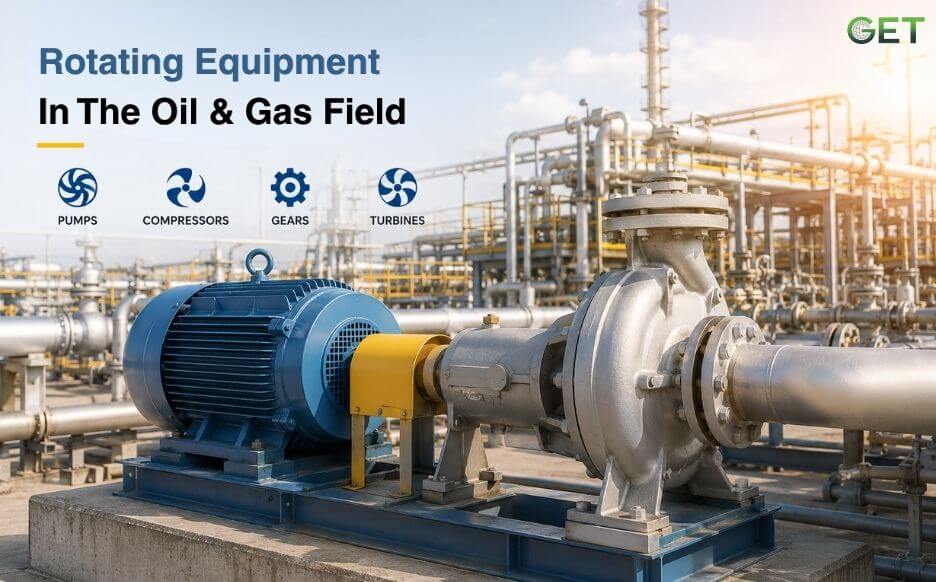
Walk onto any rig floor, production platform, or gas processing plant, and the first thing you notice isn’t the pipework – it’s the sound. That low, constant hum coming from somewhere in the facility is almost always rotating equipment doing its job. Pumps pushing fluid through miles of pipeline. Compressors […]

By Get global | September 9, 2026