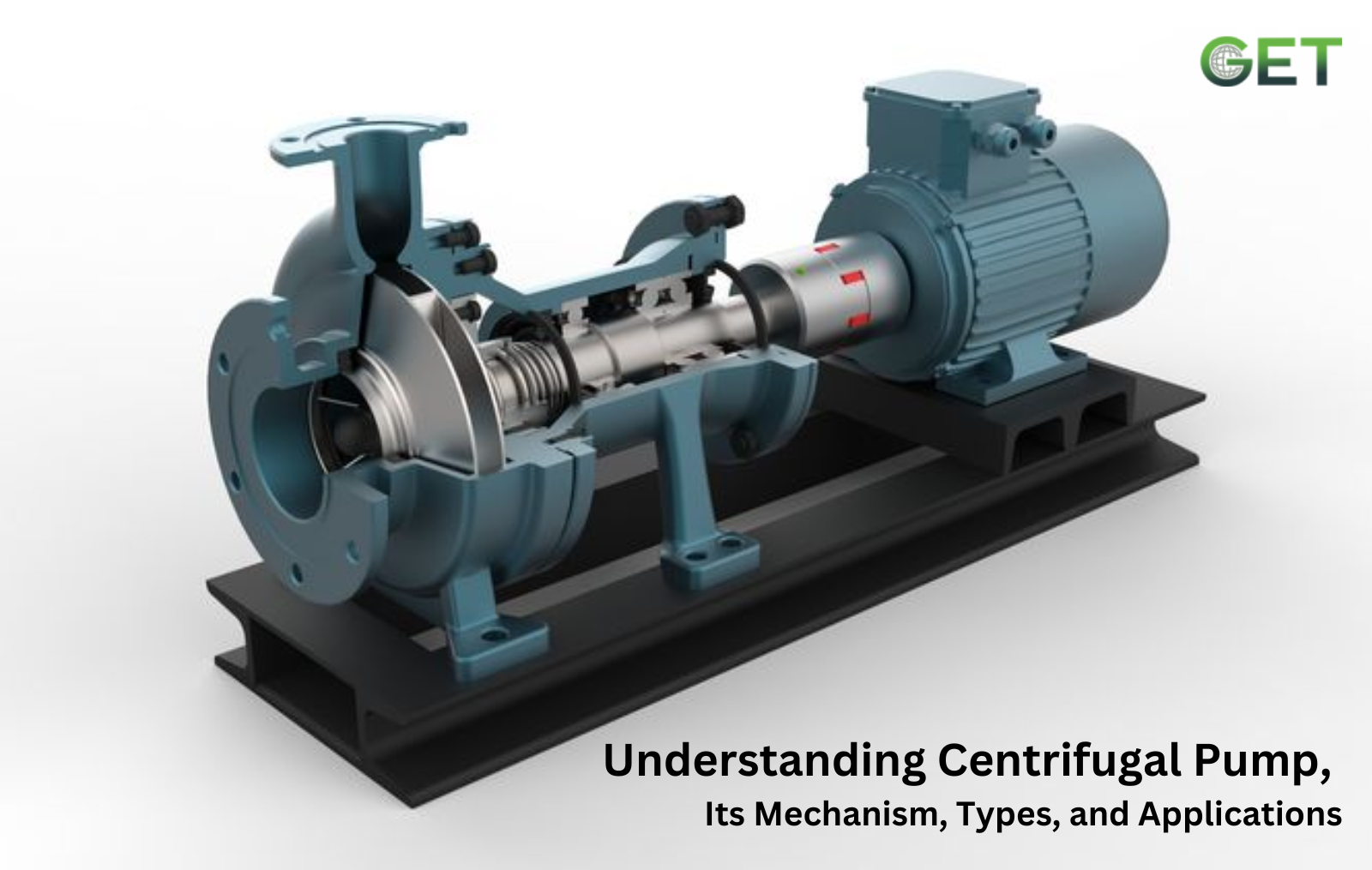
If you’ve ever worked near an oil refinery, a water treatment plant, or even a large HVAC system, chances are you’ve heard that steady hum in the background. That’s likely a centrifugal pump doing its job — quietly, continuously, and efficiently.
Centrifugal pumps are everywhere. They move crude oil through pipelines, push water through city supply networks, and circulate coolants in power plants. Yet, for something so widely used, many professionals only have a surface-level understanding of how they actually work.
This guide changes that. Whether you’re a mechanical engineer, an oil & gas technician, or someone preparing for a job in the energy sector, you’ll walk away with a clear, practical understanding of centrifugal pumps — from their working principle to their real-world applications.
A centrifugal pump is a mechanical device that uses rotational energy — typically from an electric motor or engine — to move fluids from one place to another.
The core idea is simple: spin a fluid fast enough, and centrifugal force will push it outward, build pressure, and send it flowing through a pipe.
These pumps fall under the category of dynamic pumps, which means they transfer energy continuously to the fluid — unlike positive displacement pumps that move fluid in discrete amounts.
The working principle of a centrifugal pump is based on the conversion of kinetic energy into pressure energy.
Here’s how it happens, step by step:
It’s a smooth, continuous process — no back-and-forth motion, no complex valves. That’s part of what makes centrifugal pumps so reliable.
Understanding the parts helps you troubleshoot problems and make better maintenance decisions.
The heart of the pump. It’s a rotating disc with curved vanes that accelerates the fluid using centrifugal force. Impellers can be open, semi-open, or closed depending on the application.
The casing surrounds the impeller and collects the fluid. Its spiral shape gradually slows the fluid and converts kinetic energy into pressure.
The shaft connects the impeller to the motor. It transmits the rotational force (torque) needed to spin the impeller.
Bearings support the shaft and keep it properly aligned during rotation. They reduce friction and absorb the mechanical loads.
Seals prevent fluid from leaking out along the shaft. In oil & gas applications, choosing the right seal material is critical — because the fluids involved can be hazardous or corrosive.
Not all centrifugal pumps are the same. Depending on the application, engineers choose from several designs.
Oil & Gas Industry This is one of the most demanding environments for pumps. Centrifugal pumps are used for:
In upstream operations specifically, electric submersible pumps (ESPs) — a type of centrifugal pump — are widely deployed inside oil wells to lift reservoir fluid to the surface.
Water Supply & Wastewater Treatment Municipal systems rely heavily on centrifugal pumps to distribute drinking water and manage sewage. They handle large volumes at relatively low pressures — exactly what radial and mixed flow pumps do best.
Power Plants Boiler feed pumps (multi-stage centrifugal pumps) deliver high-pressure water into steam boilers. Cooling water systems also use them extensively.
Chemical & Process Industries From acid transfer to solvent circulation, centrifugal pumps handle a wide range of corrosive and non-corrosive fluids in process plants — with appropriate material selection for the casing and impeller.
Centrifugal pumps are low-maintenance by nature — but “low” doesn’t mean “none.”
In upstream oil & gas — the exploration and production side — centrifugal pumps are indispensable. Here’s why:
Artificial Lift: When reservoir pressure alone isn’t enough to bring oil to the surface, ESPs take over. These are essentially multi-stage centrifugal pumps installed deep inside the wellbore. They’re one of the most commonly used artificial lift methods globally.
Water Injection: To maintain reservoir pressure and enhance oil recovery, large volumes of water are injected into the formation. High-pressure multi-stage centrifugal pumps make this possible.
Produced Water Handling: Oil production brings a lot of water with it. Centrifugal pumps move this produced water to treatment facilities or disposal wells.
Reliability Matters: In offshore platforms or remote onshore fields, equipment downtime is expensive. Centrifugal pumps — when properly maintained — offer the kind of reliability that these environments demand.
Centrifugal pumps are not just mechanical components — they’re the circulatory system of modern industry. From moving crude oil in remote oilfields to supplying clean water to millions of homes, their role is quiet but absolutely essential.
As industries push toward greater efficiency and automation, centrifugal pump technology is evolving too — with smart monitoring systems, variable frequency drives (VFDs) for energy savings, and better materials for extreme environments.
If you’re working in oil & gas or any process industry, developing a solid understanding of centrifugal pumps isn’t just helpful — it’s a career asset.
Read Also- What is a Barrel in the Oil and Gas Industry?
A centrifugal pump is a mechanical device that uses a rotating impeller to convert kinetic energy into fluid pressure. When the impeller spins, it pulls fluid in through the suction inlet, accelerates it outward using centrifugal force, and pushes it out through the discharge at higher pressure.
The main types include single-stage and multi-stage pumps, axial flow pumps, radial flow pumps, mixed flow pumps, and submersible pumps. Each type is suited for specific flow rate, pressure, and fluid conditions.
Centrifugal pumps are widely used in oil & gas (drilling, refining, water injection), municipal water supply, wastewater treatment, power plants, and chemical processing industries.
Common causes include cavitation (vapor bubble formation at the inlet), impeller wear, air leaks in the suction line, incorrect pump sizing, and operating far outside the design flow range (off Best Efficiency Point or BEP).
Centrifugal pumps can handle slightly viscous fluids, but their efficiency drops significantly as viscosity increases. For highly viscous fluids like heavy crude oil or slurries, positive displacement pumps are generally more suitable.
Cavitation occurs when the pressure at the pump inlet drops below the vapor pressure of the fluid, causing it to vaporize and form bubbles. When these bubbles collapse near the impeller, they create micro-shockwaves that erode the metal over time — leading to noise, vibration, and reduced performance.
Service frequency depends on the application and manufacturer guidelines, but a general rule is to inspect bearings and seals every 3–6 months, check alignment quarterly, and perform a full overhaul every 2–3 years or based on run-hours. In demanding environments like oil fields, more frequent checks are standard practice.

By Get global | September 30, 2026

By Get global | September 28, 2026

By Get global | September 28, 2026

By Get global | September 28, 2026
Technology has touched every corner of modern oil and gas operations—from upstream exploration and drilling to midstream pipelines, downstream facilities, maintenance, and performance monitoring. One area where digital transformation delivers exceptional value is HSE (Health, Safety and Environment), a core priority for GET Global Group and the wider energy industry. […]

By Get global | September 22, 2026