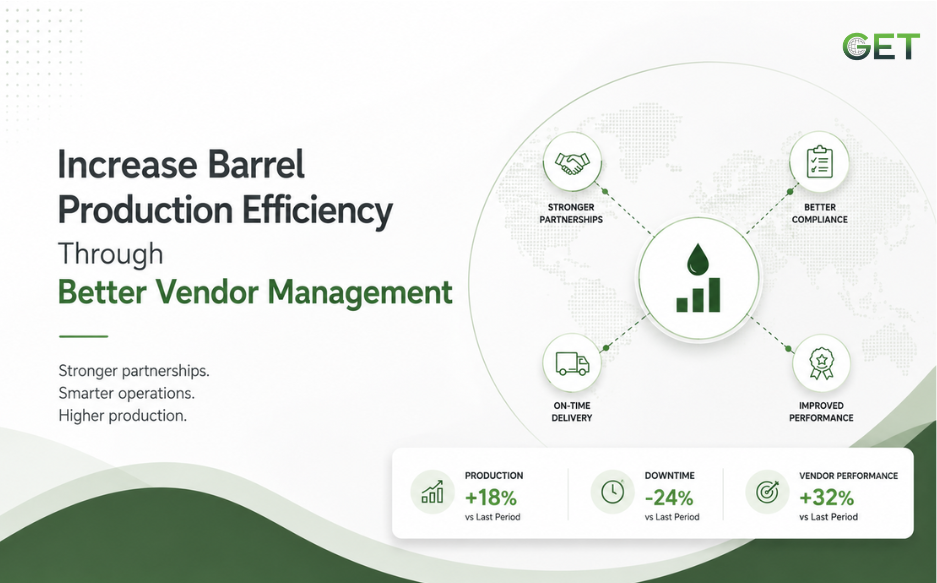
In upstream oil and gas, the margin between a profitable well and an underperforming one is rarely just a matter of geology. It comes down to execution, and execution depends heavily on the vendors, contractors, and service providers working alongside operators every single day.
When equipment arrives late, when a specialist crew is underqualified, when a spare part gets stuck in procurement limbo, production stalls. Barrels that should have come out of the ground simply don’t. And in a market where WTI has been hovering around $61 per barrel, operators cannot afford to leave recoverable production on the table because of fragmented or reactive vendor management.
The good news is that better vendor management is one of the most direct levers operators can pull to improve barrel production efficiency, without drilling a single new well.
Most efficiency conversations in the upstream sector focus on drilling performance: longer laterals, faster completions, optimised well spacing. These are real gains. The Permian Basin, for instance, has seen average oil output per rig exceed 1,300 barrels per day, a result of years of technical refinement at the wellsite.
But there’s a quieter drag on production that rarely makes it into headline metrics: vendor-related downtime.
Think about what it takes to keep a well-running production. You need qualified field crews rotating on schedule. You need spare parts and consumables arriving before they’re critically needed, not after. You need maintenance windows planned and executed efficiently so production isn’t interrupted longer than necessary. Each of these depends on vendors, and each vendor relationship, managed poorly, introduces risk into the production chain.
Whether it’s a geopolitical issue, logistics problems or just bad contract terms, the impact of the disruptions is reflected in the number of barrels per day. Operating expenditure (OpEx) has increased due to rising labour costs, rising material costs and an increasing complexity of managing multi-vendor offshore and onshore operations, while some operators are facing challenges to keep the output consistent.
The conclusion is straightforward: production efficiency and vendor management are not separate problems. They are the same problem, looked at from different angles.
It’s worth being specific, because “inefficient vendor management” can sound like an abstract back-office concern.
Consider an offshore platform where a critical pump seal fails. If the right spare isn’t in the warehouse, because inventory was managed reactively rather than proactively, the operator has to fast-track a procurement order. That might mean paying premium freight charges, waiting days for delivery, and losing production for the duration. Multiply that across a fleet of assets, and the cost impact is significant.
Or consider an integrated maintenance programme where different contractors handle mechanical, electrical, and instrumentation work, but nobody has clear ownership of the schedule. Tasks get duplicated, dependencies get missed, and planned maintenance that should take five days drags into eight. Every extra day is lost production.
McKinsey analysis of upstream operators found that production efficiency was dropping even as operating expenditure was rising, with labour rates growing at more than 9 percent per annum and standard-use material costs increasing at 5 percent annually. In that environment, the companies gaining ground are those managing their vendor ecosystems as strategic assets, not administrative necessities.
Ready to take control of your supply chain?
GET Global Group’s Procurement and Supply Chain Management solutions are built specifically for upstream oil and gas operators.
None of these requires a capital project or a new technology platform. They require a harder look at how vendor relationships are structured, managed, and held to account across the operation.
Walk into any upstream operator’s procurement office, and you’ll likely find a vendor list nobody fully owns. It grew the way most things do in field operations — one contract at a time, one emergency at a time, until you’ve got forty suppliers doing what fifteen could handle better. Nobody intended it. It just happened.
The problem isn’t the number. It’s what comes with it: no single supplier feels enough accountability to go above and beyond, quality checks become inconsistent across the board, and when you need to push back on pricing or timelines, you’re negotiating from a weak position. Preferred supplier relationships, on the other hand, change the dynamic entirely. When a vendor has real volume commitments and knows the business is theirs to lose, they show up differently. Faster. More invested. That’s not a soft benefit — it shows up in uptime.
Here’s a contractor arrangement most field teams will recognise: the service vendor gets paid for days on-site regardless of what actually got done. Equipment sat idle on Tuesday? Still billable. Maintenance took twice as long as planned? That’s the operator’s problem. The contract said nothing about outcomes.
Output-based contracting flips this. When a contractor’s payment is tied to equipment availability, or response time, or delivery accuracy, the incentive structure changes. Suddenly, they care about the same things the operator cares about. Risk-sharing clauses push this further — if production suffers because of vendor underperformance, the vendor carries part of that cost. It’s a harder negotiation upfront, but operators who have made the shift consistently report it as one of the better decisions they’ve made.
In practice, procurement and field operations often work like two teams playing different sports on the same pitch. Procurement is optimising for unit cost and approved vendor lists. The field team is optimising for “we need this now.” Neither team has a clear view of what the other is managing, and the production schedule sits somewhere in between, absorbing the friction.
The fix isn’t complicated in theory, though it takes real effort to implement: both sides need to see the same data. When field teams can see vendor lead times and inventory levels, and when procurement can see the forward maintenance schedule and production targets, decisions start getting made earlier. Procurement and supply chain management stops being a support function reacting to field requests and starts being a function that prevents the requests from becoming crises in the first place.
Managing five vendors across the same operational area sounds manageable until something goes wrong and each one points at the others. Who owns the outcome when the mechanical contractor, the instrumentation team, and the logistics provider all had a hand in the delay? In practice, the operator ends up owning it by default.
An integrated service provider changes that equation. Instead of managing interfaces between vendors, you’re managing one relationship with clear accountability across the full scope. For operators in remote environments, especially, this matters enormously. Getting five vendors coordinated across a frontier location burns time and management bandwidth that most lean field teams simply don’t have. Consolidating that under one accountable partner isn’t just operationally cleaner — it’s often meaningfully cheaper once the coordination costs are factored in.
The industry has run on reactive vendor management for decades. Something breaks, you call someone. Stock runs out, you raise a purchase order. There’s a kind of operational muscle memory around it — the field knows how to scramble, and vendors have built their own businesses around being available for emergencies.
The cost of this model rarely shows up cleanly in any one line item, but it’s real. Emergency freight, premium rates for short-notice crew, unplanned downtime while parts are sourced. Operators who have started using predictive approaches — tracking consumption patterns, feeding maintenance data into forecasting tools, giving vendors earlier visibility into upcoming demand, are finding that a lot of those emergency calls simply stop happening. The parts are already there. The crew is already booked. It’s a less dramatic way to run operations, and that’s exactly the point.
The current environment makes the case for better vendor management more urgent than it has been in years.
Prices are subdued. Drilling activity has slowed. Operators face pressure to sustain and grow output without proportional increases in capital expenditure. In this context, the efficiency gains that come from optimising existing production, rather than drilling new wells, are exactly where operators should be looking.
Better vendor management sits at the intersection of cost control and production performance. It doesn’t require new wells or new technology. It requires a more disciplined, integrated approach to the vendor relationships that underpin every barrel an operator produces.
For companies operating in the upstream sector, the question isn’t whether vendor management matters for production efficiency. It’s whether the current approach to vendor management is as good as it needs to be, and what a more integrated, performance-driven model could unlock.
See how GET Global Group can help.
Our Procurement and Supply Chain Management solutions are trusted by upstream operators across the Middle East, Africa, and Asia to lower operating costs and protect production performance.
GET Global Group provides turnkey outsourced solutions for the upstream oil and gas industry, including procurement and supply chain management, integrated maintenance services, expertise-based field services, and on-demand energy solutions. With a presence across the Middle East, Africa, Asia, and beyond, GET partners with operators to lower operating expenses, optimise resources, and improve production performance.

By Get global | October 19, 2026

By Get global | October 16, 2026

By Get global | October 12, 2026

By Get global | October 9, 2026
Ask any person working night shifts in rigs and compressor stations what holds the industry back, and you will seldom hear anything about geology. Disconnected information, delayed decision-making, and machinery breaking down at the wrong moment – all these factors are more common causes of productivity losses in the industry. […]

By Get global | October 5, 2026
Specialized expertise turns a hard project in the oil and gas industry into a workable one. Every oilfield has its own geology, risks, and surprises. The teams that handle them the operations on field have usually met something similar before. In the modern world, upstream oil and gas companies are […]