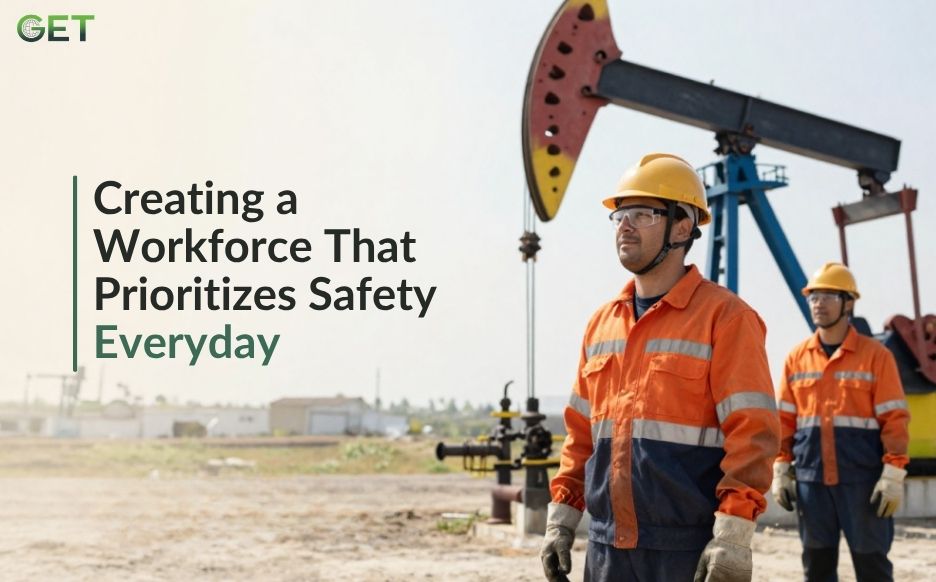
Real safety starts with the people, not the paperwork. A worker puts on gloves and a hard hat without being reminded. A crew checks each other’s harnesses before a lift. A new hire asks a question instead of guessing, because he’s been told it’s fine to ask. None of that shows up in an audit report. It shows up on the site, every shift, in small decisions nobody writes down. That’s the real challenge behind oil and gas safety – getting a workforce to own it, instead of just following what’s handed to them on a laminated sheet.
This industry doesn’t get to treat safety as optional. High-pressure systems, flammable materials, heavy equipment, crews working odd hours in remote places – put all that together and you get one of the more dangerous working environments out there. When oil and gas safety breaks down, it’s rarely subtle. Injuries, fatalities, environmental fallout, fines, and a reputation hit that can outlast the incident itself by years.
Here’s the part that surprises people outside the industry: most incidents aren’t caused by some freak equipment failure nobody could’ve predicted. They come from small stuff. Someone skips a step on the permit because the job’s already running late. A glove gets left in the truck because it’s a five-minute task, what’s the harm. That’s why oil and gas safety must live in the daily routine, not in a binder that gets pulled out once a quarter for an audit.
Companies that actually get this right aren’t just safer on paper. Workers stick around longer. Morale holds up better. And people are more willing to flag something that looks off, because they trust that raising a hand won’t get them in trouble – which, frankly, is the single biggest factor in whether a near-miss stays a near-miss or turns into something worse.
If you want to see where the stakes are highest, look upstream. Exploration and production – seismic surveys, drilling, well completion – happens in places that are remote, physically brutal, and often geologically unpredictable. Upstream oil and gas safety isn’t downstream’s cousin with slightly higher stakes. It’s a different animal entirely.
Downstream work generally happens in more controlled facility settings. Upstream doesn’t get that luxury. Crews deal with unstable ground conditions, weather that can turn without warning, and equipment pushed close to its limits. That’s part of why upstream oil and gas safety programs tend to get audited harder and more often than almost anything else in an HSE framework.
That last point matters more than people realize. When help is genuinely far away, upstream oil and gas safety planning has to assume the worst-case response time – not the best case. It changes how much redundancy you build in, and how deep the first-responder training goes for field crews who might be the only medical help available for an hour or more.
Here’s where a lot of companies drop the ball. They spend heavily on equipment, on systems, on software – and barely touch the human side. Real oil and gas workforce safety has less to do with how many harnesses are on-site and more to do with whether a worker actually feels safe enough to stop a job, or admit they messed up, without getting reamed out for it.
A few things tend to show up together in workforces that take this seriously:
HSE – health, safety, and environment – is basically the scaffolding that holds everything else up. It’s what turns “we care about safety” into something you can audit, measure, and improve. HSE in oil and gas ties together compliance, risk assessment, incident investigation, and whatever comes after that.
A solid HSE in oil and gas program usually rests on a handful of things:
The gap between companies that do this well and companies that just check boxes usually comes down to follow-through. Writing a policy is easy. Going back six months later and actually checking whether people are following it – that’s the part most organizations skip.
Read Also- HSE Excellence in Oil & Gas: Building a Safer, Sustainable and Compliant Workplace
Frameworks matter, sure. But what actually determines whether a shift ends clean or ends with an incident report is the day-to-day stuff – the oilfield safety practices crews run through without thinking twice.
What ties all of these oilfield safety practices together is consistency. A rule followed nine times out of ten isn’t really a safety practice. It’s a bet. The goal is making the safe choice the automatic choice, so it doesn’t come down to whether someone remembered or felt like it that day.
None of this holds up without training, and training is usually the first thing to get cut when budgets tighten – which tends to backfire, because undertrained crews get hurt more often. That’s not opinion, it’s just how the numbers play out.
Good oil and gas safety training isn’t a one-time orientation video. It includes:
The companies doing this well track more than attendance. They track whether the training actually stuck, using digital systems that flag gaps before those gaps turn into incidents. Oil and gas safety training treated as a real investment – not a box to check – tends to correlate pretty directly with fewer incidents down the line.
Long-term, improving workforce safety in oil and gas comes down to leadership that shows up on a normal Tuesday, not just during an audit or right after something’s gone wrong. Field supervisors set the tone more than any policy document ever will.
When workforce safety in oil and gas is genuinely a leadership priority – not just a line in a mission statement – it shows up in the numbers. Fewer lost-time incidents. More near-misses actually getting reported, which sounds bad but is actually a sign people trust the system. Better retention among the experienced people you don’t want to lose.
None of this works as separate pieces. HSE management in oil and gas is what ties strategy, systems, training, and day-to-day culture into something that actually improves over time instead of just sitting static.
Modern HSE management in oil and gas increasingly leans on:
Companies with mature HSE management in oil and gas don’t box safety off into its own department. It threads through operations, HR, even finance – because a strong safety record isn’t just a compliance win. It’s a real business indicator.
Creating a workforce that prioritizes safety every day isn’t one program or one initiative. It’s the sum of a lot of smaller things – solid HSE in oil and gas frameworks, oilfield safety practices that people actually follow, oil and gas safety training that sticks, and leadership that treats workforce safety in oil and gas as a daily job, not a quarterly review. From upstream oil and gas safety out on a remote drilling site to HSE management in oil and gas happening in a corporate office somewhere, it all has to point the same direction: safety isn’t for when someone’s watching. It’s just how the job gets done.
The companies that live this – instead of treating oil and gas safety as a regulatory hoop to jump through – tend to come out ahead in more than just their safety stats. Productivity, retention, the ability to keep operating without disruption. It’s all connected.
Read Also- How Oil & Gas Companies Can Reduce Environmental Impact and Improve Operations
Frequently Asked Questions
HSE is the formal system – the policies, audits, and management structure. Oil and gas safety is the outcome that system is supposed to produce: a workforce that operates without harm, day to day.
Upstream work happens in remote, unpredictable settings with less nearby emergency infrastructure, and it involves well-control hazards and equipment running closer to its limits than most downstream operations.
More than just at onboarding. Most solid programs run annual refreshers, role-specific updates, and regular emergency drills, instead of waiting for a certification to expire.
A big one. Frontline crews usually spot hazards before anyone else does, which is why things like stop-work authority and peer accountability matter as much as any written procedure.
Less downtime from incidents, lower insurance and liability costs, better retention, and a reputation that holds up with regulators and investors.
By Get global | September 28, 2026
Technology has touched every corner of modern oil and gas operations—from upstream exploration and drilling to midstream pipelines, downstream facilities, maintenance, and performance monitoring. One area where digital transformation delivers exceptional value is HSE (Health, Safety and Environment), a core priority for GET Global Group and the wider energy industry. […]
By Get global | September 22, 2026
By Get global | September 21, 2026
Regulators are tightening the screws on emissions. Investors are asking harder questions about ESG performance. And communities near production sites have gotten a lot less patient with flaring, leaks, and spills that used to get a shrug. For upstream operators, environmental performance isn’t a side conversation anymore. It’s sitting right […]
By Get global | September 18, 2026
By Get global | September 14, 2026
Ten years back, most HSE policies stopped at the company gate. Whatever happened past that point, subcontractors, transport, equipment vendors, was technically someone else’s problem, at least on paper. Not anymore. And the reason is blunt: trace a serious incident back far enough, and often it started somewhere in the supply chain, not […]