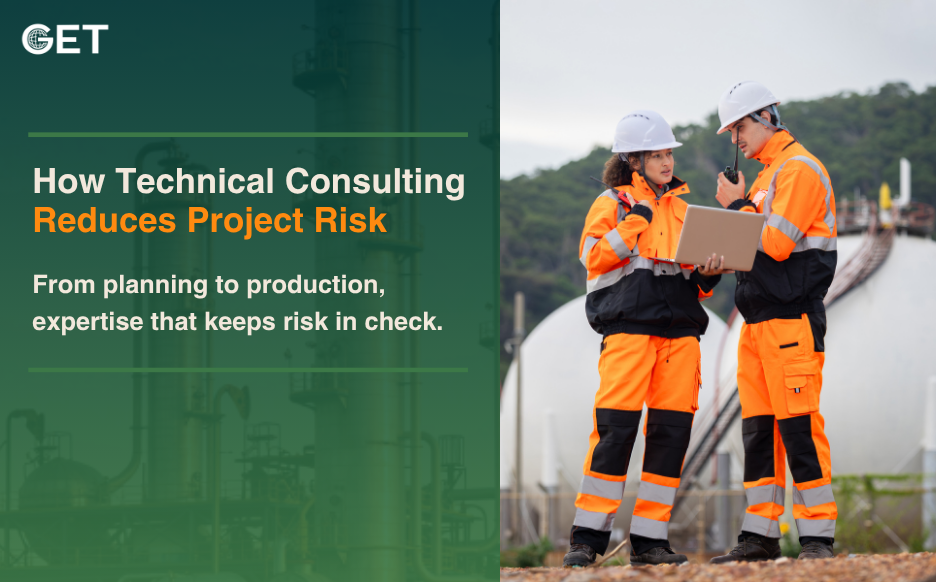
Drilling sites, pipeline expansions, refinery turnarounds — most of the time, none of them go exactly to plan. Soil conditions shift. Equipment often turns up late. Rules change mid-build. And it’s usually the project manager left holding the budget, the schedule, and the safety record together. This is precisely where technical consulting services earn their keep. They don’t eliminate risk – no one can promise that in an industry this complex, but they give operators the foresight, structure, and specialized knowledge needed to catch problems before they become expensive disasters.
At GET Global Group, this is a pattern we see play out repeatedly across projects in the Middle East and South Asia, which is why bringing in the right technical partner at the right stage makes such a measurable difference.
In the last twenty years, the industry has advanced a lot. Wells are more complex now, reservoirs sit deeper, and regulators are watching environmental impact far more closely than they used to. Given all that, it’s no surprise upstream oil and gas consulting has gone from something nice to have to something most operators genuinely can’t do without.
There’s a simple reason for that. Teams that bring in outside technical expertise tend to make fewer costly mistakes – because they’re not limited to what one in-house team happens to know. They’re pulling from experience across dozens of projects, not just their own.
Internal teams are often stretched thin. A drilling engineer might be juggling three active wells at once. A project manager might be overseeing budgets across multiple sites simultaneously. When bandwidth is limited, small warning signs get missed like a slightly-off pressure reading, a subcontractor falling behind schedule, a permit that’s about to lapse. None of these issues are catastrophic on their own, but stacked together, they can derail an entire project.
This is exactly the gap that oil and gas project management specialists tend to fill. They’re not there to replace the internal team – more to work alongside them, adding another set of eyes that isn’t buried in the daily grind. And that outside view often picks up on risks that internal staff, too close to the day-to-day, just don’t have the bandwidth to notice.
One of the biggest risk factors in any oil and gas project is a knowledge gap. Not every operator has deep, current expertise in every discipline a project touches geophysics, drilling engineering, environmental compliance, process safety, and logistics all require different specialists. Technical expertise in oil and gas is rarely something a single company can always maintain across every one of those disciplines, especially for mid-sized operators who don’t have the budget for a full bench of niche specialists sitting idle between projects.
Consultants solve this problem in a practical way – they show up when the expertise is needed, and step back once that specific challenge is handled. Maybe it’s a reservoir engineer brought in for three weeks to sign off on a development plan. Or a process safety expert who reviews a facility design before anything gets built. Either way, it means companies get access to real technical depth when they need it, without having to keep a full specialist team on payroll all year.
Here’s the thing – most project risk doesn’t show up during execution. It gets baked in way earlier, during planning, long before anyone’s broken ground. A rushed feasibility study, a timeline nobody really believes in, a budget that’s off by a few key numbers – any of these can set a project up to struggle months down the line, and often nobody notices until it’s too late. This is exactly why technical consulting services matter so early on, well before crews or rigs ever show up on site.
Experienced consultants stress-test assumptions. They ask uncomfortable questions: Is this timeline achievable given current supply chain conditions? Has the geological data been independently verified? Are the cost estimates based on current market rates or numbers from two years ago? These questions, asked early, save companies from far more expensive corrections in the later stage. An oil and gas consulting company that specializes in upfront due diligence can often save a client multiples of its consulting fee simply by preventing one heavy and avoidable planning mistake.
Once a project moves from planning into execution, risk doesn’t disappear – it just changes shape. Now the concerns are operational: Is drilling progressing at the expected rate? Are contractors meeting quality standards? Is the budget tracking against forecasts? This is where oilfield technical support becomes indispensable, because it puts trained eyes directly on the ground where problems happen.
Experienced field-based consultants can spot equipment issues before they cause downtime, flag safety concerns before they become incidents, and identify scheduling slippage while there’s still time to course-correct. Compare that to a phase where problems aren’t discovered until a monthly report lands on someone’s desk – by then, the cost of fixing the issue has often multiplied several times over. Real-time oversight, delivered by people who understand both the technical and operational sides of oilfield work, is one of the most effective risk-reduction tools available to any operator. This is a big part of why teams like GET Global Group focus on placing experienced personnel directly in the field rather than managing projects purely from a distance.
Strong project management is the backbone that holds everything else together. Even the best technical expertise in oil and gas won’t help much if the overall project isn’t being coordinated properly. Oil and gas project management consultants bring structured methodologies, which includes but is not limited to clear milestones, defined accountability, transparent reporting – all that keep every stakeholder aligned and every risk visible.
This matters enormously in an industry where projects involve multiple regulatory bodies. Without disciplined project management, it’s easy for responsibility to become diffuse – everyone assumes someone else is watching a particular risk, and it slips through the cracks. A dedicated project management consultant closes that gap by taking the full ownership of the project, not just one slice of it.
What About Regulatory Risk
Regulatory risk is one of the areas where operators most often get caught off guard. Environmental permitting, safety regulations, and reporting requirements vary by region and change frequently. A project that looked fully compliant at the planning stage can suddenly find itself out of discussion with new rules introduced midway through construction.
Consultants who specialize in upstream oil and gas consulting typically track these regulatory shifts as part of their core job, which means they can flag compliance risks long before they turn into fines, project delays, or reputational damage. This is particularly valuable for companies expanding into new regions or new types of projects, where local regulatory nuances aren’t always obvious from the outside.
Budget overruns are one of the most visible and most damaging forms of project risk in oil and gas. A project that blows past its budget doesn’t just cost more money; it can also erode investor confidence, delay other planned projects, and put pressure on teams to cut corners elsewhere to compensate. Technical consulting services help control this risk by bringing more accurate cost modelling into the process from day one.
Because consultants work across many projects and many clients, they often have a more current and realistic sense of material costs, labor rates, and equipment lead times than an internal team working from historical data. That real-world pricing knowledge translates directly into tighter, more reliable budgets and fewer unpleasant surprises six months into a project.
Not all consulting partnerships are created equal, and choosing the wrong one can introduce new risk rather than reduce it. The strongest partnerships tend to share a few common traits: consultants who have hands-on experience on the field rather than purely theoretical backgrounds, a track record across projects of similar scale and complexity, and a willingness to be transparent about risks rather than simply telling clients what they want to hear.
An efficient and innovative oil and gas consulting company doesn’t just show up with a generic playbook. It takes the time to understand a project’s specific geology, regulatory environment, and operational constraints before making recommendations. That tailored approach is what separates consulting that genuinely reduces risk from consulting that just adds another layer of overhead without much practical value. It’s the same principle GET Global Group applies when matching technical personnel to a project – focusing majorly on – the fit has to be right, not just the resume.
Teaching, Not Just Troubleshooting
The best technical consulting engagements don’t just solve the immediate issue in front of them; they leave the client’s internal team stronger and more prepared for the next project. This might mean training internal staff on new risk-assessment techniques, helping build better internal reporting systems, or simply documenting lessons learned in a way that future projects can draw on.
This looking-ahead view matters because risk in oil and gas isn’t a one-time problem to be solved and forgotten. It’s an ongoing reality of operating in a complex, capital-intensive, and closely regulated industry. Oilfield technical support that focuses purely on short-term fixes without building longer-term capability is missing an opportunity to deliver more lasting value.
Project risk in oil and gas will never disappear entirely the industry is simply too complex, too capital-intensive, and too exposed to external variables for that to be realistic. But risk can absolutely be managed, anticipated, and reduced with the right support in place. Technical consulting services bring specialized knowledge exactly when and where it’s needed. Upstream oil and gas consulting adds rigor to planning and regulatory compliance. Skilled oil and gas project management keeps execution disciplined and transparent. And on-the-ground oilfield technical support catches problems in real time, before they escalate.
For operators weighing whether to bring in outside help, the question usually isn’t whether they can afford a consulting partnership — it’s whether they can afford the risk of going without one. Partnering with an experienced oil and gas consulting company is, in many cases, one of the more cost-effective risk management decisions a project team can make. It’s the reason GET Global Group continues to work closely with operators who want technical depth on the ground, not just a report on a desk.
Read Also- What to Look for in a PSCM Service Provider for Upstream Oil & Gas Operations
Frequently Asked Questions:
Technical consulting services typically cover engineering review, project planning, regulatory compliance, cost estimation, and on-site technical oversight. The scope depends on the project’s stage and needs, ranging from early feasibility studies to hands-on support during construction and operations.
Upstream oil and gas consulting focuses on exploration, drilling, and production activities — the earliest stages of getting hydrocarbons out of the ground. Downstream consulting, by contrast, deals with refining, distribution, and marketing. The technical challenges and risk factors differ significantly between the two.
Many operators, especially mid-sized ones, don’t have a full bench of project management specialists available for every phase of a project. Outsourcing this function brings in structured methodologies and dedicated oversight without the cost of maintaining a large permanent team.
By Get global | September 22, 2026
By Get global | September 21, 2026
Regulators are tightening the screws on emissions. Investors are asking harder questions about ESG performance. And communities near production sites have gotten a lot less patient with flaring, leaks, and spills that used to get a shrug. For upstream operators, environmental performance isn’t a side conversation anymore. It’s sitting right […]
By Get global | September 18, 2026
By Get global | September 14, 2026
Ten years back, most HSE policies stopped at the company gate. Whatever happened past that point, subcontractors, transport, equipment vendors, was technically someone else’s problem, at least on paper. Not anymore. And the reason is blunt: trace a serious incident back far enough, and often it started somewhere in the supply chain, not […]
By Get global | September 14, 2026
Health, safety and environment in the oil and gas sector was long treated as a back-office function, running quietly alongside the core work of drilling, extraction, and processing. That is no longer the case. Extreme pressures, volatile materials, remote sites, and heavy machinery mean the risk in this industry has […]