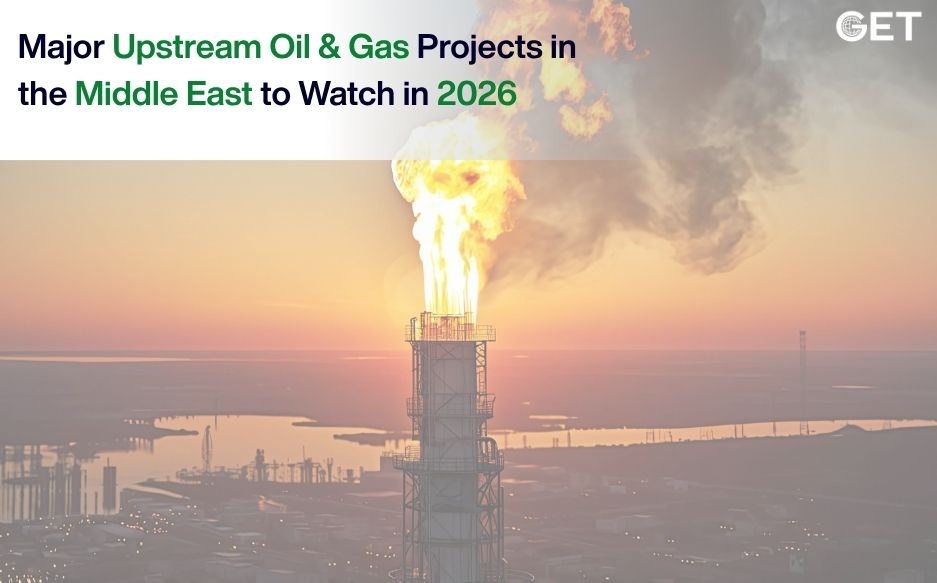
An extraordinary paradox exists within the Middle East in 2026; while significant engineering accomplishments are being carried out in order to increase production capacity, the substantial instability in this part of the world—including the closing of the vital Strait of Hormuz by March 2026.
As well as military interference that has forced an assessment of how energy will move out of the Gulf—will continue to present many challenges to these massive infrastructure investments that have been made by both the “Big Three” of Saudi Arabia, UAE, and Qatar, along with Iraq and Oman.
Digital Oilfield Technology Investment, Automated Facilities, and Carbon Management Systems are additional areas being pursued, as regional producers seek to increase production while facing global pressure to reduce their emission intensity. This indicates that there has been a significant strategic shift to maximize production while creating resilient assets to withstand geopolitical shocks as well as the risk of transitioning from fossil fuels to renewable energy sources.
1. The Gas Revolution and Expansion of Non-Conventional Resources at Saudi Aramco
The 2026 program of Saudi Aramco is adopting a new direction for the oil and gas industry, concentrating on natural gas and “smart” infrastructure. Capital expenditure guidance is $50 to $55 billion for the year, with an emphasis on increasing domestic gas production, freeing crude oil for exports, and powering the growth of the oil and gas industrial sector.
As the largest liquids-rich shale gas formation in the Middle East, Jafurah represents the crown jewel of Saudi Arabia’s unconventional
portfolio. Early in 2026, Jafurah reached a significant production milestone. 2026 Focus: Continue to expand the Tanajib gas processing plant and continue to build compression and gas processing facilities in the kingdom. Strategic Objective: 2 billion SCFD of sales gas will be produced in by 2030, with 2026 as the base year to complete phase two of the project.
2. Qatar Energy: The North Field Expansion (NFE)
Qatar Energy’s North Field Expansion Qatar is the world’s leading exporter of LNG and the North Field Expansion in the oil and gas industry represents a significant commitment to global energy security. North Field East and North Field South Qatar plans to increase its LNG production from 77 million tonnes per annum (MTPA) to 126 MTPA by 2027. 2026 Status: In 2026, the world was expected to begin phase one of construction on the North Field Expansion project; however, due to geopolitical unrest, the deadline was impacted.
Infrastructure: Six LNG mega-trains (8 MTPA each) will be used for the North Field Expansion project. There have been engineering delays to build the mega-trains, but construction remains on track due to remote engineering hubs.
3. UAE ADNOC’s Upstream Growth and Net-Zero Goal
The $150 billion five year capital expenditure plan (2026 – 2030) is being implemented by ADNOC to achieve a unique “scale first” strategy to achieve a target production volume of 5 million barrels perday in 2027. This is a big deal in the upstream oil and gas industry. Hail and Ghasha mega project Global’s largest offshore sour gas project and a global leader in the oil and gas sector decarbonising upstream activities.
Innovative: The project is being developed to operate at net-zero emissions using carbon capture and storage (CCS) to capture and store 1.5 million tonnes of CO_2 per year.2026 milestone – FID for RGD phases 2 and 3 expected Q1 2026 to increase gas production capacity by 30%.
4. Iraq: The “Only” Major New Oil Projects
Iraq is presently the only Middle Eastern country with large scale new upstream oil and gas development projects for oil in 2026, while other countries are mainly concentrating on either developing brownfield oil resources and expanding their natural gas reserves. East Baghdad (South) – Operated by China’s EBS – because of East Baghdad’s 2026 supply estimate, this project is a major bright spot in the production forecast.
Production Increase – Expected to add: an additional 46,500 bpd by the middle of 2026 Target: Long Term = 120,000 bpd in 2027 Challenge: Iraq is in the process of balancing that new production capacity with a forced reduction in current production levels to only 1.2 mm bpd as a result of the shutdown of southern ports from which it exports oil.
5. Oman: The Indian Ocean Alternative
Alternative Indian Ocean Routes for Oman Due to location relative to the Strait of Hormuz, Oman changed its upstream oil and gas industry’s plans to maximize profit. Oman has issued a Request for Proposals for a 400-kilometer (248-mile) pipeline from their national oil pipeline grid to the Ras Markaz terminal (48 inches in diameter) in February 2026. Why It’s Important: This project represents the creation of a new “energy hub” on the Indian Ocean; allowing producers in the region to use alternate routes instead of passing through the Strait of Hormuz.
How This Fits Into Upstream Production: OQ Exploration & Production (OQEP) is spending between $800 million and $900 million in 2026 on development projects to bring production up to 300,000 barrels of oil equivalent per day.
6. Kuwait: The Off-Shore Adventure
For many years Kuwait has been developing its tremendous Burgan on-land oil reserves but is now looking to take to the oceans. Off-Shore Development Stage Two In the first half of the year 2026 the Kuwait Petroleum Corporation (KPC) has invited International Oil Companies to help begin production from the first major off-shore finds in its history. This is revolutionary in the oil and gas sector.
2026 To-Do List: Complete the drilling of 9 additional exploratory wells. Technology: Kuwait is making heavy investments in Managed Pressure Drilling (MPD) so as to be able to develop the high-pressure(s) and high-temperature(s) (HPHT) found in Kuwait’s territorial waters.
Read Also- The Future of the Oil & Gas Industry in the Middle East: Technology, Investments, & Workforce Trends
7. Iran: South Pars Optimization and Sanctions-Resilient Development
Iran’s national oil company is committed to the optimization of its natural gas resource in the South Pars gas field, which contains the world’s largest quantity of recoverable natural gas reserves. This is a major celebration in the upstream oil and gas industry. This resource is located in the northern part of Iran and is also in a joint development agreement with Qatar.
Anticipated Actions in 2026: The Iranian national oil company (NIOC) is also working on developing improved recovery methods, upgrading compression facilities and redeveloping older phases to address natural production declines. Iran is increasingly relying on its
domestic engineering capabilities and regional partnerships to maintain gas production at sustainable levels.
In terms of technical capability, these upstream oil and gas projects are at the highest levels of technical capability ever seen—using AI, 3D seismic imaging, and carbon capture—as well as being tier one project types; however, the top “watch item” globally for 2026 will be geopolitical resiliency.
The movement towards gas (Qatar/Saudi) and the Indian Ocean (Oman) exporting routes would indicate that Middle Eastern producers are now also concerned with strategic flexibility to negotiate through a fragmented global economy and not merely throughput.
Read Also- Challenges and Opportunities for Oilfield Service Providers in the Middle East