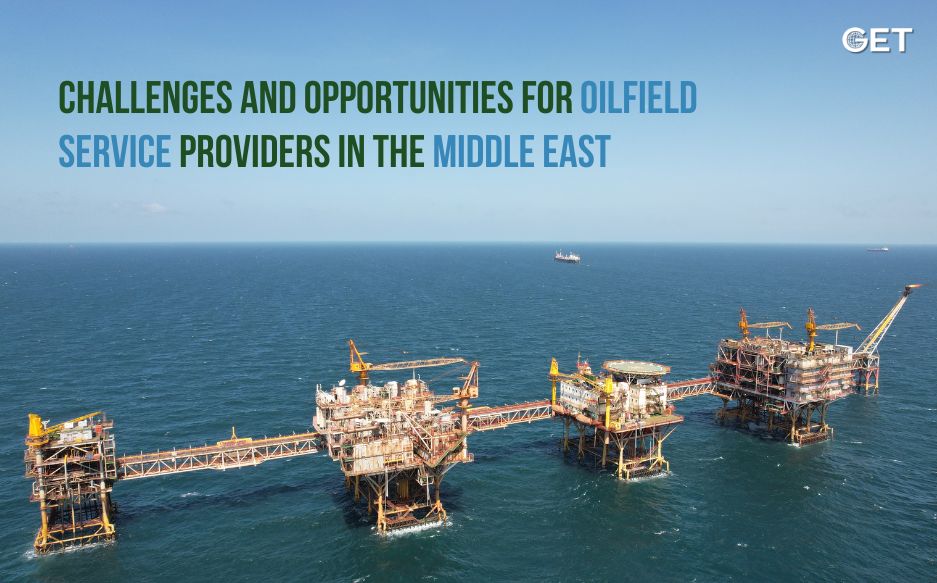
The Middle East has always been the heartbeat of the global energy industry. It holds some of the world’s largest oil and gas reserves. And for decades, it has attracted investment from every corner of the globe.
But the landscape is changing. Fast.
Today, oilfield service providers operating in this region face a mix of serious challenges and exciting opportunities. At the same time, upstream oil and gas companies are rethinking how they operate, invest, and partner.
This blog breaks it all down in simple, clear terms. Whether you are a service provider, an investor, or just someone trying to understand the energy industry — this is for you.
The Middle East is home to some of the biggest national oil companies in the world. Saudi Aramco, ADNOC, QatarEnergy, and Kuwait Petroleum Corporation are just a few names that dominate the region.
These companies spend billions every year on services like drilling, well completion, seismic surveys, engineering, and maintenance. This creates a massive market for oilfield service providers.
According to recent industry estimates, the Middle East oilfield services market is expected to grow significantly through 2030. Countries like Saudi Arabia, the UAE, Iraq, and Kuwait are all increasing their production targets.
But here is the thing: with growth comes pressure. And that pressure falls heavily on service providers.
Let us be honest — working in the Middle East as a service provider is not easy. There are real hurdles that companies must deal with every day.
1. Price Pressure and Margin Squeeze
National oil companies (NOCs) in the region are powerful buyers. They negotiate hard. And they expect the best services at the lowest prices.
This puts oilfield service providers in a tough spot. They must keep their costs low while still delivering high-quality work. For many smaller companies, this is a constant struggle.
2. Local Content Requirements
Many Middle Eastern governments now require foreign companies to hire local workers and partner with local firms. This is known as a local content or in-country value (ICV) requirement.
In Saudi Arabia, there is a program called Iktva (In-Kingdom Total Value Add). In the UAE, it is called ICV. These programs push service providers to invest locally — which adds cost and complexity.
3. Talent and Workforce Challenges
Finding skilled workers in the Middle East is getting harder. The demand for engineers, geologists, and technical experts is growing. But the supply is limited.
Many international workers are also hesitant to relocate to certain parts of the region due to lifestyle or safety concerns. This makes workforce planning a major challenge for upstream oil and gas companies and their service partners alike.
4. Technology Adoption Gaps
The oil and gas industry is going digital. AI, automation, and data analytics are changing how wells are drilled and managed. But not all service providers are keeping up.
Smaller companies often lack the capital to invest in new technology. This creates a gap — and those who fall behind risk losing contracts to more advanced competitors.
Now for the good news. The Middle East also offers some of the best opportunities in the world for oilfield service providers. Here is where the growth is happening.
Saudi Aramco aims to increase its oil production capacity significantly. ADNOC in the UAE has plans to reach 5 million barrels per day by 2027. Iraq is also investing heavily in new oilfields.
These expansion plans mean more contracts, more projects, and more revenue for service providers. The pipeline of work is huge.
Natural gas is the fuel of the energy transition. And the Middle East has enormous gas reserves. QatarEnergy is expanding its LNG capacity massively. Oman and Saudi Arabia are also developing their gas sectors.
This opens up a whole new market for service providers who can handle gas-related work — from drilling to processing to pipeline installation.
This might surprise you. But the energy transition is actually creating new opportunities for oilfield service providers in the Middle East.
Countries like the UAE and Saudi Arabia are investing in carbon capture, hydrogen projects, and emissions reduction technologies. Service companies that can offer these solutions have a real competitive edge.
For upstream oil and gas companies, this means their service partners need to be future-ready — not just focused on drilling and extraction.
NOCs across the region are investing in digital oilfield technology. This includes real-time monitoring, predictive maintenance, and AI-driven decision making.
Service providers who can offer digital solutions — not just hardware and labor — are winning big contracts. There is strong demand for companies that blend technical services with data capabilities.
Many NOCs are moving away from short-term, transactional contracts. Instead, they prefer long-term, integrated service agreements. These agreements give service providers stability — and they reward companies that deliver consistent results.
For providers who are willing to invest in the relationship and show long-term commitment, these contracts are a goldmine.
If you want to dive deeper into the Middle East energy landscape, here are two reliable resources:
→ International Energy Agency — Middle East Energy Overview — Comprehensive data and analysis on energy trends in the region.
→ S&P Global Commodity Insights — Middle East Oil & Gas — Market intelligence and expert analysis for energy professionals.
So how do you win in this environment? Here are some strategies that are working for leading companies in the region.
It is worth stepping back and looking at how upstream oil and gas companies are influencing the entire ecosystem.
These companies are not just clients — they are shaping the future of the industry. They set the standards, define the technology requirements, and decide which service providers rise and which ones fall.
Right now, they are pushing for three things: lower costs, higher reliability, and greener operations. Service providers who can deliver on all three will lead the market.
The relationship between upstream oil and gas companies and their service partners is also evolving. It is becoming more collaborative. More strategic. Less transactional.
That is actually good news for service providers who are willing to think long-term.
The Middle East oilfield services market is complex. It is competitive. And it is full of change. But it is also full of opportunity.
The region is investing more in energy production, gas development, digital transformation, and clean energy than ever before. For service providers who are agile, well-connected, and technologically capable — the next decade could be the best yet.
The key is to understand the challenges clearly and prepare for them. And to recognize the opportunities before your competitors do.
Upstream oil and gas companies in the Middle East are not slowing down. They are accelerating. And the service providers who keep pace with them will build something truly lasting in one of the world’s most important energy markets.
Read Also- Oil and Gas Exploration and Production Operations

By Get global | May 19, 2026
Starting Out in Oil and Gas — What Nobody Tells You Breaking into the oil and gas industry is not like applying for a desk job. The sector operates on a different rhythm — long rotations, remote locations, technically demanding environments, and a culture that rewards competence above almost everything […]

By Get global | May 15, 2026
Introduction: In the ever-evolving landscape of the energy sector, a revolutionary force is steering the industry toward a more sustainable future — the integration of hybrid solutions. As the world grapples with the imperative of balancing energy demands and environmental preservation, the concept of combining traditional and renewable energy sources […]
By Get global | May 11, 2026
Introduction The energy industry is facing unprecedented challenges in the 21st century, including the need for sustainable and environmentally responsible solutions to meet growing global energy demands. As a result, successful project delivery has become vital for companies in the energy sector. Among the methodologies gaining prominence is Integrated Project […]
By Get global | May 7, 2026
By Get global | May 6, 2026
Effectively managing risks within the oil and gas industry demands a meticulous blend of foresight, innovation, and resilience. In this complex sector, risk mitigation strategies are crucial for ensuring operational stability, safeguarding financial investments, and upholding stringent health, safety, and environmental standards. Amidst the diverse array of challenges faced by […]