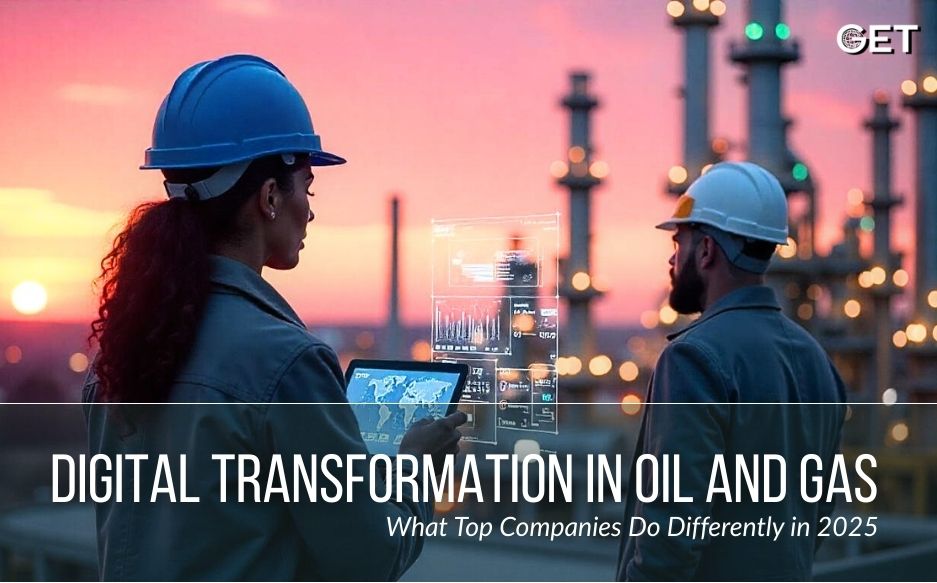
I want to start with something that happened at an industry conference last year. A veteran operations manager — 28 years in the field, seen everything — leaned over during a panel discussion on AI and automation and said quietly: “Five years ago I thought this was all hype. Now I’m watching companies that ignored it fall behind in ways they can’t recover from.”
That stuck with me. Because digital transformation in oil and gas has been talked about for over a decade. But 2026 feels genuinely different. The gap between companies that have committed to it and those that haven’t isn’t a gap anymore — it’s a chasm. And it’s showing up in margins, in safety records, in talent retention, and in how fast these companies can respond when things go sideways.
So what exactly are the top companies doing differently? Let’s get into it.
This is the first and honestly most important distinction. Companies that are genuinely leading in digital transformation in oil and gas didn’t create a separate “digital team” and hand them a budget and a mandate. They embedded digital thinking into core operations — into how drilling decisions get made, how maintenance gets scheduled, how supply chains get managed.
The companies still stuck in pilot-project purgatory? They’ve been running proofs-of-concept for three years. They have dashboards nobody looks at. They have IoT sensors collecting data that sits in a server somewhere and informs nothing. The technology isn’t the problem. The organizational commitment is.
Shell is a good example of a company that made this shift structurally. Their Integrated Gas and Upstream digital programs aren’t bolt-ons to existing operations — they’re embedded in how production targets get set and how field performance gets evaluated. That’s the difference between using technology and being transformed by it.
A few years ago, having real-time visibility into your drilling operations was a differentiator. Now, if you don’t have it, you’re simply not competitive. The top companies have moved well beyond collecting data — they’re acting on it, automatically, at a speed no human decision-making chain can match.
We’re talking about AI-driven systems that detect early signs of equipment failure days or weeks before a breakdown would occur. Predictive maintenance platforms that have slashed unplanned downtime by 20–30% at major operators. Digital twins — virtual replicas of physical assets — that let engineers run thousands of scenario simulations before committing to a single operational decision.
BP’s work with digital twins on their North Sea assets has been well-documented. So has Chevron’s partnership with Microsoft on AI-powered operations. These aren’t R&D experiments anymore. They’re running in production, on live assets, saving real money.
The companies falling behind aren’t just missing the technology — they’re missing the data infrastructure underneath it. Garbage in, garbage out. You can’t build intelligent operations on top of inconsistent, siloed, poorly structured data. That foundational work — unglamorous as it is — is what separates the leaders from everyone else.
Here’s where I push back on a narrative that’s become frustratingly common: the idea that digital transformation in oil and gas is fundamentally about cutting headcount. That framing is both inaccurate and counterproductive — and the companies doing this well know it.
Yes, automation is handling tasks that used to require people. But the top companies aren’t just eliminating roles — they’re redefining them. The engineer who used to spend 60% of their time manually compiling production reports is now spending that time interpreting AI-generated insights and making better decisions faster. That’s not a job cut. That’s a job upgrade.
TotalEnergies has invested heavily in internal reskilling programs, training operational staff to work alongside digital tools rather than be sidelined by them. The World Economic Forum’s Future of Jobs report consistently shows that companies combining automation with workforce upskilling outperform those that treat the two as mutually exclusive. The energy sector is no exception.
There’s also a talent retention angle here that doesn’t get enough attention. Younger engineers — the people this industry desperately needs — want to work with modern tools. If your field operations still run on spreadsheets and radio calls, you’re going to lose the best candidates to companies that don’t.
The more connected your operations become, the more exposed they are. This is the uncomfortable flip side of digitalization that the industry spent too long ignoring — and paid for in some very public ways.
The 2021 Colonial Pipeline ransomware attack wasn’t an upstream incident, but it sent shockwaves through the entire energy sector. It made clear that critical infrastructure with digital connectivity is a target, and that a cyberattack can shut down operations just as effectively as a physical one. Upstream facilities — remote, often lightly staffed, with legacy control systems that were never designed to be internet-connected — are particularly vulnerable.
Top companies have responded by elevating cybersecurity from an IT department concern to a board-level operational risk. That means dedicated OT (operational technology) security teams, regular penetration testing of field systems, and network segmentation that limits how far an intrusion can spread. It also means vendor scrutiny — because your cybersecurity is only as strong as the weakest link in your supply chain.
One of the more interesting shifts in 2026 is how closely digital transformation and sustainability goals have become linked. This isn’t greenwashing — it’s operational logic.
Digital monitoring systems that optimize production in real-time also reduce flaring and emissions. Predictive maintenance that prevents equipment failures also prevents leaks and spills. AI-driven logistics optimization that cuts operational costs also cuts fuel consumption and carbon intensity. The sustainability win and the efficiency win are often the same win.
Companies like Equinor have been explicit about this connection, building emissions monitoring directly into their digital operations platforms. When your real-time dashboard shows both production performance and emissions per barrel simultaneously, the decisions that follow are naturally better on both dimensions.
It would be easy to frame this as “just adopt the technology and you’ll be fine.” But the honest picture is more complicated. Companies that are behind in digital transformation face a compounding problem: the gap widens every year.
Here’s why catching up is harder than it looks:
None of this is insurmountable. But it does mean that the companies leading right now have an advantage that isn’t just technological — it’s temporal. They started earlier, made their mistakes earlier, and have years of operational learning that can’t be bought off the shelf.
The companies pulling ahead in 2026 aren’t necessarily the biggest or the best-funded. They’re the ones that made a genuine organizational commitment — not to technology for its own sake, but to using technology to make better decisions, faster, with less waste and less risk.
Digital transformation in oil and gas has moved past the “should we do this?” conversation. The only question left is how fast you move, and whether you’re building something that will compound in value over time or scrambling to catch up while the leaders extend their lead.
The 28-year veteran at that conference wasn’t lamenting the change. He was adapting to it. That instinct — more than any specific technology — is what actually separates the companies winning in this industry right now.
Read Also- What is Coiled Tubing? A Simple Guide to a Complex Technology
By Get global | October 19, 2026
By Get global | October 16, 2026
By Get global | October 12, 2026
By Get global | October 12, 2026
Saudi Arabia is traditionally considered a key country where people work in the oil and gas sector. As there is quite a lot of drilling, well intervention and production processes in this country, many engineers, technicians and specialists from the field try to find suitable positions there. However, not all […]

By Get global | October 9, 2026
Ask any person working night shifts in rigs and compressor stations what holds the industry back, and you will seldom hear anything about geology. Disconnected information, delayed decision-making, and machinery breaking down at the wrong moment – all these factors are more common causes of productivity losses in the industry. […]