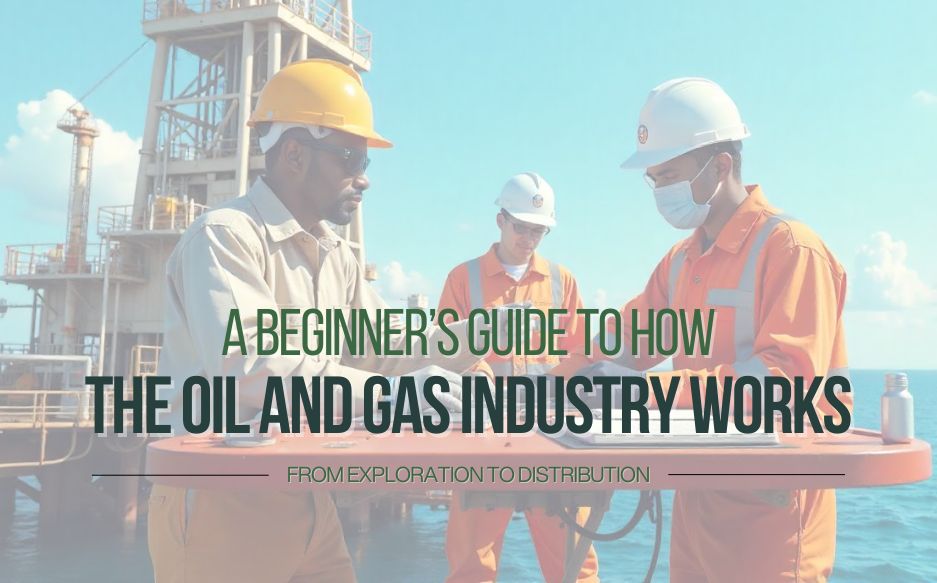
The oil and gas industry is one among those very few spokes that holds the global economy together. Without it, there will be no mobility; indeed, factories would shut down, and homes would remain dark. Have you ever stopped to think of how crude oil, buried deep under the earth, is turned into fuel for your moving automobile or the gas that keeps your home warm?
This guide breaks it all down into baby steps such that it will take you right from exploration to distribution.
Before oil and gas can be extracted, it must all be established where they are; – and this is usually called exploration: the geologists and geophysicists apply very sophisticated technical means such as seismic survey, satellite imaging, and geological mapping for exploration underneath the earth surface or the ocean floor.
Exploration companies drill exploratory wells (also called wildcat wells) to determine whether oil and gas exist in commercial quantities. If the findings are promising, further drilling and assessment are carried out to estimate the size and feasibility of extraction.
At such a time when a find is announced in respect of reserves, it is time to start drilling. Depending on where this process is taking place, it can be carried out offshore or land, meaning onshore drilling or offshore drilling. It is a deep bore to reach that reservoir-from it, allowing that oil or gas to flow up by gravity.
This advanced method may either be hydraulic fracturing (fracking) or enhanced oil recovery (EOR). Fracking means introducing high-pressure fluid into fractures within the rock formation to enable oil and gas extraction through increased permeability. EOR recovery involves using steam, gas, or chemicals to improve recovery from a reservoir.
After crude oil or natural gas is extracted, it has to be refined to remove impurities and separated:
The processes of refining include-
For natural gas, the processing includes the removal of water, impurities, and several gases for consumption.
Read Also- Oil and Gas Jobs in the KSA – Current Opportunities & Career Development
Once refined, oil and gas products must be transported to consumers. This can be done through pipes, tankers, trucks, and rail. Pipelines provide the most efficient means of transporting vast quantities of oil and gas on long haul distances.
At one end of the pipeline, transport involves getting refined products to end-users. This includes:
GET Group Global has a key role in the oil and gas industry providing workforce solutions, training, and technical support. Primarily operating within the Middle East, GET Global Group assists companies in optimizing their operations through its Integrated Crew Services (ICS) and training activities known as Get Learning and Kafayat.
GET Global Group meets the demand for efficiency and safety by ensuring the availability of trained professionals to the industry for exploration, drilling, and production. The company further invests in developing a local workforce and thereby enabling companies in Saudi Arabia and elsewhere to fulfill nationalization targets while also ensuring high operational standards.
The oil and gas industry are a complex yet fascinating sector undergirding life on Earth. From searching for oil reserves to refining and transporting the fuel to consumers, each stage is crucial in securing energy. Companies such as GET Global Group are working to supply skilled professionals and disruptive solutions that increase the efficiency of operations in the oil and gas industry.
The oil and gas domain are ever-changing just as the world’s energy needs change. Cleaner energy and sustainability initiatives are being embraced. Knowing about oil and gas operations is pertinent for enterprises, policymakers, and customers as the world shifts toward an energy balance.
Let us guide you whether you are an expert in oil and gas, an oil and gas student, or just someone curious about this wonderful field. If you are in need of a partner for workforce solutions or training in the energy sector, GET Global Group is your partner for success.
By Get global | October 19, 2026
By Get global | October 16, 2026
By Get global | October 12, 2026

By Get global | October 9, 2026
Ask any person working night shifts in rigs and compressor stations what holds the industry back, and you will seldom hear anything about geology. Disconnected information, delayed decision-making, and machinery breaking down at the wrong moment – all these factors are more common causes of productivity losses in the industry. […]
By Get global | October 5, 2026
Specialized expertise turns a hard project in the oil and gas industry into a workable one. Every oilfield has its own geology, risks, and surprises. The teams that handle them the operations on field have usually met something similar before. In the modern world, upstream oil and gas companies are […]