
Ask anyone who’s worked in oil and gas procurement long enough, and they’ll tell you the same thing: the moment you think you’ve got costs under control, something shifts. A tanker gets rerouted. A sanctions list gets updated overnight. Steel prices jump 15% because of a policy announcement three continents away. And suddenly the budget you signed off on last quarter looks nothing like the reality you’re managing today.
This isn’t a new problem. But it’s getting harder. Supply chains that once had some room to absorb shocks are now running leaner, which means there’s less buffer when things go sideways. So what actually works when you’re trying to manage costs that won’t sit still?
There’s a tendency in supply chain management to treat cost overruns as one big problem. They’re not. A spike driven by commodity prices needs a completely different response than one driven by freight volatility or a supplier restructuring their operations.
In oil and gas, the cost pressure usually comes from a handful of places. Raw material prices of steel, copper, specialty chemicals – move with global markets that you have zero influence over. Logistics costs can double in a matter of weeks when fuel surcharges kick in, especially on long international hauls.
Geopolitical changes, sanctions, and new compliance requirements hit supply chains in ways that are hard to predict and expensive to navigate quickly. And then there’s the industry’s own demand cycle: when oil prices are high, everyone’s spending, lead times stretch, and suppliers know they have leverage. When prices drop, operators cut back and suddenly the whole ecosystem contracts.
The cost managing teams are the ones that have the ability to see a problem and at the same time, recognize which of these forces is in action That clarity saves time and avoids expensive overcorrections.
This is self-evident, yet in reality, many companies have become single-supplier reliant, whether by long-term association or a procurement push that has brought vendors together to save in short term.
When costs are stable, this can look like efficiency. When costs are volatile, it looks like a vulnerability. If your only qualified source for a critical component decides to reprice, you’re negotiating from a weak position. You either absorb the increase or scramble to qualify an alternative under time pressure, which is expensive in its own right.
Establishing an appropriate supplier portfolio is a time-consuming and costly process, screening of secondary suppliers, conducting audits, ensuring ties to regional options. The reward of this is however, authentic bargaining strength and the capacity to switch gears when the cost of a primary supplier no longer makes sense. In the case of businesses spanning various geographies, sourcing in various regions also cushions against currency fluctuations and other country-specific shocks that can severely strike on a concentrated supply base.
Long-term fixed-price contracts feel safe when markets are rising. They feel like a trap when markets correct. Purely spot-based procurement works in a buyer’s market and burns you in a seller’s one.
The operators who navigate this best tend to use a mixed approach, locking in volume pricing for the materials where they have strong forward visibility and keeping more flexibility in categories where volatility is harder to predict. Price escalation clauses, tied to published indices, can take a lot of tension out of longer agreements. They protect both sides, which actually makes suppliers more willing to engage on better baseline terms because they’re not carrying all the risk of a market move.
The point isn’t to find the perfect contract structure once and apply it everywhere. It’s to match the terms to the actual risk profile of each category, and revisit that as the market changes.
When procurement teams don’t have good visibility into what’s coming, they compensate by holding excess inventory or by paying premium prices for urgent orders. Neither is cheap, and both get worse in a volatile cost environment.
Better forecasting doesn’t require a massive technology overhaul. A lot of it comes down to getting field operations and procurement teams talking to each other more regularly, sharing data that one side holds and the other needs. Collaborative forecasting with key suppliers — where you give them enough forward visibility that they can plan capacity and hold buffer stock, which significantly reduces the frequency of emergency orders and the cost premium that comes with them.
For high-turnover consumables, vendor-managed inventory arrangements are worth serious consideration. When a trusted supplier is managing replenishment directly, you reduce administrative burden and eliminate a lot of the costly over-and-under ordering that eats into procurement efficiency.
Read Also- Why Integrated Crew Services are Important in Upstream Operations
When budgets are under pressure, the instinct is to focus on headline purchase price. It’s an understandable instinct, but it regularly leads to decisions that cost more in the long run.
A piece of equipment that fails twice as often, or requires specialist maintenance, or has a shorter operational lifespan will outspend the premium alternative by a significant margin over its lifecycle. In oil and gas especially, where downtime has direct production consequences and safety implications, the total cost of ownership calculation matters enormously. Delivery costs, import duties, commissioning requirements, spares availability, expected service intervals, these all need to be part of the evaluation, not treated as afterthoughts once the purchase order is placed.
When supply chains tighten, the customers who get looked after first aren’t always the biggest spenders. They tend to be the ones that suppliers are actually happy to do business with, and they make payments on time, are open and understandable, are not going to negotiate every interaction as a battle, and provide enough forward information that the supplier can make proper plans.
That kind of relationship is genuinely hard to build and surprisingly easy to lose. But in a volatile market, it shows up in real ways: a heads-up before a price change goes live, a bit of flexibility on lead times, a willingness to absorb short-term pressure rather than immediately passing it on.
At GET Global Group, this is something we’ve seen play out repeatedly across our client work and our own supplier relationships. The supply chains that hold up best under cost pressure aren’t just the most optimised ones on paper. They’re the ones where the relationships on both sides are strong enough to carry weight when things get difficult.
Cost volatility in oil and gas isn’t a temporary condition you manage through until things stabilise. It’s the operating environment. The companies that have accepted that — and built their supply chain strategies accordingly — tend to weather the swings without the same level of disruption that hits teams still waiting for prices to calm down.
Diversified suppliers, realistic contracts, better forecasting, a genuine commitment to total cost thinking, and strong vendor relationships. None of this is revolutionary. But consistently applying all of it, at the same time, is rarer than it should be — and that’s exactly where the advantage lies.
Read Also- Why NEBOSH and IWCF Certifications Matter in the Oil & Gas Industry
By Get global | June 29, 2026

By Get global | June 26, 2026

By Get global | June 22, 2026
By Get global | June 15, 2026
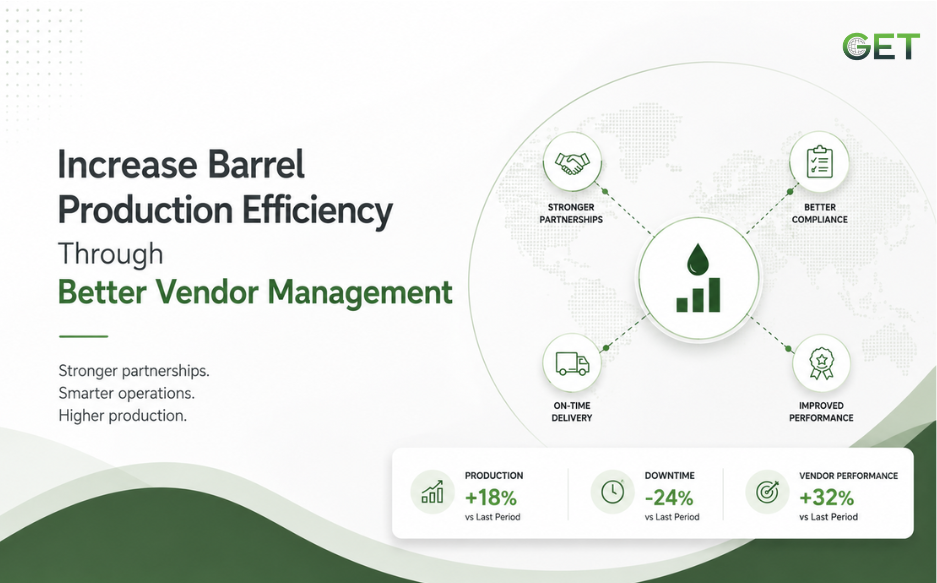
In upstream oil and gas, the margin between a profitable well and an underperforming one is rarely just a matter of geology. It comes down to execution, and execution depends heavily on the vendors, contractors, and service providers working alongside operators every single day. When equipment arrives late, when a […]
By Get global | June 10, 2026
A drilling superintendent I spoke with last year summed it up better than most. His team had just missed their annual production number. Budget wasn’t the issue. The acreage was solid. Wells had been drilled. But three reservoir engineering seats were running on skeleton cover for the better part of […]